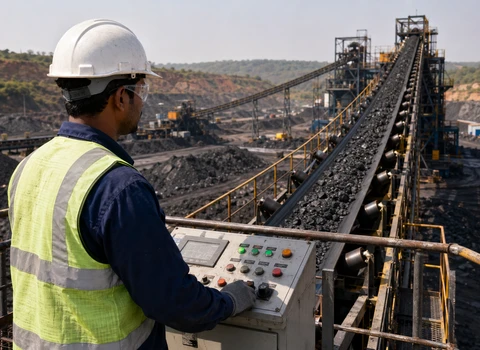
What a Conveyor Belt Operator Actually Does at a Mining Site
Walk onto any large mine, and you'll hear it before you see it - the steady hum of belts carrying tonnes of ore or coal from the pit to the crusher. Someone has to keep that line running. That's the job. A Conveyor Belt Operator watches the system, keeps material moving without jams or spills, and steps in the moment something looks off. This is a Full-time role based in Angul, Odisha, India, paying ₹32,100 a month, and it's a good entry point into the mining and material handling side of the industry.
Why This Job Exists in the First Place
A conveyor belt sounds simple. It isn't, not at the scale mines run them. One misaligned belt or one blocked chute can stop the entire flow of material for hours, and that costs a mining operation real money. So companies don't leave these systems unattended. They put a trained person on the line - someone who notices a belt starting to drift before it tears, or a motor running hotter than usual before it fails. That's the value an operator brings.
How a Shift Usually Goes
Most shifts start with a walk along the belt line. You check the alignment, listen for anything unusual coming from the rollers or pulleys, and make sure the guards are where they should be. Once material starts moving, the real work is watching - the control panel, the loading points, the transfer chutes. Spillage at a transfer point, a belt tracking off-center, a sudden spike in load - these are the things you catch early, or you deal with later, and later is always messier.
On a typical day, the work involves:
- Starting, stopping, and adjusting belt speed from the control panel
- Spotting spillage, slippage, or belts running off-track
- Flagging unusual noise, vibration, or heat in motors and rollers before they fail
- Clearing small blockages at chutes and transfer points
- Logging shift data - tonnage moved, downtime, stoppages
- Staying in contact with the crusher or loading crew so material keeps flowing evenly
Where the Work Actually Happens
Angul sits in one of Odisha's more active mining and mineral-processing belts, which is part of why this kind of role exists here. Operators typically work at open-cast mine sites, ore handling plants, or material transport yards, wherever coal, iron ore or other bulk minerals need to move from one stage of processing to the next.
Equipment You'll Get to Know
Beyond the belt itself, there's a fair amount of machinery involved - idlers, rollers, drive pulleys, belt weighing scales that track tonnage, magnetic separators pulling out tramp metal, dust suppression units keeping the air breathable. For day-to-day upkeep, spanners, belt scrapers and greasing tools come into play. The control panel is really the operator's main instrument - speed, load, motor status, all in one place.
What Makes Someone Good at This Job
You need a working understanding of how a belt drive system behaves, plus the ability to read gauges and panel readouts without second-guessing yourself. But honestly, half of this job is temperament - staying sharp through a long shift, communicating clearly over radio when something's wrong, and not panicking when a fault does show up. Freshers can pick most of this up on the job. Anyone with prior exposure to material handling or plant machinery has a head start.
Education and Training That Helps
Employers tend to prefer candidates with some technical background - an ITI in a mechanical or electrical trade, or a Diploma in Mining or Mechanical Engineering, generally covers what's needed. That said, hands-on familiarity with plant machinery, basic engineering drawings and measuring instruments often counts for just as much as the certificate itself, especially if you're eyeing a supervisory role down the line.
The Physical Side of the Job
Expect to be on your feet - walking the belt line, occasionally climbing platforms to check equipment at height. Mining operations often run round the clock, so this Full-time position may involve rotational shifts, including night duty. A reasonable level of fitness and comfort working outdoors, in whatever weather the day brings, matters here.
Safety on the Line
Belt areas near a mine can be dusty and loud, and there's heavy machinery close by. Before any maintenance work, operators follow lock-out tag-out procedures, and they keep well clear of moving belts and pulleys during operation. Helmets, safety shoes, high-visibility vests, ear protection and dust masks are standard PPE. None of this is optional, and the operators who last in this line of work treat it that way from day one.
What Tends to Go Wrong
Belts drift out of alignment. Loads spike without warning. Parts wear down faster than expected on a line that never really stops. None of this is unusual - it's the nature of running equipment continuously. The operators who avoid bigger breakdowns are usually the ones who catch the small warning signs early, a slightly odd noise or a belt edge that's just starting to fray.
Where This Can Lead
Put in a few years, and this role can open into senior operator positions, shift in-charge, or a move toward conveyor maintenance work at the same site. What employers notice most is consistency - showing up reliably, staying alert to safety, and genuinely understanding how the equipment behaves over time.
Pay and What Else You Might Get
This Full-time role in Angul, Odisha, India comes with a monthly salary of ₹32,100. Some employers add extras on top - overtime pay, PF, ESI coverage, festival bonuses, uniforms, or transport and canteen facilities. None of these are guaranteed across every employer, so it's worth confirming what's actually on offer before you accept a position.