What This Job Actually Involves
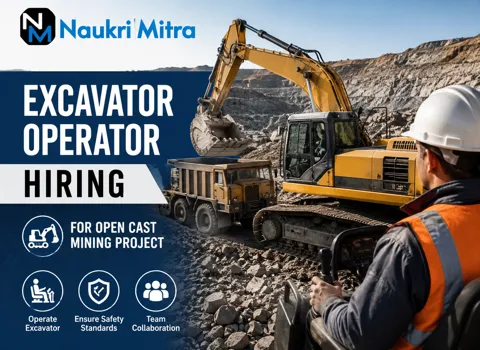
An open-cast mine, seen from above, looks like a giant staircase cut into the earth. Along those steps, called benches, an excavator is usually at work, and someone sits inside, deciding exactly where the bucket will dig next. That's the role on offer - Excavator Operator, Full-time, on an open-cast mining project in Singrauli, Madhya Pradesh, India.
For anyone new to this field, open-cast mining (sometimes called opencast or surface mining) simply means minerals are reached by peeling away the ground from the top, layer after layer, instead of tunneling underneath. Singrauli's coal belt has run this way for decades, and mines here have always relied on operators who can handle this equipment with real skill.
Why the Excavator Isn't Handed to Just Anyone
A poorly operated excavator gets expensive fast, in ways that aren't obvious unless you've watched it happen. Fuel use goes up. Parts wear out sooner than they should. One careless cut into hard rock, or one badly judged bench edge, can hold up not only that operator but every truck waiting in line behind them. That knock-on effect is a big reason mining projects are careful about who ends up in the cabin.
Walking Through a Typical Shift
The shift rarely opens with digging. It opens with a walk-around of the machine - checking bucket teeth, hydraulic hoses, fluid levels, track tension. Once that's done, the operator moves to the pit section or bench assigned for the day, usually on the instructions of a shift supervisor.
Then the actual work begins. Overburden or coal gets loaded into haul trucks. Benches get cut to whatever depth and slope the day's mine plan specifies. Drainage channels need clearing so rainwater doesn't collect and soften the ground. Areas get leveled wherever other equipment needs to pass through. Throughout, the operator stays alert for anything unusual - loose rock overhead, a truck parked too close, an odd sound from the machine that wasn't there the day before.
The Part of the Job That Isn't Just Digging
There's coordination behind the scenes that's easy to miss from outside. Every cut follows a mine plan issued by the planning office, and staying close to it isn't just a formality - a bench cut too steep can cause instability weeks down the line, well after the shift responsible for it is forgotten. Working near drilling and blasting teams means knowing exactly where blasted rock has settled before moving equipment in. Logging machine problems, even minor ones, matter more than people assume too. A small hydraulic leak brushed aside today has a habit of turning into a stalled machine by the following week.
The Machine and What Goes With It
Most open-cast projects run hydraulic excavators, and the size depends on how the operation is scaled - mid-sized units on smaller sites, heavier mining-class machines wherever volume demands it. Buckets change depending on the material being dug; loose overburden and dense rock don't require the same attachment.
Grease guns come out for routine lubrication work. A two-way radio stays within reach since communicating with truck drivers and supervisors happens throughout the shift. Grade stakes and markers left by the survey crew show where a cut should stop. And there's usually a basic hand tool or two nearby for the kind of small fix that doesn't need a mechanic pulled off another job entirely.
The Kind of Skill a Resume Can't Show
Learning the controls is the easy part of becoming an excavator operator. What actually separates a strong one from an average one is how well they read the ground - whether a patch of clay will hold the machine's weight, whether a slope is stable enough to work near, how full a bucket can get before it stops being efficient and starts burning fuel for nothing. None of that lives in a manual. It comes from time spent in the seat, usually with someone more experienced watching over the first stretch of work.
On paper, employers tend to favor candidates who've completed an ITI course in a relevant trade or completed vocational training related to heavy equipment operation. A Diploma in Mining or Mechanical Engineering also helps. That said, a good number of people doing this job today learned nearly everything on the job, and most supervisors care more about whether someone can work safely and consistently under pressure than about which certificate they're carrying.
What the Body Goes Through on This Job
Sitting doesn't sound like hard work until it means eight or ten hours inside a cabin that vibrates the whole time, heat pressing in, dust hanging just outside the window. Climbing on and off the excavator repeatedly through a shift takes more out of a person than it looks like it should. Sharp eyesight and quick reflexes aren't optional here - misjudging distance or depth, even slightly, is often where trouble starts. Mining projects around Singrauli generally operate on rotational shifts to keep production running around the clock, so night work is the norm rather than an exception.
Keeping Safe Around Heavy Machinery
Pit edges, overhead power lines, other machines moving close by - an open-cast mine offers more ways for things to go wrong than most workplaces, and that's exactly why safety habits get built in from the first week on the job. Keeping distance from unstable edges. Following signal protocols before moving near other equipment. Never assuming a hydraulic fault will hold through "just one more shift."
On site, protective equipment usually includes a helmet with chin strap, a high-visibility jacket, steel-toe boots, goggles and a dust mask wherever dust gets heavy, and hearing protection near louder machinery. Lockout procedures during maintenance aren't treated as optional either - among operators who've been at this a while, that particular rule simply doesn't get bent.
Where This Job Gets Genuinely Tough
Monsoon season softens the pit floor and makes footing unpredictable, so everything has to slow down and get more deliberate. Dry months bring the opposite problem - dust thick enough to cut visibility, particularly during early morning or late evening shifts. There's a quieter difficulty too, one no checklist really covers: staying alert through long, repetitive stretches of digging, since it's usually a single lapse near a pit edge that causes real trouble, not the hundred uneventful hours that came before it.
What Tends to Help in the Early Days
New operators generally settle in faster when they spend real time observing before taking full control of a machine - not just skimming a manual, but actually watching how a senior operator handles a tight slope or a tricky loading sequence. Keeping track of recurring machine issues, even informally, helps too. Practicing smoother, more deliberate bucket movement might sound minor, but it quietly saves fuel across a full shift. And checking the day's mine plan instead of assuming today will look like yesterday avoids more mistakes than most people expect.
How the Role Can Develop Over Time
Operators who put in solid years on smaller or mid-sized machines often eventually move up to larger mining-class excavators, where both pay and responsibility increase. Some progress into senior or lead operator roles. Others shift toward supervision, guiding newer operators and coordinating pit work directly. What usually decides who moves up isn't years on the job alone - it's a clean safety record paired with steady, dependable output over time.
Salary and What Might Come Alongside It
This Excavator Operator position, based in Singrauli, Madhya Pradesh, India, pays ₹44,600 a month, offered on a Full-time basis. Depending on the specific project, additional benefits may include overtime pay, PF and ESI coverage, a festival bonus, uniforms, and transport or canteen facilities on site. None of these should be assumed guaranteed, since they tend to vary from one project to another.