
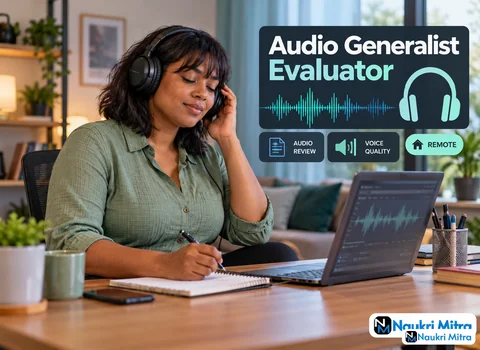
Halfway through a weather report, the synthetic voice puts the stress of "forecast" on the second syllable. Most listeners would shrug. You would mark it. This listing is for online audio generalist evaluator jobs, paid at $20 per hour (USD): part-time contract work you can do from any country with a good pair of headphones. The work is listening to AI-generated and recorded speech, rating how natural it sounds, checking transcripts word by word and tagging noise, clipping or robotic artefacts.
A session starts before you press play. Find the quietest room you have, shut the window, and switch off the ceiling fan if it hums. Then put on closed-back, over-ear headphones. Laptop speakers and most earbuds mask exactly what you are paid to hear: low rumble, a faint click at the end of a word, a breath cut off halfway.
Set your system volume once and leave it alone. Nudge it up for one clip and down for the next, and your clarity scores drift without you noticing.
Most audio projects open with a few calibration clips that already carry agreed scores. You rate them blind, then compare. If the reference gives a clip with one mechanical pause a 4 for naturalness and you gave it a 2, you are marking too harshly, and clip three is a better place to learn that than clip three hundred.
A typical rubric line reads: "5 = indistinguishable from a careful human speaker; 3 = clearly synthetic but easy to follow; 1 = distracting or hard to understand." Reread the anchors each session; guidelines change, and an outdated anchor is the usual reason a batch comes back.
Once you are calibrated, the queue opens, and this middle stretch is really the whole audio generalist evaluator job description. Clips usually run 3 to 20 seconds, and one item takes roughly one to three minutes with notes. For each clip you may be asked to:
Play everything twice. The second pass, often at 0.75x speed, is where the dropped "the" or the swallowed final consonant shows up.
The text says: "Please record your address before the deadline." The voice is warm and the room tone clean. But "record" comes out as the noun (REcord) where the sentence needs the verb (reCORD), and there is a slightly long pause before "before".
A fair mark: naturalness 3, pronunciation 2, audio quality 5. The note: "Noun stress on 'record', should be verb stress. Pause of roughly 400 ms before 'before' sounds mechanical. No artefacts." Notes that point at a word and a moment tend to be approved untouched.
The audio is a phone call with mild street noise. The speaker says, "I'll send it over by Thursday, not Friday." The transcript reads, "I'll send it over by Thursday Friday." One dropped word, and the meaning flips.
Audio quality might earn a 3 (noise is audible, speech is clear), while transcript accuracy falls hard because the error changes the meaning. The note: "Deletion: 'not' missing at 0:04. Background traffic throughout, speech still intelligible." Keep the two problems apart: noisy audio is not the transcript's fault.
Every batch has a few items that break the rules: silence after one second, the wrong language, someone reading out a phone number. Do not guess. Use the flag option and write one line saying why; a careful flag counts as finished work.
Hearing counts for more than paperwork, and a high school education is enough to apply. You do need to speak the project language like a native, since you are judging whether speech sounds right to a native listener. You also need to catch metallic, "phasey" vowels and clicks at edit points.
Audacity and Praat are both free, and knowing either helps. Switch an Audacity track to spectrogram view and clipping or a noise burst becomes visible. Praat was built for phonetics research and draws pitch contours, so you can check whether a question really rises at the end. The other audio generalist evaluator skills are plainer: staying alert for an hour and writing short notes.
These are realistic audio generalist evaluator jobs for freshers; people who have edited a podcast or sung in a choir often do well. The kit is modest: over-ear headphones, a quiet room, a computer with a current browser and a stable connection.
The audio generalist evaluator salary on this listing is $20 per hour (USD). If you searched for the audio generalist evaluator salary per hour, that is the figure for this project. Hours follow the amount of audio in the queue, so no fixed weekly total is promised.
Comparing part time audio generalist evaluator jobs with transcription? Transcription is commonly paid per audio minute, which ties your real hourly figure to typing speed and how messy the recordings are. Hourly rating is easier to predict and calls for judgement rather than typing.
People who search how to become audio generalist evaluator often expect a list of courses. Ear training helps more. Most projects use a short assessment: read the guidelines, rate 10 to 30 sample clips, sometimes correct a transcript. You pass by landing close to the reference scores and writing notes that cite exact words and timings.
No audio generalist evaluator course or audio generalist evaluator certification is required. An hour of TTS demos in spectrogram view, plus the introduction to the Praat manual, teaches more than a paid programme.
An audio generalist evaluator resume should list your native languages, any audio work (podcast editing, voice-over, subtitling) and your tools. "Edited 40 podcast episodes in Audacity, including noise reduction and level matching" says more than "attention to detail".
Audio generalist evaluator interview questions tend to be practical: "How would you rate a clip that sounds natural but mispronounces a name?" or "What headphones do you use?" Answer with an example. If you found this page by typing audio generalist evaluator jobs no experience, rate and annotate five TTS clips yourself; that small self-test gives you something concrete to talk about.
Welocalize, among others, has advertised audio rater generalist roles, so the work itself is real. Fake offers circulate too, and the tell is money flowing the wrong way: a "joining kit" or headphone deposit, a request for the OTP your bank just texted, a recruiter who will only talk on Telegram, or a "premium queue" you pay to enter. Nothing about this listing costs you money, from application to payout.
If audio generalist evaluator work from home that rewards careful listening suits you, apply through the button on this page. Mention your native language, your headphones and any audio tools you know. Freelance audio generalist evaluator jobs like this one, and online audio generalist evaluator jobs in general, suit anyone who notices the click at the end of a word. Applying is free, and you will hear back if your profile fits the project.