
+ Post Job +
Speech-to-Speech Voice AI Tester Remote
Home › AI Training & Evaluation

Speech-to-Speech Voice AI Tester Remote

📍 Anywhere 🏷️ AI Training & Evaluation 💰 $20 / hour

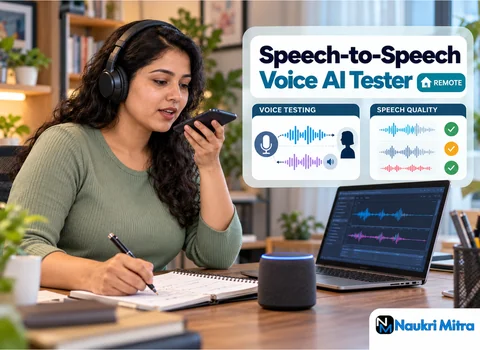
You say "actually, make it eight", and the voice assistant keeps confirming seven o'clock for another full second. Catching that, timing it and writing it up is what these online speech-to-speech voice AI tester jobs are about. The pay is $20 per hour (USD), the hours are part-time, and you can test from anywhere in the world. No degree is needed. Students and freshers with sharp ears: this one is for you.

Why the project team wants real people talking to its voice bot

Speech-to-speech models hear you and answer out loud, with no text box in between. Then a real person coughs, changes their mind mid-sentence or speaks with a Tamil or Texan accent, and things wobble. Lab recordings miss that, so the hiring team needs live humans on the line.

So the speech-to-speech voice AI tester job description is about conversations, not clips. You are on the call. You check reply speed, whether it stops when you cut in, and whether it heard you right. Engineers use your notes to fix it.

What a test session asks you to do

  • Run scripted scenarios as written, such as booking a table or reporting a lost card.
  • Hold free-form chats where you steer the topic and speak the way people really do.
  • Interrupt the assistant on purpose to test barge-in handling.
  • Score replies for accuracy, latency, turn-taking and naturalness against the rubric.
  • Mark cut-offs, clipped words and echo in Audacity, with timestamps.
  • Write down each mishearing next to what you actually said.
  • Repeat a failed scenario to confirm the bug is reproducible.
  • File short bug notes an engineer can act on without asking you anything.

What you need to bring: a clear voice, sharp ears and patience

  • No degree. Seriously, none.
  • Clear spoken and written English, or another target language.
  • Ears that notice a half-second lag or a swallowed syllable.
  • Patience to run one conversation five times without getting sloppy.
  • A headset with a mic, a quiet room and stable internet.

Of all the speech-to-speech voice AI tester skills, patience is the underrated one. The fourth retry of a pizza order is where careless testers skip steps.

Nice to have

  • Basic Audacity: zooming into a waveform and reading timestamps.
  • A second language or a regional accent the project wants covered.
  • Tele-calling, tutoring, debate or anchoring the college fest.

$20 an hour, part-time, and how sessions get booked

The rate is $20 per hour, paid in USD; at a rough ₹95 that is about ₹1,900, an estimate only. The speech-to-speech voice AI tester salary per hour is fixed. Hours are not; nothing here promises a set amount of work.

These are part time speech-to-speech voice AI tester jobs. Work comes in batches; one batch might be six scenarios taking 25 to 35 minutes with scoring. Pick them up around your college timetable while they are open.

It is speech-to-speech voice AI tester work from home, literally: your room, your headset, your Wi-Fi. You work as an independent contractor, so tax on your earnings is yours to handle.

Step 1 of a test call: headset on, room quiet, mic checked

Use a wired or USB headset with a boom mic, not laptop speakers. Speaker sound leaks into the mic, the assistant hears itself and "interrupts" itself, and your barge-in scores are ruined. Fan off, door shut.

A choppy network looks exactly like model latency, so pause big downloads. Then do a 10-second mic check in Audacity, which is free. Peaks should sit well below the top edge with no flat-topped clipping, and silence should be a thin, flat line.

Steps 2 and 3: the table-booking scenario and the live call

A sample scenario card:

  • Goal: book a table for four, Saturday at 7 pm.
  • Twist: while the assistant reads the booking back, interrupt and change the time to 8 pm.
  • Persona: casual, slightly rushed, first name only.
  • Pass condition: final confirmation says four people, Saturday, 8 pm, correct name.

The call, timed from the start of the recording:

  1. 0:02, you: "Hi, I need a table for four on Saturday, around seven."
  2. 0:05, assistant, after a pause of about 1.4 seconds: "Sure! Four people this Saturday at 7 pm. Can I get a name?"
  3. 0:09, you: "Rahul."
  4. 0:11, assistant: "Thanks, Raoul. So that's four people, Saturday at seven, under..."
  5. 0:13, you cut in: "Wait, sorry, make it eight."
  6. 0:14, assistant keeps talking for about 1.2 seconds, finishes "...Raoul", then says: "Got it, four people at 8 pm on Sunday."

Fifteen seconds, three problems. The name was misheard, the barge-in was slow, and the day quietly changed when only the time should have.

Steps 4 and 5: scoring the call and writing the bug line

Illustrative scores on a 1 to 5 scale:

  • Latency: 3. The first reply came about 1.4 seconds after you stopped. Noticeable, not painful.
  • Barge-in handling: 2. It talked over you for 1.2 seconds.
  • Mishearing: 2. "Rahul" became "Raoul".
  • Naturalness: 4. Warm tone, good pacing, no robotic artefacts.
  • Task success: fail. The final booking says Sunday.

A classic reviewer comment: "Score what you heard, not what you think the model meant." You heard Sunday, so it is Sunday.

The bug report, one line: Scenario 4.2: barge-in at 0:13 ignored for 1.2 s; after the change to 8 pm, the day switched from Saturday to Sunday; reproduced in 2 of 3 runs; timestamps marked in Audacity. That "2 of 3 runs" is what makes engineers trust you.

Getting into online speech-to-speech voice AI tester jobs as a fresher

People type "how to become speech-to-speech voice AI tester" expecting a long checklist. It is short:

  1. Practise on your phone's voice assistant. Interrupt it and time how long it takes to stop.
  2. Spend one evening on free Audacity tutorials.
  3. Write three practice bug lines, each with a timestamp and a repeat count.
  4. Apply, and take the screening seriously.

No paid course or voice testing certificate is needed; the project guidelines teach the rubric. That is why speech-to-speech voice AI tester jobs for freshers make sense: screening checks your ears, not your marksheet.

Your resume and the screening questions

Keep your speech-to-speech voice AI tester resume to one page: languages, accents, headset, Audacity, any job talking to strangers. Sample speech-to-speech voice AI tester interview questions:

  • "It answered correctly but took two seconds. How do you score it?" Keep accuracy and latency separate.
  • "Write a one-line bug report for this call." Include what happened, the timestamp and whether it repeats.
  • "Run this scenario three times. What changed?" They check whether you stick to the script.

Voice AI tester vs audio rater: talking versus listening

An audio rater scores finished clips. A voice AI tester is inside a live conversation, creating awkward moments on purpose: talking over the bot, pausing mid-sentence, mumbling a name. Both need good ears, but testing also needs timing and a bit of improv.

Voice assistants now run car dashboards and bank helplines, and testers with clean bug notes can grow into QA lead roles. Freelance speech-to-speech voice AI tester jobs also appear on platforms such as Appen, which posts conversational speech AI evaluator projects, and SME Careers, which has advertised English speech-to-speech tester roles. They are examples only and did not post this listing.

Fake voice testing offers, and applying to this one for free

Real projects test your voice. Fake ones test your wallet. Walk away if anyone asks for a "registration fee" or "voice kit" payment, wants a bank OTP or your UPI PIN read out, keeps all contact inside Telegram or WhatsApp, demands money before tasks open up, or offers the job with no screening.

Applying here costs nothing, and no fee is ever asked. Use the apply button on this page, mention your languages and headset, and complete the screening. Selection depends on the assessment.

Frequently Asked Questions

You talk to a voice assistant, follow scripted or free-form scenarios, and interrupt it on purpose to see how it copes. Afterwards you score each reply for accuracy, latency, turn-taking and naturalness, then log any bug with a timestamp.
This listing pays $20 per hour in USD, close to ₹1,900 if you take the dollar at about ₹95; the rupee amount is only a guide. Hours vary with how much testing the project needs, so none are guaranteed.
Apply through this page for free, list your languages, accents and headset, and mention any practice calls you have timed. The screening checks listening and note-writing, so earlier tester experience is not needed.
A wired or USB headset with a boom microphone works best, because laptop speakers leak sound back into the mic. You also need a quiet room with the fan off and a stable internet connection, since a choppy network can look like model lag.
Clear speech, careful listening and patience for repeat runs come first. Basic Audacity use helps you mark cut-offs and glitches, and you will learn the project rubric from its guidelines.
Appen has advertised Conversational Speech AI Evaluator projects in several languages, and SME Careers has posted Speech-to-Speech English Voice AI Tester roles. Both are named only as examples of where this work appears; neither posted this listing.
An audio rater scores finished recordings by listening to them. A voice AI tester joins live conversations and deliberately creates interruptions, pauses and accent challenges, then scores how the assistant handled them.
Genuine voice testing work exists and is paid by the hour, but scams copy it. Never pay a registration or kit fee, never share an OTP or UPI PIN, and be wary of Telegram-only recruiters or offers made without any screening.
Apply Now