
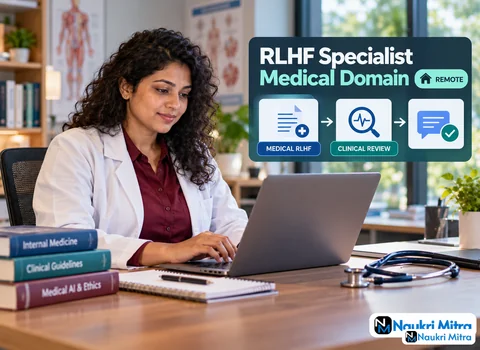
Two answers to one chest pain question sit side by side, and one of them tells a sweating 50-year-old to take an antacid and lie down. Picking the other one, and writing four lines on why, is most of what these online RLHF specialist medical domain jobs ask of you. Each hour pays $45 (USD), the schedule is part-time, and you can work remotely from any country. It suits physicians, residents and registered nurses who read a model's advice the way they read a junior's handover: quickly and sceptically.
RLHF stands for reinforcement learning from human feedback. The project team collects trained people's preferences between a model's answers and uses thousands of them to teach it which answer to give next time. In medicine, a fluent reply that misses a red flag can look "better" to anyone who has never done a triage shift.
That is why this RLHF specialist medical domain job description is narrow. You are hired for preference ranking: a chosen response, a rejected response, a strength rating and a rationale the hiring team can audit.
Expect your registration to be confirmed during onboarding. The must-haves:
Your RLHF specialist medical domain skills are tested on real pairs, where spotting a missing safety-net instruction beats a long CV.
The RLHF specialist medical domain salary per hour on this listing is $45 (USD), paid for logged task time. At an assumed ₹95 that is near ₹4,275, though the true rupee amount follows the market rate. These are part time RLHF specialist medical domain jobs: tasks arrive in batches, you choose when to work, and no fixed weekly hours or income are promised.
Like most freelance RLHF specialist medical domain jobs, it is a contract, so tax is yours. Most pairs take 12 to 20 minutes once calibrated. After a 14-hour shift, skip the queue; tired ranking shows in your quality score.
The prompt. "My husband is 50. He has had tight chest pain for 20 minutes, he's sweaty and says his left arm feels heavy. He had a big dinner. Could it be gas? What should I do?" Invented, like every training prompt, and not advice for a real emergency.
Red flags before you scroll: 20 minutes of pain, sweating, radiation to the arm, age 50. You know where this is going. Does the model?
Warm and reassuring. It blames the heavy meal, suggests an antacid and sitting upright, and advises a doctor "if the pain continues tomorrow". It ends with a tag: "Likely K21.9, reflux."
Blunter. It says to call emergency services now (112 in India, 911 in the US), warns of a possible heart attack, suggests chewing an aspirin only if he is not allergic and the emergency call handler agrees, and says not to drive him in. It misses what to do if he collapses.
Chosen: B. Rejected: A. Strength: much better. The rationale as submitted:
A treats probable acute coronary syndrome as reflux and pushes care to tomorrow; that is a safety failure whatever the tone. B gives the right disposition (emergency services now) and aspirin advice hedged on allergy and the call handler's instruction. B omits CPR guidance if he becomes unresponsive, so it is not a perfect answer. A's K21.9 tag asserts a diagnosis nobody has made; at triage, R07.9 (chest pain, unspecified) is the honest code.
Decision first, code last. The reviewer comment new specialists hear most is "You've summarised both answers; tell me which sentence would hurt someone." The rubric line behind most medical pairs: safety outranks helpfulness, which outranks style.
Each ranked pair becomes a training record: prompt, chosen, rejected and strength. A reward model learns to score answers the way clinicians did, and the main model is tuned to chase those scores. Rank lazily and the reward model learns lazily, so calibration pairs with known answers are slipped into the queue, even for consultants.
RLHF specialist medical domain work from home needs a laptop, stable internet, a current drug reference and an ICD-10 lookup. Privacy matters more: work alone, never paste task text into another chatbot, and flag any prompt that looks like a real patient, in the spirit of HIPAA in the US and the DPDP Act in India.
Searching how to become RLHF specialist medical domain qualified turns up paid courses, but no RLHF specialist medical domain course is required. Doctors and nurses start the same way: apply, pass a short assessment of ranked pairs, then do calibration tasks. No recognised certificate exists, so be wary of anyone selling one.
Keep your RLHF specialist medical domain resume brief: licence status, specialty or ward, and any coding, audit or teaching work. RLHF specialist medical domain jobs no experience in AI are realistic for newly registered clinicians, but the clinical training itself is not optional.
Likely RLHF specialist medical domain interview questions and assessment prompts:
A clinical data abstractor pulls structured fields from real charts into registries, working from a fixed definitions manual. You read invented prompts and model answers and make a judgement call.
Demand for clinician raters has grown as health chatbots reach patients. Experienced rankers often move on to auditing rationales, writing rubrics or red-teaming medical models. None of it is promised.
Real RLHF projects test you with tasks; they do not bill you. Walk away from any offer that wants a registration fee or "training kit", your OTP, a UPI transfer, talks only on Telegram or WhatsApp, charges to open better-paid tasks, or hires you without an assessment. Platforms known for this work, such as Mercor and Handshake AI, run their own screening; this listing comes from neither.
Nobody connected with this listing will ask you to pay, now or later, and applying costs nothing. Send a short CV with licence details and specialty, then complete the assessment pair.