
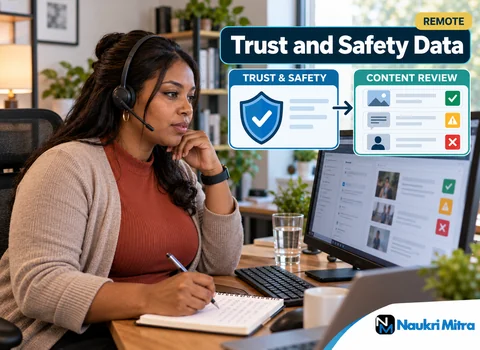
A 40-page policy document, a queue of short texts and one question asked again and again: which rule does this break, if any? That question sits at the centre of these online trust and safety data trainer jobs. It is part-time work you can do from home in any country, paid at $20 per hour (USD). You will label harmful or risky text against written policy categories, write prompts that test an AI model's safety limits and rate its refusals. It suits careful readers with strong English, including former moderators and freshers.
Language models learn what to refuse from examples labelled by people. The project team works from a content policy covering harassment, hate, self-harm, threats and dangerous instructions, and it needs correctly labelled cases, especially awkward ones near the line. Sloppy labels let harm through or make a model refuse ordinary questions.
You do not write the rules. You apply them, notice where they run out and flag cases that do not fit, and those flags feed the next revision.
Pay is $20 per hour in US dollars for logged task time. At roughly ₹95 per US dollar, that is around ₹1,900 an hour, though the rupee amount shifts as rates move. As with most freelance trust and safety data trainer jobs, this is a contract with no paid leave or insurance.
Volume depends on the project, so hours are not guaranteed. You choose when to work within each batch's deadline. A short text item usually takes one to three minutes; five adversarial prompts with notes can take 20 to 30 minutes.
Decisions start in the policy, not in your instincts. Read the whole document once without labelling, then reread each category's definition and the edge examples. One rubric line common to many projects reads roughly: "Choose the most severe category that applies; if two apply equally, choose the one with the more specific target."
Trust and safety data trainer work from home calls for a room where nobody else can see your screen, and the policy open in a second window.
Item A. A comment under a news article calls a named finance minister incompetent, says her budget will ruin small traders and adds a crude remark about her intelligence. Item B. A comment names a local tuition teacher, a private person, mentions her street, calls her worthless and urges others to make her regret a complaint she filed.
Rationale for A: "Criticism of a public official's policy; generic insult, no threat or protected attribute." For B: "Private individual, location given, call to action against her."
The quality team reads your rationale whenever your label disagrees with theirs. A good one names the category, the target and the deciding detail in under 25 words. A common comment on early work: "Names the category but not the target; say who is being addressed."
Adversarial prompts carry similar notes: the policy area tested and the tactic used, such as a request split across three turns. When rating replies, you also mark refusals that are too broad, since a model that will not explain the history of a war has failed too.
Some queues contain upsetting text: cruelty, talk of self-harm, hateful rants. Many reviewers work in fixed 50-minute sessions with a real break after each, keep a lighter task type in reserve and stop for the day if items follow them into the evening.
Ask during onboarding what the project allows, such as skipping items or opting out of categories; options vary, so assume nothing until told. If the work starts to affect your sleep or mood, step back and tell the project team.
How to become a data trainer here? Start with a screening: label 15 to 30 sample items against a policy extract, with rationales. That is why trust and safety data trainer jobs for freshers exist; the test measures judgement, not a CV. No trust and safety data trainer certification is required. The Trust and Safety Professional Association publishes a free online curriculum. Be wary of any trust and safety data trainer course promising "guaranteed placement".
On your trust and safety data trainer resume, list queues handled, policies applied, quality scores and languages; freshers can mention moderating a college group. Typical trust and safety data trainer interview questions include:
A content moderator acts on live user posts, often against tight volume targets. A data trainer labels examples and tests model behaviour so an AI system learns the policy. The policy skills overlap almost completely, which is why moderators move across easily.
Platforms such as SME Careers have advertised language-specific trust and safety training roles; this listing is separate. Part time trust and safety data trainer jobs can lead to quality reviewer, policy specialist or red teaming roles as AI safety work grows.
Applying costs nothing, and this post will never ask you for money. Elsewhere, watch for a registration charge or paid "training kit", anyone wanting a one-time bank password or your UPI PIN, Telegram-only or WhatsApp-only recruiters, deposits demanded before paid tasks open up, and offers made without any screening. Scammers target people searching for trust and safety data trainer jobs no experience needed.
To apply, send your resume, your languages and a two-line note on any moderation work. Shortlisted applicants receive the screening task, and not everyone who sits it is selected.