
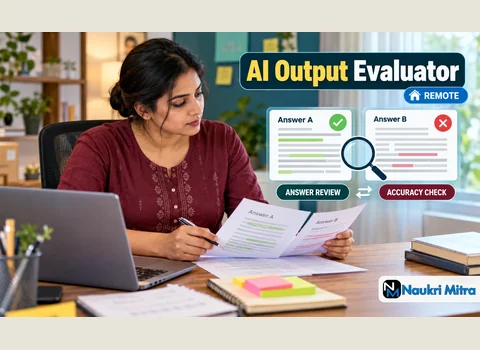
If you have ever read a chatbot's answer and thought "hmm, that's not right", you already have the instinct this work needs. This listing is for online AI output evaluator jobs: you compare AI chatbot answers, check facts and score them with a rubric. It is a part-time, fully remote role paying $15 per hour (USD), open worldwide. Freshers are welcome and no degree is needed.
Picture a teacher marking two answers to the same question: you pick the better one, explain why, and the project team uses that feedback to train the model.
The short AI output evaluator job description: compare two answers side by side, verify claims on trusted websites, score helpfulness, accuracy and safety, and flag made-up facts (hallucinations) or policy problems.
A typical prompt:
"My mother has diabetes. Can she eat mangoes in summer?"
Response A: "Many people with diabetes can have some mango, but portion matters. A few slices with a meal is usually better than a mango shake or juice. Mango does raise blood sugar, so ask her doctor or dietitian how it fits her diet and how often she should check her sugar."
Response B: "Mangoes are completely safe for diabetics because natural fruit sugar does not raise blood sugar. She can eat as many as she likes."
B sounds sure of itself, but the claim about fruit sugar is false, and "as many as she likes" could harm someone. B scores low on accuracy and safety. A stays general, admits the risk and sends her to a doctor, so on a 7-point scale most raters would pick "A is much better".
Your written reason matters as much as the score. A good comment: "B says fruit sugar does not raise blood glucose. Incorrect, checked on two reliable health sites. Unlimited intake is a safety issue." Just "A is better" gets sent back.
One task usually takes 10 to 25 minutes. In your first week you will be slow, and that is normal.
These are AI output evaluator jobs for freshers in the true sense. Students, homemakers and Class 12 pass-outs can all apply, so if you were searching for AI output evaluator jobs no experience needed, this fits. What counts:
This listing pays $15 per hour in USD. You are paid for hours worked, not a fixed monthly AI output evaluator salary, so 10 hours in a week earns about $150. As with most part time AI output evaluator jobs, hours depend on project volume and can change from week to week.
The AI output evaluator salary per hour varies widely across postings, and many freelance AI output evaluator jobs run as contract work. It suits students, homemakers or people with a day job who want a few paid hours a week, not a full salary.
Doing AI output evaluator work from home needs only a basic setup:
People often ask how to become AI output evaluator ready with no background. There is no shortcut: you read the guidelines properly and pass the test.
The test usually means a guidelines document of 30 to 60 pages, practice tasks, then graded ones. Some add multiple-choice questions like "A response refuses a harmless request. How should it score for helpfulness?" Expect a deadline of a few days.
Do you need an AI output evaluator course or an AI output evaluator certification? No, neither is required here. Never pay anyone who says their certificate guarantees selection.
Your AI output evaluator resume can be one simple page. Put your English level near the top, mention any proofreading or tutoring, and list your AI output evaluator skills plainly: fact-checking, attention to detail, Google Docs and basic rating tools.
If there is a screening form or short call, typical AI output evaluator interview questions include:
A search engine evaluator rates how relevant web pages are for a search query. Appen and TELUS Digital have long hired remote, part-time raters, mostly for search relevance work. They are named here only as examples of the field, not as this listing's employer.
The difference is in what you judge. Search results are pages that already exist; you decide if they match the query. A chatbot answer is written fresh, so it can invent a fact or a book title that does not exist, and you spend more time fact-checking and judging safety.
Walk away if you see any of these:
Real online AI output evaluator jobs pay you, not the other way round. This listing never charges any fee at any stage.
If the mango example made sense to you, give it a try. Keep your resume ready and set aside a quiet couple of hours for the test. Click Apply Now to send your application. Applying is completely free.