
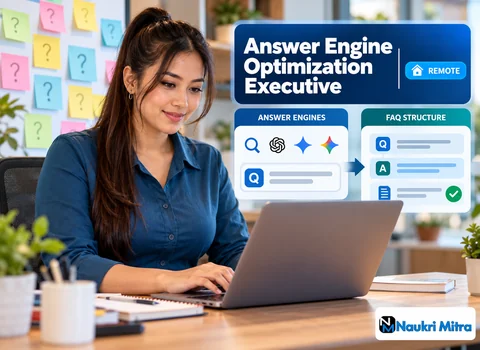
An answer engine reads a long page, lifts out two or three sentences and shows them alone, under someone else's question, with no headline, no intro and no paragraph before them to explain what "it" refers to. Whatever it lifts has to make sense in isolation. Writing answer paragraphs that pass that extraction test, page after page, is much of the work behind remote answer engine optimization executive jobs, including this one.
As answer engine optimization executive work from home jobs go, this one runs on a full-time contract at $75,000 a year in USD; you may be based in any country. You will own the page level: how individual answers are worded, where they sit, and how the markup around them describes the page to machines. Other people may set the overall search strategy; your job is to make each page easy to quote correctly.
Before a page gets rewritten, you need to know what people actually type or ask. In Semrush, the Questions filter in Keyword Magic Tool narrows a seed term down to queries that start with who, what, how, why and can. Ahrefs Keywords Explorer has a similar questions report that helps you group near-duplicates so one paragraph can serve several phrasings.
You will also read the People Also Ask boxes that show up for a topic and note which questions repeat across them. The output is a short list per page: the main question it should answer, three to six follow-up questions, and the wording people use.
Most existing pages bury the answer. They open with history or a sales pitch, and the useful sentence turns up somewhere in paragraph four. Your rewrite flips that order. Under each question-style heading, the first one or two sentences give the plain answer, using the subject's full name instead of a pronoun. Supporting detail, caveats and examples come after.
A hypothetical example: a help page titled "Our return process" might become a section headed "How long does a refund take?", opening with one sentence that states the timeframe and the condition it depends on. A reader skimming gets the answer. So does a model that quotes only that sentence. You keep the brand voice but cut sentences that only work if the reader saw the previous one.
Many pages benefit from a short block of related questions near the end, each with a compact answer of a few sentences. You decide which follow-ups belong on the page and which deserve their own URL.
These blocks are written for people first. If an answer reads like it exists only to hold a keyword, it gets rewritten or removed. You also check that the same question is not answered differently on two pages of the same site, because conflicting answers make it harder for any system to trust either one.
Schema markup tells machines what a page is and what is on it. You will mostly write JSON-LD, choosing types from the schema.org vocabulary that honestly match the visible content:
The rule you will repeat to developers: markup must describe what a visitor can see. Marking up hidden questions or absent steps is the fastest way to get structured data ignored.
Every change gets tested. Google's Rich Results Test shows whether a page qualifies for the search features Google supports and flags missing or invalid properties. The Schema Markup Validator at schema.org checks the code against the wider vocabulary, which matters for types Google does not display. You will run both, fix errors, and recheck after developers deploy.
You also need to be straight with colleagues and clients about limits. Google now limits rich results for question-list markup mainly to authoritative government and health sites, and it has retired HowTo rich results. Schema can still describe a page to search engines and answer engines, but valid markup never guarantees any visual feature, ranking or citation.
After pages go live, you watch what happens to them. That means searching target questions, checking whether a Google AI Overview appears, and noting which sources it links to. In ChatGPT with search, you ask the same questions and record which URLs it cites. Tracking features in Semrush and Ahrefs help at scale, but manual checks catch wording details.
What you are looking for is pattern, not proof. If rewritten pages with tight opening answers are cited more often than pages still waiting for edits, that is a signal worth reporting. These systems change their behaviour often, so findings go into the report labelled as observations.
A typical day, though client deadlines shift the order:
Candidates should be graduates in marketing, journalism or a related field, bringing 2 to 3 years of hands-on SEO and content optimisation. You should already be comfortable in Semrush and Ahrefs, able to read and write schema markup, and used to checking it in Google's Rich Results Test. Clear, concise English writing tops the list of answer engine optimization executive skills, because the sentence itself is the product.
If you have basic SEO experience and wonder how to become an answer engine optimization executive, the path is concrete. Take three pages you have worked on, rewrite them answer-first, add appropriate markup, validate it and keep before-and-after copies. A completed answer engine optimization executive course or structured data course is a plus, and Google's own documentation on structured data is free to study.
Because the role asks for real SEO hours, it is not aimed at people starting from zero. Some agencies offer entry-level AEO posts, but this one expects you to handle pages without close supervision.
Search engine optimization is about earning a click from a ranked list: titles, internal links, crawlability and relevance across the whole site. Answer engine optimization works at a smaller scale. The unit is the passage, and the aim is for an engine to quote it accurately, with or without a click. The two overlap heavily: an uncrawlable page will not be cited, and a clear answer often helps rankings too. The difference is emphasis: AEO spends far more time on sentence structure, answer placement and markup than on links.
The answer engine optimization executive salary per year here is $75,000 USD. Work of this kind is commonly found at digital marketing agencies, SEO consultancies and in-house content teams at publishers and software companies.
As more people ask questions through AI assistants and AI-generated search summaries, the skill of writing passages that stand alone and marking them up correctly is likely to stay useful. How these systems will behave next year cannot be known from outside, so test, document and adjust rather than rely on fixed tricks. If you like editing at the sentence level and do not mind reading JSON, send your application with examples of pages you have restructured.