
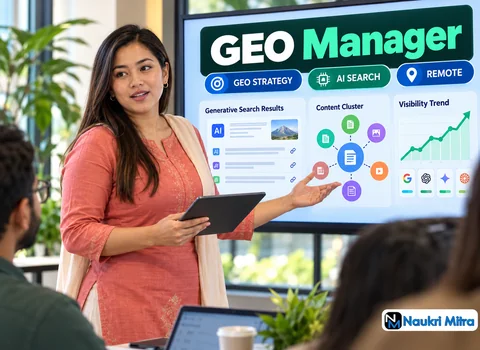
A buyer asks an AI assistant which payroll platform suits a forty-person company with staff in three countries. The answer names two of your competitors, quotes a well-known software review site, and never mentions your brand. Several gaps sit inside that one reply, and you cannot close all of them this quarter. The manager here decides which gap matters most, what it will cost, and who picks it up on Monday. Of the remote GEO manager jobs around, this one leans hardest on that judgement. It is a full-time, home-based post with $95,000 per year in USD attached, and candidates may live in any country. You set the generative engine optimisation strategy, track AI search share of voice, direct content and digital PR effort, coordinate SEO and content teams, and report to marketing leaders.
Strategy starts with a shortlist. Any brand can generate hundreds of plausible prompts, but only some of them map to real purchase decisions. A useful first pass sorts questions by commercial weight: late-stage comparisons, early category questions, and support-style questions from customers who might churn.
For each cluster you decide where the brand should be cited. Sometimes that is your own product page. Often it is a review site, an industry guide or a trade roundup, and the real question is which of those you can influence. That map of topics, questions and target sources becomes the document everyone works from.
Once gaps are visible, three kinds of work compete for the same hours. Content updates are usually cheapest: refreshing a stale comparison page, adding the facts an assistant needs to describe your product accurately, or merging thin pages that contradict each other. Digital PR is slower and harder to forecast, yet often the only route into the third-party sources AI answers quote. Technical work, such as crawl access or rendering problems, rarely wins attention until it blocks everything else.
A practical way to rank them is to ask three things of every candidate task. How many priority questions does it touch? How long before you could reasonably expect a change? And does it depend on another team saying yes? A page refresh your own writers can ship this sprint might beat a bigger PR idea that waits on legal review. You own that call and explain it, because the people doing the work deserve to know why their project slipped. If you strip the GEO manager job description down to one line, it is this ordering.
You should be comfortable in Profound or AthenaHQ, which track how often a brand is mentioned and cited across AI assistants for a defined prompt set. Here they serve as planning evidence: which competitor is gaining in which topic, which sources keep appearing, and whether last quarter's work moved anything. A specialist may run the prompt sets day to day; you read the trend and turn it into decisions.
Google Search Console remains the anchor for search signals. A sudden drop in impressions for a page you want cited is often the first sign that a GEO problem is really an SEO problem. Analytics dashboards show whether visits from AI assistants turn into sign-ups or sales.
The people you coordinate will not all report to you. SEO may sit in growth, content in brand, PR with an agency. One plan needs a clear rhythm: a weekly check on the priority queue, a monthly review of what shipped, and a shared document naming who owns each question cluster.
Managing people well here means protecting focus. Writers should not be pulled onto a new cluster every time a dashboard twitches. PR leads need notice to pitch properly. SEO specialists need early warning when a content plan creates redirect work. With direct reports, expect regular one-to-ones, honest feedback, and space for each person to learn the newer parts of the discipline.
Every plan has more ideas than money. You will weigh tool subscriptions against freelance writing hours, agency retainers against in-house outreach, and new projects against maintaining pages that already perform. Good budget notes say what you fund, what you leave out, and what evidence would change your mind.
Saying no is part of the job. A leader might want visibility in a topic where the brand has little to offer. Push back politely, offer a smaller test, and keep the team on the work most likely to pay off.
Senior marketers want three answers: is the brand showing up more often where it matters, what caused the change, and what you need next. Lead with the decision you are asking for, then the share-of-voice evidence behind it, kept to a few measures the team agreed and tracks the same way each month, with Search Console and conversion data alongside.
Be careful with promises. When a leader asks for a committed citation count by quarter end, offer a target for effort and a range for outcomes, since no assistant takes instructions from a marketing plan. Report direction, admit what you do not know, and keep the prompt set stable.
Generative engine optimisation builds on SEO rather than replacing it. Assistants still draw on pages that are crawlable and trusted, so the basics keep their value. GEO adds attention to how a brand is described across many sources and the gap between being ranked and being quoted. The outlook for people who understand both looks sound, though titles are still settling.
An AEO specialist usually works at page level, shaping answers and schema so one page can be quoted cleanly. A GEO manager works above that: choosing topics, balancing channels, setting budgets and managing people. Many teams need both.
You need a bachelor's in marketing or a related field, plus 5 to 7 years in SEO or content strategy, at least one of them managing campaigns or people. Experience with Profound or AthenaHQ, Google Search Console and analytics dashboards is expected, along with strong planning and reporting. The GEO manager skills that matter most are judgement and clear communication, which is why this seat suits someone who has already run programmes.
On a resume, lead with decisions. A line about pausing a content series to fund review-site outreach, and what followed, beats a list of tools. Likely interview questions: how you would build a first-quarter plan, handle a stakeholder who wants citations promised, and split a fixed budget.
Content strategists already have editorial planning, audience research and the habit of judging work by results. The usual gaps are technical SEO, share-of-voice tools and managing PR. Close them with a small AI visibility pilot in your current job: track a modest prompt set for a few months and present what you learned.
Running a programme is learned mostly by running one. If you want a GEO manager course for structure, choose a recent AI search module from an established SEO trainer and read the Search Console help pages beside it. Employers have no agreed GEO manager certification to check for, another reason a documented pilot often carries more weight.
Here, $95,000 per year in USD is the GEO manager salary on offer, for full-time work from home, and applicants are welcome worldwide. Similar roles appear at software companies, consumer brands, ecommerce businesses and publishers building in-house AI visibility teams, and at SEO and digital PR agencies adding GEO services. If your experience fits, send a resume showing the programmes you led and the trade-offs you made.