
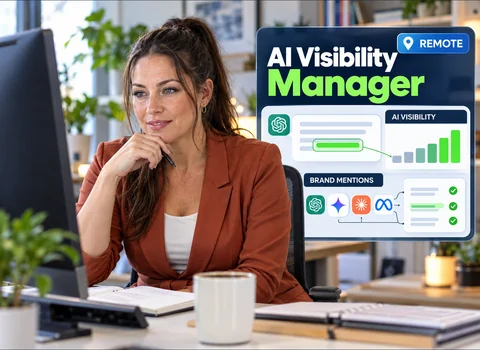
Slide eleven of the quarterly leadership deck holds one number in large type: the share of AI assistant answers in your category that mention the brand at all. The room studies it, then the questions start. Is that good? Why did it move since last quarter? What are we going to do about it? Answering those three honestly, without dressing up a noisy figure as a precise one, is the whole of this job. Among remote AI visibility manager jobs, this one sits squarely on measurement and reporting. The hours are full-time, the pay comes to $95,000 a year in USD, and your location can be anywhere on the map.
Every number you report later depends on the questions you chose to ask. A prompt set built from the marketing team's favourite keywords will flatter the brand and tell leadership nothing. You will build yours from sales call notes, support tickets, review sites, community threads and the comparison questions buyers type when they are close to a decision. Group prompts by buying stage and keep the set stable enough that quarterly trends mean something.
You will also version it, logging every addition so nobody mistakes a wider net for growth.
A mention is the brand name appearing in the generated text. A citation is the engine linking to a source, which may be your page, a review site, a journalist's article or a competitor's comparison post. The two move separately, and conflating them is a common reporting error. You will track both, plus where the brand appears in the answer and how it is described. Sentiment matters too: being named as the expensive option with weak support is a mention, but hardly one to celebrate.
Share of voice is the headline figure, and it needs a definition you can defend. In this role it means, roughly, how often the brand is mentioned across the prompt set relative to a named list of competitors, reported separately for each engine. ChatGPT, Perplexity and Google AI Overviews behave differently. Perplexity cites heavily and visibly, AI Overviews draw on pages Google already indexes, and ChatGPT answers vary with browsing and model version. Blending them into one figure hides more than it shows, so the deck should keep the engines apart before offering any combined view.
Hands-on use of at least one dedicated tracker such as Profound, Peec AI or Otterly.ai is needed for this role. These platforms run your prompts on a schedule, log mentions and cited sources, and chart competitors. You should know what each one samples, how often and from where, because those settings change the numbers.
The trackers tell you what the engines say. GA4 and Search Console tell you what happens next. In GA4 you will separate referral sessions from AI assistants and watch what those visitors do on the site. In Search Console you will look for queries where impressions hold but clicks fall, a pattern that often points to an AI Overview answering the question on the results page. Neither source is complete, and your reports should say so.
Ask an assistant the same question twice and you may get two different shortlists. Models are probabilistic, retrieval results shift, and personalisation and location play a part. A single screenshot proves nothing, which is awkward when an executive has just forwarded one.
The answer is sampling discipline. You will run each prompt several times per period, report rates rather than single outcomes, and show a range when the movement is within normal variation. When share of voice drops a few points, part of your job is saying, calmly and with evidence, whether that is a change or just noise. A measurement-sceptical habit is worth more here than any dashboard.
An executive pack usually rests on a short list of indicators:
Each figure goes on the slide with a sentence on what changed, why you think it changed and how confident you are. Strong stakeholder communication is listed as a requirement, and this is where it gets used.
Measurement only earns its budget when somebody acts on it. When the data shows the brand missing from a cluster of comparison prompts, or a third-party review site being cited where your own page should be, you will write a short brief for the team that can fix it. Content gets the missing questions, the sources the engines currently trust and the pages that need updating. Digital PR gets the publications and review platforms that keep appearing in citations. Keep asks small, and report next time on whether anything moved.
Correlation is cheap in this work. A page gets refreshed, share of voice rises, and everyone wants to claim the win. You will design simple tests instead: change a defined group of pages, hold a comparable group back, and watch both across the same prompts over enough runs to see past variation. The same approach applies to earned coverage. Inconclusive results get reported as inconclusive. Engines choose their own sources, so the honest forecast for any test is a probability, never a promised citation.
The AI visibility manager job description here calls for a bachelor's degree in marketing or communications and 5+ years in SEO, content or digital PR, including recent work on AI search. Among AI visibility manager skills, reporting carries as much weight as tool knowledge. Your resume should show prompt sets you built, a report you presented and a decision it changed. AI visibility manager interview questions tend to probe exactly that: how you would handle a sudden drop, how you separate noise from signal and how you explain uncertainty to a CFO.
Pay sits at $95,000 per year in USD, the AI visibility manager salary attached to this full-time post. Like other AI visibility manager work from home jobs, it can be done in any country, provided your hours overlap with leadership for reviews.
Most people in this seat come from SEO, and the move is shorter than the title suggests. The difference is in the unit of measurement. An SEO manager reports rankings, clicks and organic sessions from fairly stable systems. An AI visibility manager reports mentions, citations and share of voice from systems that answer differently each time and rarely send the click. Technical SEO, content judgement and analytics carry across. What you add is sampling and a habit of writing confidence levels next to every number.
For learning, the field has not settled on one credential. Marketing training providers run short courses on AI search visibility and generative engine optimization, tracking vendors publish documentation and webinars, and Google explains its AI features in Search in its own guidance. Pair any of them with a small tracking project on a brand you know, which is where the method sticks.
Some organisations will absorb the role into SEO or brand teams as the field matures. The demand for someone who can measure how a brand appears in AI answers, and say what the measurement can and cannot support, looks durable. Some in-house marketing teams at software, finance, retail and consumer brands have added the function, SEO and digital PR agencies are building it into client retainers, and the tracking vendors hire for similar skills. Whatever the org chart calls it later, a record of defensible measurement is portable.