The Future of Agriculture Careers in Smart Farming
Introduction: Agriculture is Changing Quietly but Deeply
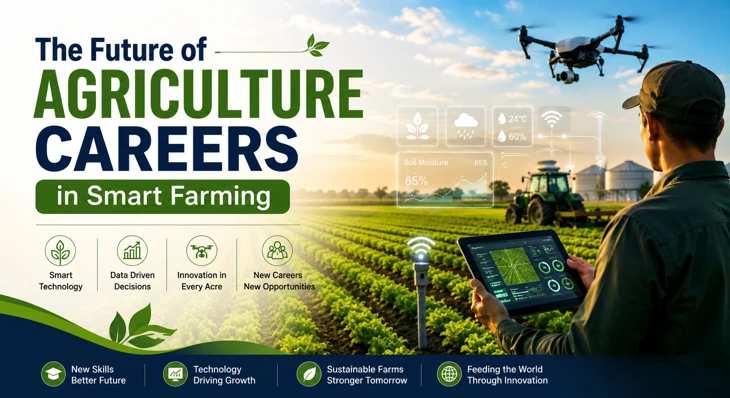
Walk into any modern farm today, and you’ll notice something different. It doesn’t look like the agriculture many of us grew up imagining. Instead of only fields, tools, and manual effort, you now see sensors in the soil, drones in the sky, and mobile dashboards guiding decisions in real time.
This shift is not just about technology—it’s about how people build careers in agriculture. The future of agriculture careers in smart farming is no longer limited to working the land in a traditional sense. It now includes working with data, machines, software, and intelligent systems that quietly reshape how food is grown.
What makes this change important is not just efficiency, but survival. With rising population pressure, unpredictable weather, and shrinking resources, agriculture has been forced to evolve. And with that evolution, new kinds of jobs are emerging that didn’t exist even ten years ago.
What Smart Farming Really Means in Everyday Terms
Smart farming, often called precision agriculture, simply means using technology to make better farming decisions. Instead of relying only on experience or guesswork, farmers now depend on real-time information.
That information comes from tools such as soil sensors, weather-tracking systems, satellite imagery, and automated machines. Together, they help farmers understand what a crop needs, when it needs it, and how much is enough.
In practical terms, it reduces waste, improves yield, and saves time. But on a deeper level, it changes who can work in agriculture and which skills matter.
Why Agriculture Careers Are Expanding Beyond Farming Fields
Earlier, agricultural careers were mostly associated with fieldwork, irrigation, or livestock management. That still exists, but it’s no longer the full picture.
Today, agriculture is becoming a space where technology and science meet real-world food production. This means career opportunities are also spreading into new directions.
For example, someone might never set foot on a farm but still play a key role in improving crop production through data analysis or drone mapping. Another person might design systems that automatically control irrigation based on soil moisture levels.
This is why the idea of agricultural technology jobs for the future is gaining attention among students, professionals, and even tech workers seeking meaningful careers.
Technologies Quietly Powering Smart Farming
Behind every smart farming system, there is a combination of technologies working together. Most of them operate silently in the background, but their impact is very visible in the results.
Farmers today use sensors to monitor soil conditions in real time rather than relying on manual testing. Drones fly over fields to detect crop health issues early. AI-based tools analyze weather patterns and suggest the best time to plant or harvest.
Even tractors and irrigation systems are becoming automated, reducing physical workload and improving precision.
These tools are not replacing humans—they are changing what humans do. Instead of repetitive tasks, people are now managing systems, interpreting data, and making strategic decisions.
New Career Paths Emerging in Smart Farming
The most interesting part of this transformation is the variety of new roles it is creating. These are not limited to one industry or one type of education.
A person with an agricultural background might move into crop analytics. Someone with a tech background might work on building farming software. Even drone operators are now recognized as part of agricultural operations.
Some growing roles include precision agriculture support, farm data analysis, automation system handling, and remote crop monitoring.
What’s important here is flexibility. These careers are not rigid—they evolve as technology evolves.
Skills That Matter in the New Agriculture Landscape
Success in smart farming careers depends on a mix of old and new skills. Agricultural knowledge still matters, but it is now supported by technical understanding.
Being comfortable with data is becoming increasingly important. Many decisions are now based on numbers rather than assumptions. Understanding how machines work, how software systems operate, and how data is interpreted can make a significant difference.
At the same time, soft skills like adaptability and problem-solving are just as valuable. Technology in this field changes quickly, so the ability to learn continuously is essential.
How Rural Employment is Being Rewritten
One of the less discussed but important impacts of smart farming is its effect on rural employment.
Traditional labor-based roles are slowly decreasing in some areas, but new technical roles are appearing in their place. Farmers are learning to operate digital tools, while rural youth are exploring careers in agri-tech services.
Training programs and digital education initiatives are helping bridge the gap between traditional farming communities and modern agricultural systems.
This transition is gradual, but it is reshaping how rural economies function.
Education and Learning Pathways for Future Careers
Education in agriculture is no longer limited to textbooks about crops and soil. Many universities and institutes are now offering programs that combine agriculture with technology, data science, and business management.
Courses in precision farming, agricultural analytics, and drone operations are becoming more common. Online learning platforms are also making it easier for individuals to upskill without leaving their current jobs.
This accessibility is important because the demand for skilled professionals is outpacing the rate at which traditional education systems can produce graduates.
Real Trends Shaping the Future of Smart Farming Careers
Looking ahead, agriculture will continue to become more automated and data-driven.
We are already seeing early versions of fully automated farms where machines handle most of the routine work. Artificial intelligence is being used to predict crop diseases before they spread. Some farms are experimenting with vertical farming systems in urban areas.
Blockchain is also entering the food supply chain to improve transparency, ensuring that consumers know exactly where their food comes from.
These trends point toward a future where agriculture is not only about production but also about intelligence, sustainability, and traceability.
Challenges That Still Need Attention
Even though opportunities are increasing, the transition is not without challenges.
Not all regions have equal access to technology. In some rural areas, awareness and training are still limited. The cost of implementing smart systems can also be high for small farmers.
Another challenge is keeping up with constant technological change. Tools and systems evolve quickly, which means continuous learning is no longer optional—it is necessary.
Despite these hurdles, the direction of change is clear and irreversible.
Conclusion: A Career Path That is Still Taking Shape
The future of agriculture careers in smart farming is still unfolding. It is not a fixed path but a growing ecosystem of opportunities shaped by innovation and necessity.
What makes this field unique is that it combines purpose with progress. It is about feeding a growing population while using fewer resources and smarter methods.
For anyone entering this space today, the most important advantage is openness to change. Those who are willing to learn new systems, understand evolving tools, and adapt to new ways of thinking will find this field full of long-term potential.
Agriculture is no longer just about land. It is about intelligence, technology, and the people who know how to connect both.