Telepathology Explained: How to Start a Remote Career in Digital Pathology
Introduction
Healthcare is going through a major digital shift, and telepathology is one of the strongest examples of this transformation. What once required physical presence in a laboratory can now be done from almost anywhere using advanced imaging and secure digital platforms. This change is not just technical—it is reshaping how medical professionals build careers, especially those interested in a remote career in digital pathology.
At its core, telepathology blends medical science with digital imaging and online communication systems. It allows pathologists to review and interpret tissue samples without being physically present in the lab. For students, professionals, and anyone exploring careers in healthcare technology, this field offers a practical, future-ready pathway.
What is Telepathology?
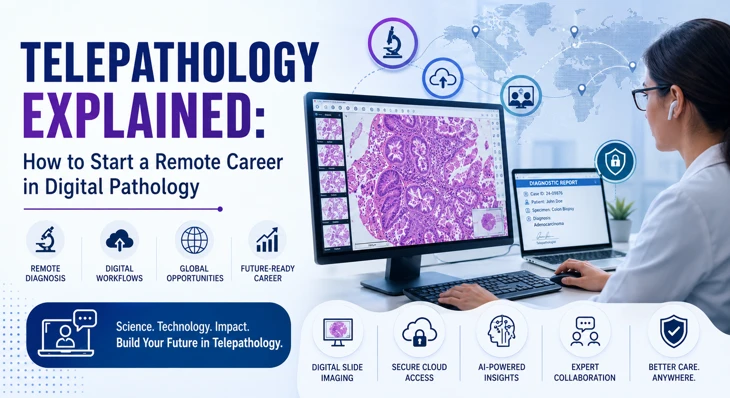
Telepathology refers to the remote practice of pathology using digital images of tissue samples. Instead of relying only on traditional microscopes and glass slides, specialists now analyze high-resolution scanned images on computer systems.
In simpler terms, it enables diagnosis and expert consultation without needing the pathologist to be on-site.
This practice is a key part of digital pathology, which focuses on converting traditional lab workflows into fully digital systems using imaging technologies and software platforms.
Telepathology vs Digital Pathology
Although both terms are closely related, they are not exactly the same:
- Digital pathology covers the complete digital transformation of pathology workflows.
- Telepathology focuses specifically on remote diagnosis and consultation using those digital systems.
Together, they are improving the speed, accessibility, and accuracy of pathology services across healthcare institutions worldwide.
How Telepathology Works in Real Practice
Telepathology follows a structured digital workflow that connects laboratories and specialists through technology.
A tissue sample is first collected from a patient and prepared in a pathology laboratory using standard procedures. After that, the sample is processed into slides, just like in conventional pathology methods.
These slides are then scanned using high-resolution imaging systems to create detailed Whole Slide Images (WSI). These digital files capture the entire tissue structure at microscopic clarity.
Once scanned, the images are securely uploaded to cloud-based systems or hospital networks. Pathologists can then access these files remotely using specialized software.
From there, a telepathologist examines the digital slides, zooming in and out to study cellular patterns and structures. Based on this analysis, a diagnostic report is prepared and shared with the concerned medical team.
This approach significantly improves turnaround time and makes expert opinions available even in regions with limited pathology specialists.
Why Telepathology is Becoming So Important
The demand for telepathology and remote diagnostic services is increasing for several practical reasons.
Many regions face a shortage of experienced pathologists, making timely diagnosis difficult. At the same time, healthcare systems are under pressure to deliver faster and more accurate results.
Telemedicine adoption has also accelerated, and pathology has naturally become part of this digital ecosystem. Additionally, advancements in artificial intelligence and cloud-based healthcare platforms have made remote diagnostics more reliable and scalable.
As a result, remote pathology careers are no longer niche—they are becoming an essential part of modern healthcare delivery.
Skills Needed for a Remote Career in Digital Pathology
Building a strong foundation in telepathology requires a combination of medical knowledge and digital competence.
Medical Understanding
A clear grasp of human anatomy, histopathology, and disease mechanisms is essential. Strong diagnostic thinking and attention to microscopic detail also play a major role.
Technical Knowledge
Familiarity with digital pathology tools, Whole Slide Imaging systems, and cloud-based platforms is increasingly important. Understanding how digital data is stored and accessed in healthcare environments adds further value.
Professional Skills
Communication becomes critical when working remotely with teams across different locations. Time management, adaptability, and the ability to interpret complex data efficiently are also highly valuable in this field.
Professionals who can balance clinical expertise with digital confidence tend to perform best in telepathology roles.
Career Paths in Telepathology
The growth of digital pathology has opened multiple professional opportunities across the healthcare and research sectors.
A telepathologist primarily focuses on diagnosing diseases by reviewing digital slides remotely and providing expert reports. This role is central to remote diagnostic services.
Digital pathology specialists work with imaging systems, software tools, and workflow management platforms that support telepathology operations.
Remote laboratory consultants assist healthcare facilities in improving diagnostic accuracy and transitioning from traditional systems to digital workflows.
Medical imaging analysts focus on examining digital slides and supporting diagnostic decisions through advanced visualization tools.
In research and innovation, AI-focused professionals work on integrating machine learning into pathology systems to improve efficiency and diagnostic precision.
These roles are increasingly available in hospitals, diagnostic networks, biotech companies, and healthcare technology startups.
How to Enter the Field of Telepathology
A career in telepathology usually begins with a strong academic foundation in medicine, followed by specialization in pathology or related disciplines.
Practical exposure in hospital laboratories helps build confidence in traditional diagnostic techniques before moving into digital systems.
As the field evolves, learning digital pathology software and imaging tools becomes an important next step. Many professionals also explore training programs and certifications focused on digital healthcare technologies.
Understanding cloud systems, data security practices, and artificial intelligence applications further strengthens career readiness.
With this combination of clinical experience and technical awareness, professionals can transition into remote pathology roles or hybrid positions with growing ease.
Telepathology relies on a range of advanced technologies that enable remote diagnosis.
Whole Slide Imaging systems convert physical slides into high-resolution digital formats that preserve every microscopic detail.
Specialized pathology software allows users to view, annotate, and analyze these images with precision.
Cloud storage systems ensure secure access to large medical files from different locations without data loss or compromise.
Artificial intelligence tools are increasingly being used to highlight abnormalities and support diagnostic accuracy.
Laboratory information systems help organize patient records, manage workflows, and integrate digital results into healthcare databases.
Together, these tools create a seamless digital environment for modern pathology practice.
Challenges in Telepathology
Despite its advantages, telepathology still faces a few practical challenges.
The cost of high-quality imaging equipment can be high, especially for smaller healthcare facilities.
Large digital files require a strong storage infrastructure and reliable internet connectivity for smooth access.
Some professionals also face a learning curve when transitioning from traditional microscopy to digital platforms.
In addition, regulatory requirements and patient data privacy standards must be strictly upheld across all digital systems.
Even with these challenges, continuous technological progress is making the system more efficient and accessible each year.
Future of Telepathology and Remote Diagnostics
The future of telepathology is closely tied to advancements in artificial intelligence, cloud computing, and global healthcare connectivity.
Diagnostic systems are expected to become faster and more intelligent, with AI supporting pathologists in detecting complex patterns.
Access to expert pathology services will expand into rural and underserved regions, reducing healthcare gaps.
Cross-border consultations will become more common, enabling global collaboration among medical experts.
Hospitals are also moving toward fully integrated digital pathology ecosystems where remote diagnostics become a standard part of patient care.
Telepathology is not just an upgrade to existing systems—it represents a long-term shift in how medical diagnosis is delivered.
FAQs About Telepathology
Is telepathology a stable career option?
Yes, it is steadily growing and offers long-term opportunities in both clinical and digital healthcare environments.
Can pathology work be done completely remotely?
In many cases, yes. Some institutions offer full remote setups, while others follow hybrid models depending on requirements.
Is special training required for digital pathology?
Formal pathology education is essential, along with additional training in digital imaging systems and related software tools.
How is telepathology different from telemedicine?
Telemedicine covers general remote healthcare services, while telepathology focuses specifically on diagnostic pathology using digital systems.
Will automation replace pathologists in the future?
Automation and AI will support diagnostic work, but expert pathologists remain essential for final interpretation and clinical decisions.
Conclusion
Telepathology is redefining the way medical diagnosis is performed by moving traditional pathology into a fully digital environment. It offers flexibility, faster results, and opportunities for professionals to work beyond geographical boundaries.
For those aiming to build a remote career in digital pathology, this field offers a meaningful blend of science and technology. As healthcare continues to evolve, professionals who embrace digital tools will play a key role in shaping the future of diagnosis and patient care.