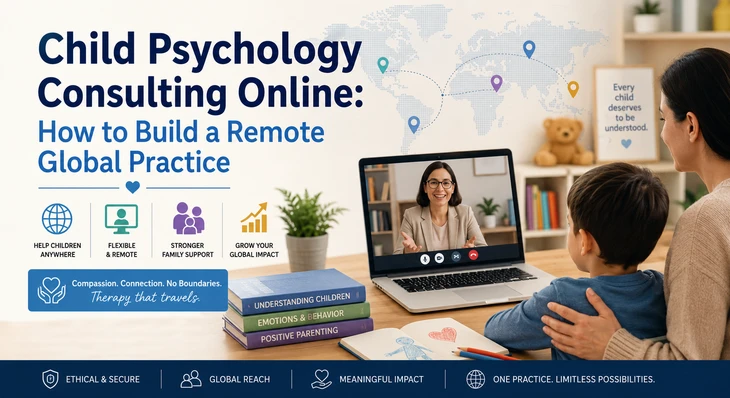
Child Psychology Consulting Online: How to Build a Remote Global Practice
Introduction: A Shift That Changed Everything
A few years ago, most child psychologists worked in a fairly traditional setup—appointments in a clinic, families traveling across town, and sessions packed into tight schedules. That world is still there, but something important has changed.
Today,
child psychology consulting online has quietly become a normal, trusted option for many families. What started as a convenience has become a preference among parents who want support without adding stress to their already busy routines.
And for professionals in this space, it has opened an entirely new way of working—a chance to build a
remote global child psychology practice that is not tied to a single city, country, or even time zone.
This isn’t just about going digital. It’s about rethinking how care is delivered, how trust is built, and how impact can travel far beyond physical boundaries.
What Online Child Psychology Consulting Really Looks Like
If you strip away the technical terms, online child psychology consulting is still very human at its core. It simply means helping children and parents navigate emotional, behavioral, and developmental challenges through digital communication.
Most sessions happen over video calls. Some involve structured conversations with parents. Others include guided activities that children can do at home while being observed online.
Interestingly, many psychologists find that once they adjust to the format, the experience feels surprisingly natural. You still listen, observe, interpret, and guide. The setting has changed—but the work hasn’t lost its essence.
There is, however, a subtle difference. In an online setup, parents become more actively involved. Their observations at home often become a key part of the therapy process. In a way, therapy becomes more collaborative than ever before.
Why More Professionals Are Choosing a Remote Global Practice
The rise of
online child psychology services is not accidental. It reflects real shifts in how families live and seek support.
Many parents today struggle with time. Between school schedules, work commitments, and daily responsibilities, adding travel for therapy can feel overwhelming. Online sessions remove that friction completely.
There is also a deeper issue—access. In many places, finding a qualified child psychologist nearby is still difficult. Online consulting bridges that gap instantly, allowing families to connect with specialists they would otherwise never reach.
From the professional side, the appeal is equally strong. A
remote global child psychology practice allows psychologists to work with diverse cases, expand their reach, and create a more flexible lifestyle.
It’s not uncommon now to see a practitioner based in one country working regularly with families across three or four others. That kind of reach was nearly impossible a decade ago.
Getting Started Without Overcomplicating It
One of the biggest misconceptions about building an online practice is that it requires a complicated setup. In reality, most successful practitioners begin quite simply.
Start With a Clear Direction
Instead of trying to offer everything, it helps to narrow your focus. Some professionals lean toward childhood anxiety. Others specialize in behavioral challenges, ADHD support, or parent coaching.
This clarity matters. When families search for
child psychology consulting online, they are usually looking for someone who understands their exact concern—not a generalist.
Keep the Tech Side Simple
You don’t need a heavy system to begin. A secure video platform, a basic scheduling tool, and a private space for notes are often enough at the start.
What matters more than complexity is reliability. If a session runs smoothly without distractions, families feel safe and supported.
Build a Presence That Feels Real
A website or profile is often the first impression parents get. And they can usually tell within seconds whether it feels genuine or overly polished.
Simple explanations, honest communication, and a calm tone go a long way. You don’t need exaggerated claims—just clarity about how you work and who you help.
The Human Skills That Matter More Online
Interestingly, success in
online child psychology consulting is not just about clinical knowledge. The softer skills often make a bigger difference.
Listening becomes more intentional. Without physical presence, you pay closer attention to tone, pauses, and how parents describe situations.
Communication also becomes more structured. You learn to guide conversations clearly, especially when multiple concerns come up at once.
And then there’s collaboration. In a remote setup, parents are not just observers—they are active participants in the process. The more effectively you involve them, the more progress you tend to see.
Cultural sensitivity also becomes important. When working globally, parenting styles and expectations can vary widely. What feels normal in one household may be completely different in another.
Trust: The Real Foundation of Online Practice
If there is one thing that determines the success of a
remote global child psychology practice, it is trust.
And trust online is built differently. It doesn’t come from a handshake or a physical office. It comes from consistency.
When sessions start on time, when communication is clear, and when progress is explained in simple terms, families begin to feel secure.
Transparency also plays a big role. Parents appreciate knowing what to expect, how sessions will unfold, and what kind of outcomes are realistic.
Over time, even small signs of improvement become powerful trust-builders. A child handling emotions better at home. A parent notices fewer outbursts. These small shifts matter more than anything else.
Growing Your Practice in a Natural Way
Marketing
an online child psychology consulting service doesn’t have to feel aggressive or overly technical. In fact, the most effective growth often comes from simple, consistent visibility.
Many professionals start by writing about everyday parenting situations. Things like managing tantrums, understanding children's anxiety, or supporting children through school struggles.
These topics naturally attract parents who are already searching for answers.
Search engines also play a quiet but powerful role. When your content includes phrases
such as "online child psychology services" or "remote child counseling support," it becomes easier for families to discover you organically.
Social platforms can help too, but they work best when used as educational spaces rather than promotional ones.
Behind every smooth online session, there is usually a set of simple tools doing the background work.
Scheduling tools help avoid constant back-and-forth messages. Secure video platforms ensure privacy. Digital forms allow parents to share observations before sessions, which often saves time and improves clarity.
None of these tools replaces clinical skill—but they do make the process smoother for everyone involved.
Challenges You’ll Eventually Face
It wouldn’t be honest to say that everything is effortless in an online setup.
One challenge is observation. You don’t always see a child’s full behavioral range the way you would in a physical room. You rely more on reports and guided interaction.
Engagement can also vary. Some children take time to adjust to speaking through a screen, especially in early sessions.
There are also practical issues, such as internet stability and time zone differences, when working globally.
And finally, there are regulatory differences between countries that professionals must stay aware of.
These challenges are real, but they are not barriers. They are adjustments that come with the format.
A Simple Example of How Growth Happens
Consider a psychologist starting from a small home setup. At first, they work with a handful of local families online. Sessions are simple, focused, and personal.
Over time, they begin sharing useful insights online—nothing flashy, just real experiences and helpful guidance for parents.
Slowly, inquiries start coming from outside their immediate area. A family from another country finds their content. Then another.
Within a year or two, what started as a small practice becomes a
remote global child psychology practice, not because of marketing tricks, but because of clarity, consistency, and trust.
Ethics Still Matter More Than Ever
Even in a digital setup, ethics remain the backbone of the profession.
Clear boundaries must be maintained. Parents should always understand the nature of online sessions before beginning.
Confidentiality is non-negotiable. Information shared in sessions must remain protected.
And most importantly, every decision should prioritize the child’s well-being above everything else.
Where This Field Is Headed
The future of
online child psychology consulting is moving toward a blended model that combines human expertise with digital support tools.
We may see better assessment systems, more interactive tools, and even AI-assisted insights helping psychologists understand patterns more clearly.
But despite all these advancements, one thing is unlikely to change—the importance of human connection.
No technology can replace the feeling of being understood. That remains at the center of this work.
Conclusion: A Practice That Grows Beyond Borders
Building a
remote global child psychology practice is less about technology and more about intention.
It begins with simple steps, grows through consistency, and strengthens through trust.
For professionals willing to adapt, it offers something rare—the ability to support children and families across the world while working in a way that feels flexible and meaningful.
It doesn’t happen overnight. But with steady effort, it becomes something much bigger than a practice. It becomes a network of support that reaches far beyond physical boundaries.
FAQs
1. Is online child psychology consulting really effective for children?
Yes. Many children respond well to structured online sessions, especially when parents are actively involved.
2. What do I need to start an online practice?
A psychology qualification, clinical experience, a secure video platform, and a clear niche are usually enough to begin.
3. How do I reach clients from other countries?
Consistent online content, search visibility, and professional listings help attract international families over time.
4. Do children actually engage in virtual sessions?
Many do, especially when sessions are interactive, short, and supported by parents at home.
5. What is the hardest part of remote child psychology work?
Adjusting to limited physical observation and managing engagement in a virtual environment can be challenging initially.
6. How long does it take to build a stable online practice?
It varies, but most practitioners see steady growth within 6–12 months of consistent effort.