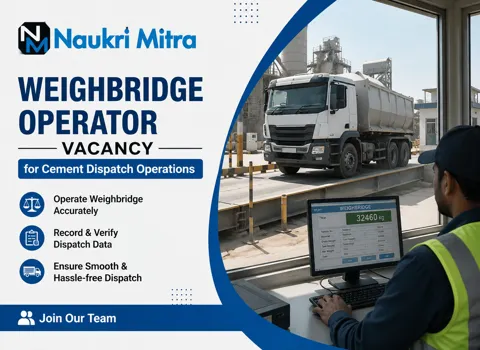
What Does a Weighbridge Operator Actually Do?
Every truck that enters or leaves a cement plant has to be weighed, and someone has to make sure that number is correct. That's the job. This Weighbridge Operator Vacancy for Cement Dispatch Operations, based in Baloda Bazar, Chhattisgarh, is a Full-time position, and the work centers on one thing: getting the weight right, every single time, because the plant's production records and billing depend on it.
If you've never looked closely at this career before, here's the short version. You sit at a weighbridge control point, log the weight of a truck when it's empty, log it again once it's loaded with cement or raw material, and the difference tells the plant how much was actually dispatched. Simple in theory. In practice, it takes focus because a wrong entry can mean an incorrect invoice.
The Business Reason Behind the Role
Cement plants move enormous quantities of material daily - limestone coming in, gypsum, coal, fly ash, and finished cement going out to dealers and construction sites. None of that can be tracked without someone consistently recording weights. Get it wrong, and a plant either loses money on under-billed dispatch or sends overloaded trucks onto the highway, which brings its own set of problems with transport authorities. That's really why this position exists in the first place.
A Shift on the Weighbridge
Shifts usually start with a quick check of the machine - is the display working, is the printer connected, has the scale been calibrated recently? Then the trucks start arriving. An empty vehicle rolls onto the platform, the weight gets recorded, and it moves off to load. Once loading is complete, it returns for the second weighing. Between these two numbers is the net dispatch quantity, and that figure must match what the dispatch order says should go out.
During busy hours, several trucks can be waiting in line at once, so there's pressure to keep things moving without compromising accuracy.
What the Job Involves Day to Day
- Recording tare weight and gross weight on the weighbridge system
- Cross-checking loaded quantity against the dispatch order
- Keeping the daily weighment register updated, whether on paper or software
- Talking to drivers, loading crew and the dispatch supervisor to keep vehicles moving
- Catching overloading or short-loading before a truck leaves the gate
- Printing the weighment slip and gate pass for each outgoing vehicle
Where People in This Role End Up Working
You'll find weighbridge operators at cement manufacturing plants, clinker grinding units, ready-mix concrete facilities, and material yards. The actual workstation is a small cabin next to the weighbridge platform, with a clear line of sight to the vehicles rolling in and out. Chhattisgarh has a fairly strong presence of cement and mineral-based industry, and plants in this belt rely on steady dispatch flow between quarries, production units, and distributors - which is exactly the kind of environment this role fits into.
Machines and Instruments You'll Be Using
The weighbridge is the central piece of equipment - a large platform scale, usually built into the ground, with load cells underneath that measure the vehicle's weight electronically. Alongside it sits a digital indicator or a computer terminal, dispatch software for logging entries, a printer for slips, and in many plants, a CCTV feed to keep an eye on the loading area. None of this requires advanced technical training, but comfort with basic computer entry and with quickly reading a digital display makes a real difference on a busy shift.
Skills That Actually Matter Here
Physical strength isn't the priority in this job - attention to detail is. You need to be reasonably quick with numbers, careful about recording data correctly, and able to keep a register updated without falling behind when trucks are queued up outside. A calm, clear way of speaking with drivers helps, too, especially when there's a dispute over a reading or a loading delay.
Freshers can get into this role. So can ITI candidates, diploma holders, and people who've previously worked in billing, store operations, or logistics. Employers generally look for someone who won't panic under a bit of pressure and who takes documentation seriously.
Does Your Training Background Matter?
Formal qualification requirements differ from one employer to another, but candidates who've had some vocational exposure - especially anything involving measurement, mechanical trades, or basic commerce and data entry - tend to pick up the work faster. Familiarity with precision instruments or structured documentation, even from a different field, transfers reasonably well here, since the underlying habit of measuring and recording accurately is the same.
What the Work Environment Feels Like
Expect a fair amount of sitting in the cabin combined with regular trips out to the loading area. There's dust, there's noise from trucks and machinery, and you're working outdoors in whatever weather Chhattisgarh happens to be having that day. Many cement plants dispatch material around the clock, so shift work - including night shifts - is a normal part of this job, not an exception.
Staying Safe Around Heavy Vehicles
Trucks moving in and out all day means safety can't be an afterthought. A helmet, reflective jacket, safety shoes, and a dust mask are the usual PPE for anyone stepping out near the loading zone. Staying inside marked safe areas, never standing close to a truck that's reversing, and reporting a faulty weighbridge sensor right away instead of working around it - these habits matter more than they might sound.
Where Things Get Difficult
Peak dispatch hours can get chaotic - a line of trucks, drivers in a hurry, and pressure to process everyone quickly without making an error. Weighbridge sensors occasionally act up, or a power cut interrupts the system right in the middle of a shift. Some drivers will argue about a reading they don't like. None of this is unusual, and operators who last in this role are usually the ones who stay steady through it, double-check before finalizing an entry, and don't let a rushed queue push them to skip a step.
Where This Can Lead
Do this well for a couple of years, and it tends to open doors within the same plant - senior dispatch coordination, logistics supervision, or a move into store and inventory management. The habit of accurate documentation and vehicle coordination that you build here is genuinely useful as cement plants scale up their operations, which makes this a reasonable entry point into the wider logistics side of the industry.
Pay and What Might Come Along With It
For this position in Baloda Bazar, Chhattisgarh, India, the monthly salary is ₹28,400. Beyond that, some employers offer overtime pay, PF and ESI coverage, a festive season bonus, uniforms, and transport or canteen facilities. These extras aren't guaranteed and vary from one company to the next, but they're common enough across similar dispatch roles in Indian cement operations that it's worth asking about them during the interview.