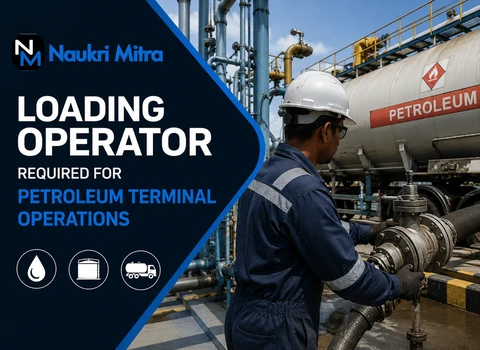
The Job Nobody Notices Until the Pump Runs Dry
You never think about how petrol actually gets to the pump until there's a shortage. Ships and pipelines bring crude and refined fuel into terminals, storage tanks hold it, and then somebody has to load it onto tankers headed out to the rest of the country. That somebody, at a terminal like the one in Paradip, Odisha, is usually a Loading Operator.
It's not a glamorous title. But without it, fuel simply doesn't move.
What the Shift Actually Looks Like
Ask ten operators what a normal day looks like, and you'll get ten slightly different answers, because it depends on how many tankers are queued and whether anything's gone wrong with the equipment that day. Some shifts are quiet, routine loading, one truck after another. Some aren't.
Still, a few things happen almost every shift. The operator connects the loading arm to the tanker, checks the product's density and temperature before allowing it to flow, keeps an eye on the meter to ensure the quantity is correct, and fills out the dispatch slip once it's done. None of this sounds difficult on paper. In practice, doing it correctly, every single time, without cutting corners, is what the job actually demands.
Why Get a Person to Do This at All
Terminals run close to non-stop because demand for fuel doesn't stop. A company could try to automate the whole process, and parts of it are automated, but someone still has to physically verify what's being loaded and catch problems before they leave the gate. That's the reason this is a Full-time position rather than something handled remotely.
Where You'd Actually Be Working
This kind of role tends to show up at petroleum tank farms, port storage terminals, and fuel distribution depots. Coastal areas see more of this activity than inland areas, since much of the crude and refined products arrive by ship first. Paradip is one of Odisha's major port towns, and the terminal work there follows much the same pattern you'd find at similar coastal facilities elsewhere in India.
The Equipment You'll End Up Knowing Well
Give it a month, and you'll be able to read a flow meter, a dip tape, and a density hydrometer without thinking twice. Loading arms, thermometers, and pressure gauges are also part of daily use. Many terminals now have Automated Tank Gauging systems and SCADA panels that display tank levels on a screen, which helps, but operators are still trained to check things manually. The screen tells you what's happening. Confirming it is still your job.
Who Tends to Do Well Here
Freshers with an ITI in a mechanical trade usually pick this up fine. So do diploma holders looking for their first proper industrial posting. What matters more than the certificate, honestly, is whether someone can follow a procedure exactly and stay sharp around flammable material for eight or twelve hours straight. Reading gauges accurately, understanding basic pump and valve behavior, and having the stamina to stand or climb around tanker platforms all through a shift matter more than any single qualification on paper.
The Part Nobody Mentions in the Job Ad: Shift Timing
Loading doesn't stop when the sun goes down, so this job usually comes with rotating shifts. You'll be outdoors a fair amount, near tanks and dispatch bays, dealing with heat, the smell of fuel, and idling tanker engines. If you're used to a fixed desk routine, this takes some adjusting to. Most people say the first month is the hardest part.
Why Safety Isn't Optional Around Here
When you're around flammable liquid all day, safety stops being a checklist item and becomes how you think. Fire-retardant coveralls, helmets, gloves, and static-free footwear are standard gear, because even a small spark near vapor is a real risk, not a theoretical one. Fire drills and spill-response training happen regularly, and new operators learn emergency shutdown steps early on, well before they're trusted with a full loading sequence alone.
A small spill, caught fast and reported immediately, is a non-event. The same spill ignored for ten minutes is a serious problem. Experienced operators know this difference in their bones. New ones learn it fast, usually the first time something goes slightly wrong.
What Actually Trips People Up Early On
Memorizing the loading sequence and every safety checklist takes longer than people expect going in. Throw in unpredictable weather, an occasional equipment fault, and a tanker queue that won't wait, and the first few weeks can feel like a lot. Ask around, and most operators say it clicks somewhere between three and six months in.
Where This Can Take You Over Time
Stick with it a couple of years, and you're usually looking at senior operator or shift-in-charge roles next. Gaining more knowledge in tank farm management, quality checks, or safety supervision tends to open up additional responsibility within the same terminal setup, without needing to jump into a completely different field.
What the Pay Looks Like
The role is based in Paradip, Odisha, India, and it's a Full-time position paying ₹36,500 a month. Some employers add extras on top, such as overtime pay, PF, ESI, bonuses, uniforms, or transport and canteen facilities, though this varies quite a bit from one company to the next and shouldn't be assumed to be guaranteed.
Should You Actually Go for This?
If you've got an ITI certificate or a mechanical diploma and you're trying to get your foot in the door of industrial work, this is a reasonable place to start. Steady full-time pay, real hands-on learning, and a front-row seat to how fuel actually gets from a port to a petrol pump. Not every job can say that.