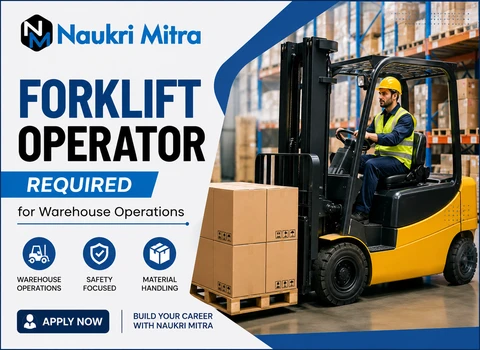
What It Actually Means to Run a Forklift in a Warehouse
Walk into any large warehouse, and you'll hear it before you see it — the beep of a forklift reversing, pallets being set down, someone calling out an aisle number. This Forklift Operator Required for Warehouse Operations opening in Pune, Maharashtra, India, is a Full-time role built around exactly that kind of environment. If you're trying to figure out whether this line of work suits you, here's a realistic look at what the job involves.
The Problem This Role Actually Solves
Goods don't move themselves. Every box, drum, or pallet stacked in a warehouse has to get from a truck to a rack, and later from that rack to another truck, without anyone getting hurt or the stock getting damaged in the process. Doing that by hand is slow and risky as volumes increase. That's the gap a trained operator fills — someone who can read a stack, judge weight, and move it through tight spaces without second-guessing every motion.
A Shift, Start to Finish
Most shifts begin with a quick check of the forklift itself — tires, brakes, hydraulic fluid, horn, lights. From there it's a mix of loading trucks at the dock, pulling stock from racks against a pick list, and repositioning pallets so the layout stays workable. Some hours are busy with back-to-back dispatches; others involve slower, more careful work, such as restacking damaged loads or clearing blocked aisles.
Typical tasks on any given day:
- Lifting and stacking palletized goods using mast and tilt controls
- Loading and unloading delivery vehicles at the dock
- Placing stock in the correct rack location, often against a coded system
- Flagging damaged goods, leaking containers, or faulty equipment
- Keeping a basic log of movements when the warehouse requires it
Where You'd Actually Be Working
Roles like this show up in distribution centers, cold storage units, retail stock yards, and manufacturing warehouses. Pune's logistics and industrial belt has seen steady warehousing growth in recent years, which is part of why demand for operators here hasn't slowed down.
The Equipment You'll Get Familiar With
The forklift is the obvious tool, but it's rarely the only one. Pallet jacks, hand trucks, barcode scanners, and platform scales all show up regularly. What matters more than the tool list, though, is understanding how it behaves — how a mast tilts, what happens to balance when a load shifts backward, why stacking indicators exist in the first place. Most accidents in this line of work trace back to someone ignoring what the machine was telling them.
What Makes Someone Good at This
Machine control matters, but it's not the whole picture. Judging how much clearance you have in a narrow aisle, knowing when a load is too unevenly distributed to lift safely, staying alert during the tenth hour of a shift — these come with time and attention, not just training. An ITI background or prior hands-on forklift experience helps, and many facilities will still consider freshers who show they can learn quickly and take safety seriously.
What the Body Goes Through
Expect a lot of seated work broken up by sudden stops, twisting to check blind spots, and getting on and off the machine repeatedly through the day. Some warehouses are open-sided and exposed to outside temperatures; others are fully enclosed and climate-controlled. Night shifts and rotating schedules aren't unusual, especially in warehouses tied to retail dispatch cycles.
Staying in One Piece
Safety here isn't a checklist that gets ignored after week one — it's what keeps operators working long-term. Safety shoes, a high-visibility vest, and a helmet are standard in most facilities. Sounding the horn at blind corners, sticking to posted speed limits, and never exceeding the rated load capacity are basics that get drilled in early and matter every single day afterward.
What Tends to Go Wrong
Congested aisles during peak hours, uneven or wet flooring, and pressure to move faster than conditions allow are the usual sources of trouble. Operators who last in this field tend to be the ones who slow down when something feels off, rather than pushing through a shortcut to save two minutes.
Where This Can Lead
Operators who build a solid track record often move into senior operator roles or take on shift coordination duties, sometimes overseeing newer staff or managing dock scheduling directly.
Pay and What Else Might Come With It
The role pays ₹26,000 a month. Beyond the base pay, some employers offer overtime, PF, ESI, bonuses, uniforms, transport, or canteen access — these vary by company and shouldn't be assumed as guaranteed.