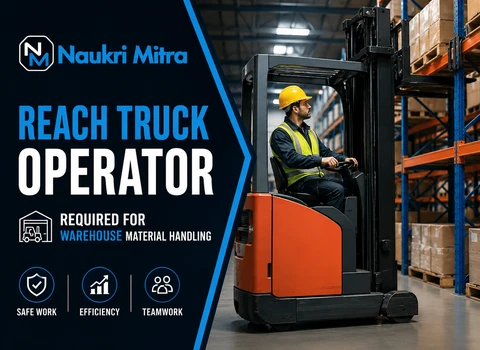
What a Reach Truck Operator Actually Does
Walk into any large distribution center, and you'll quickly notice something: goods aren't just stacked on the floor; they're stored several levels up on tall steel racks. Getting pallets up there, and bringing them back down again without damage, is the job of a reach truck operator. The machine itself looks a bit like a forklift but works differently — the mast and forks can extend forward and pull back, which lets the operator slide deep into a rack without needing much aisle width to maneuver.
Right now, a warehouse in Bhiwandi, Maharashtra, is hiring for exactly this role, on a Full-time basis. Bhiwandi has grown into one of the country's most active logistics belts over the past decade, so this kind of opening isn't unusual for the area.
Why This Skill Is in Demand
Land near major cities isn't cheap, so warehouses have started building upward instead of sprawling sideways. A standard forklift can't safely reach the eighth or tenth rack level — that's where the reach truck comes in. Companies aren't just hiring drivers here; they're hiring people who can be trusted with expensive inventory that sits several meters above the ground and is moved through gaps barely wider than the truck itself.
How the Shift Usually Unfolds
Most days start the same way — a walk-around inspection. Battery charge, brakes, hydraulics, tire condition, warning lights, the lot. Skipping this step is how small problems turn into breakdowns mid-shift.
Once the truck is cleared, tasks come in from a supervisor or, in more modern facilities, straight from a warehouse management system on a handheld scanner. From there, the work generally includes:
- Picking up pallets from receiving areas and placing them into the correct rack slot
- Pulling stock down for outbound orders based on a picking list
- Shifting inventory around to free up space or consolidate partial pallets
- Flagging damaged racking, leaking pallets, or truck faults before they become bigger issues
- Keeping basic movement records where the facility requires it
It sounds repetitive on paper. In practice, no two hours look identical — order volumes shift, aisles get congested, and priorities change depending on what's leaving the dock that day.
The Machine and the Tools Around It
Almost every reach truck in Indian warehouses today runs on an electric battery rather than diesel or LPG, mainly because indoor air quality and noise matter when you're operating inside a closed building for hours. Beyond the truck itself, operators handle handheld barcode scanners, pallet jacks for short moves, and sometimes a mounted terminal that displays live stock locations. Load charts posted near the racking help operators judge what's safe to lift at a given height — something that's easy to overlook but genuinely important.
What Employers Look For
A license or recognized training certificate for reach truck or forklift operation is usually non-negotiable. Past that, the things that separate an average operator from a good one are less about paperwork and more about instinct:
- Judging distance and height accurately, since aisles leave little room for error
- Understanding how weight shifts on a raised load, especially uneven pallets
- Comfort with scanners and basic inventory screens
- Sticking to safety rules even on the hundredth pallet of the day, not just the first
Candidates who've completed an ITI in a mechanical or electrical trade often pick up the technical side faster, since they already understand how motors, hydraulics, and controls interact. That said, plenty of capable operators come through dedicated forklift training schools with no formal engineering background at all — employers tend to weigh hands-on experience just as heavily as a certificate.
What the Body Goes Through
This isn't a desk job, but it's not heavy manual labor either. Operators sit for long stretches while running the controls, then repeatedly climb on and off the truck throughout a shift. Reasonable eyesight and quick reflexes matter more here than raw strength. Bhiwandi facilities often run rotational or extended shifts to match dispatch timings, so operators should be ready for that kind of schedule. Warehouse floors can get loud and busy, with multiple machines moving at once, so staying alert isn't optional.
Staying Safe on the Floor
Safety gear typically includes steel-toed safety shoes and a high-visibility vest at minimum, with a helmet added in zones where overhead racking poses a risk. Beyond the gear, the habits matter more: keeping distance from other equipment, sounding the horn at blind corners, never pushing a load past its rated capacity, and slowing down before any sharp turn — particularly with forks raised. Warehouses that take safety seriously usually run short refresher sessions every few months rather than training once and forgetting about it.
What Makes the Job Hard Some Days
Hours of concentration while seated in one position can wear an operator down, especially toward the end of a long shift. Add tight aisles, oddly stacked pallets, and dispatch deadlines breathing down the neck, and the pressure builds fast. The operators who last in this line of work tend to slow down rather than speed up when things get chaotic — rushing usually causes the exact damage or delay everyone's trying to avoid.
Where This Role Can Lead
Time spent on a reach truck rarely stays limited to just that one machine. Operators who show consistency often receive training on additional equipment, take on shift-coordination duties, or move into supervisory roles overseeing a section of the warehouse floor. Getting comfortable with warehouse management software along the way tends to support this progression, since supervisory roles rely more on system knowledge than on operating skills themselves.
Pay and What Might Come With It
This particular opening in Bhiwandi, Maharashtra, India pays ₹28,000 a month for Full-time work. Depending on the company, operators might also see overtime pay, PF and ESI coverage, occasional bonuses, uniforms, or transport and canteen facilities — none of this is guaranteed across the board, so it's worth confirming directly with the employer during hiring.
Who Tends to Do Well Here
People who'd rather be moving around a warehouse floor than sitting behind a desk, and who don't mind doing precise, repetitive work without losing focus, tend to fit this role naturally. Both freshers with the right training and experienced material handlers can find a place in it — and in a logistics hub like Bhiwandi, where warehouse activity keeps expanding, openings for this kind of skill aren't likely to dry up anytime soon.