
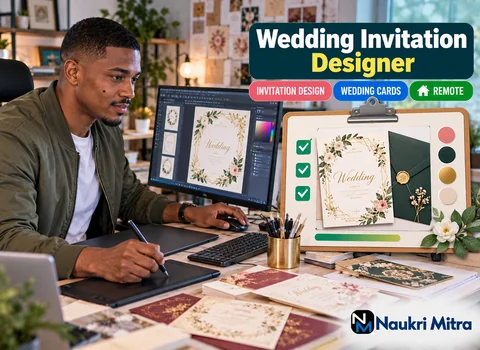
The sample card arrived in a padded envelope, and the maroon was wrong. On screen it had looked like ripe pomegranate. On 300 gsm ivory board it had turned the colour of strong tea. The file was built in RGB, the press converted it to CMYK, and the cream stock warmed every ink on top. That card holds most of what online wedding invitation designer jobs ask of you: wedding cards, save the dates and monograms that look right on paper, not only on a bright laptop. The work is part-time, done from home by designers anywhere, at $18 per hour (USD).
This is wedding invitation designer work from home: you take a couple's theme, build the card and matching pieces, prepare print-ready files, export digital versions for phones, and revise until final approval. The wedding invitation designer job description is part craft, part careful checking. A degree is not needed. A portfolio of wedding cards, monograms or event stationery is.
A monogram is the couple's initials worked into one mark, and it travels onto the main card, envelope flap, RSVP slip and often a wax seal. Motifs do the same job in pictures: a marigold border, a peacock, a temple arch.
An invented but typical brief: a couple with the initials A and R are marrying in a Rajasthan palace hotel and want "old palace, not too gold". You sketch three monograms setting A and R inside a jharokha window outline, on one PDF sheet. They pick the second. That mark then heads a 5 x 7 inch main card in deep rose and sage, a save the date sized for phone stories, a mehendi insert and an envelope liner. Every piece shares two typefaces and three colours, so the set reads as one family.
The role accepts skill in any of the three. CorelDRAW is still the working language of many Indian print shops, so when a press in Sivakasi asks for a CDR file, you can supply one. Illustrator suits vector monograms and fine borders. Canva is quick for e-invites and simple save the dates, but gives less control over print colour, so check its PDF settings.
Core wedding invitation designer skills sit beneath the software: type pairing, a hierarchy that puts names and date first, and patience to set the same details correctly on six pieces.
Here the maroon lesson pays off. Start print documents in CMYK, using the colour profile your printer works with; ask, because presses differ. Add bleed on all sides, commonly 3 mm, so colour runs past the trim and no white sliver appears after cutting. Keep text inside a safe margin of similar width.
For deep reds, ask the press for a printed proof or swatch on the chosen stock before the full run. Uncoated papers soak up ink and print duller, ivory stock warms every colour, and coated board stays brighter. Embed or outline fonts, set images at 300 ppi at final size, export the PDF the printer asked for, and name it plainly, such as AR_maincard_print_v4.pdf.
Gold foil, letterpress, blind embossing and spot UV each need separate artwork, usually a solid black vector shape on a named layer. Ask the printer how they want it. Hairlines may break up under foil and tiny text can vanish in an emboss, so keep fine detail for flat ink.
Many cards carry two scripts: English on one side, Hindi, Punjabi, Tamil or Gujarati on the other, often with a shloka near the top. Use fonts that render conjuncts and matras correctly. Never guess a name in a script you cannot read; ask a native reader or the family for a handwritten copy.
Use only licensed fonts and images. A font free for personal use does not cover a paid commission, and art lifted from search results is off limits. Keep licence notes with the files.
Send a low-resolution proof marked PROOF and ask the client to check every name, date, weekday, time and venue address in writing. Dates are often fixed by a muhurat, so one wrong digit can send guests to the wrong evening. Release the print file only after a written "approved for print", and keep that message.
Hours rise and fall with the season, so this is a sketch, not a promise. Monday brings two briefs with mood images and family text. Midweek goes on drafts. Late week covers revision rounds, set by the employer's terms, and print files for an approved suite. Deadlines are firm because printers need several working days. The wedding invitation designer salary per hour here is fixed at $18 (USD), paid for the hours you work.
You need a laptop strong enough for large CorelDRAW or Illustrator files, a monitor that is calibrated, or at the very least shows colour the same way every day, and broadband steady enough to send heavy print PDFs. A pen tablet helps with hand-drawn florals. Use cloud folders and version-named files. Family names, addresses and photos stay private, inside the client's approved channels.
Show complete suites, not single cards: invitation, save the date, insert, envelope and e-invite side by side, plus one photographed printed piece. With no paid clients yet, design for invented couples and label them honestly. That keeps wedding invitation designer jobs for freshers within reach.
A design test is often a monogram plus one card from a supplied brief. Meet the stated size and bleed, and submit a print PDF with a JPG preview. On your wedding invitation designer resume, put the portfolio link first, then software, scripts and printers you have supplied.
First clients often come from friends' weddings or local print shops busy in season. Editable templates on Etsy or custom gigs on Fiverr can bring early reviews, though Etsy and Fiverr each set their own fees and seller terms, so read them first. A short wedding invitation designer course or a broader graphic design course helps, but samples decide hiring.
A printed card designer thinks in millimetres and ink; an e-invite designer thinks in pixels and WhatsApp file sizes. This role covers both, since families often want print for elders and digital for everyone else.
Growth leads to senior studio work or a label of your own. As a home business, stationery needs modest equipment, and happy families return for anniversaries and naming ceremonies. It has quiet months, though. For anyone weighing part time wedding invitation designer jobs against studio employment, that rhythm is the main difference.
Legitimate employers set out pay, scope and revision terms in writing. Practitioners take payment only through the agreed platform or contract, never through side arrangements.
Applying is free. Share a portfolio with three to five suites, name your main tool and scripts, and add a line on how you prepare print files. That shows whether you suit freelance wedding invitation designer jobs like this one, at $18 per hour (USD), part-time and remote.