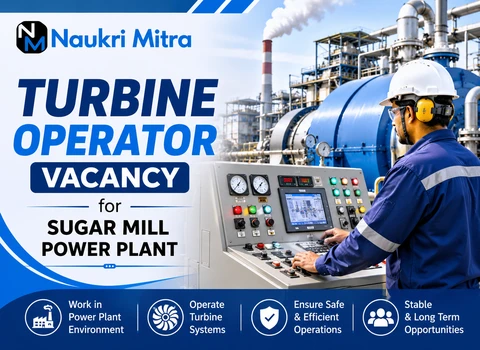
What Does a Turbine Operator Actually Do at a Sugar Mill?
Walk into the power house of a sugar mill during crushing season, and you'll hear it before you see it — a steady mechanical hum that never really stops. That hum comes from the turbine, and someone has to watch over it every single hour it's running. That's the job. This Turbine Operator vacancy is with a sugar mill power plant in Dhampur, Uttar Pradesh, India, and is offered as a Full-time position paying ₹39,800 per month.
Sugar mills don't buy all their electricity from the grid. Most run cogeneration units that burn bagasse (the crushed sugarcane fiber left over after juice extraction) to raise steam, which then spins a turbine connected to a generator. It's efficient; it uses waste that would otherwise pile up, and it keeps the mill self-sufficient during the season. But it only works if someone is reading the gauges correctly and reacting fast when something drifts off.
Why This Position Exists in the First Place
Crushing season doesn't pause for lunch breaks or festivals. Once cane starts coming in, the mill runs around the clock, and every process downstream — juice heating, boiling, crystallization — depends on a stable electricity supply from that turbine. If the turbine trips or the operator misses a warning sign, the ripple effect can shut down half the plant. That's the reason mills won't leave this post unmanned, and why they look for people who actually understand what they're monitoring rather than just watching numbers change.
A Shift on the Turbine Floor
No two shifts play out identically, but there's a rhythm to it. Operators start by checking the handover notes from whoever was on before them — pressure trends, any unusual vibration noted, oil top-ups done. Then it's a walk-around: bearings, steam lines, the governor, the condenser.
Through the shift, the work is mostly watchful:
- Tracking steam pressure, temperature, and turbine RPM at regular intervals
- Adjusting load as the mill's power demand rises or falls
- Feeling for unusual heat or vibration in bearings before instruments even flag it
- Logging readings by hand, even where digital systems exist
- Staying in constant contact with the boiler side so steam supply and turbine load stay matched
It sounds routine on paper. In practice, it demands the kind of attention that doesn't switch off for long.
The Instruments You'll Be Reading All Day
Pressure gauges, temperature indicators, vibration meters, tachometers for RPM — these become second nature fairly quickly. Many Indian sugar mills have now moved to SCADA-based control rooms, so operators often split their time between a central panel and physical rounds on the turbine deck. Knowing how to read a governor, a steam trap, or a lube oil system by hand still matters, though, because panels can lag or fail and the machine doesn't wait.
What Separates a Good Operator from an Average One
Anyone can memorize which needle should sit where. The harder part is knowing what to do the moment it doesn't.
- Reading gauges accurately without second-guessing under pressure
- Troubleshooting fast when a reading drifts, before it becomes a shutdown
- Understanding, at least at a working level, how the generator side ties into what the turbine is doing
- Sticking to standard procedure even when things get busy — this isn't a place for shortcuts
- Tolerating heat, noise, and long stretches on your feet without losing focus
Education and Training That Employers Look For
Most mills prefer candidates with an ITI in Electrical, Mechanical, or a Turbine/Boiler Attendant trade. A Diploma in Mechanical or Electrical Engineering also opens doors, particularly for someone eyeing a supervisory role down the line. That said, classroom knowledge only goes so far here — mills genuinely value hands-on exposure to turbines, steam systems, or any power plant floor gained through apprenticeship or on-the-job training, sometimes as much as the certificate itself.
What the Work Environment Feels Like
It's hot. It's loud. And during peak season, this Full-time role usually runs on rotational shifts, including night duty, because the mill simply doesn't stop crushing cane once it starts. Expect to be on your feet for long stretches, climbing between floor levels to check panels, working within a few feet of pipelines carrying high-pressure steam. It's not desk work, and it's not meant to be.
Safety Isn't Optional Here
High-pressure steam and fast-rotating machinery leave very little margin for carelessness. Lockout-tagout procedures before any maintenance, keeping clear of moving parts, and reporting any strange sound or small leak the moment it's noticed — these habits get drilled in early and stay for good reason.
Standard protective gear on the floor typically includes:
- Safety helmet and steel-toe safety shoes
- Heat-resistant gloves near steam lines and bearings
- Ear protection, since the noise level rarely drops
- Safety goggles around control panels and steam outlets
The Part of the Job Nobody Warns You About
Sugar milling is seasonal. Crushing season is intense — full shifts, constant monitoring, real pressure to keep the turbine steady. Then the off-season arrives, and things slow down considerably. New operators sometimes struggle with this swing, either burning out during the rush or losing sharpness during the lull. The ones who last tend to treat both phases as part of the same job rather than fighting its rhythm.
Where This Role Can Lead
Stay a few years, keep your logbook clean, and show you can handle pressure without panicking. The path forward is fairly clear within the same department — senior operator, shift-in-charge, eventually roles that lean more into maintenance planning or plant automation. None of this happens overnight. It comes from consistency, showing up reliably shift after shift, and slowly picking up the electrical and automation side of the plant alongside the mechanical.
Pay and What Might Come With It
The role pays ₹39,800 a month, Full-time, based at the sugar mill's power plant in Dhampur, Uttar Pradesh. Beyond the base pay, mills sometimes offer overtime during peak crushing weeks, PF and ESI coverage, uniforms, and in some cases canteen or transport facilities. None of these extras are guaranteed — they vary from one employer to another — but they're common enough in this line of work to mention.
Is This the Right Move for You?
If you're an ITI or Diploma holder who'd rather work with real machinery than a screen, this kind of role gives you exactly that. It rewards people who can stay alert through a long shift, who don't panic when a needle moves the wrong way, and who don't mind the heat and noise that come with standing next to a working turbine. Build a few solid years here, and the skills carry weight well beyond this one mill.