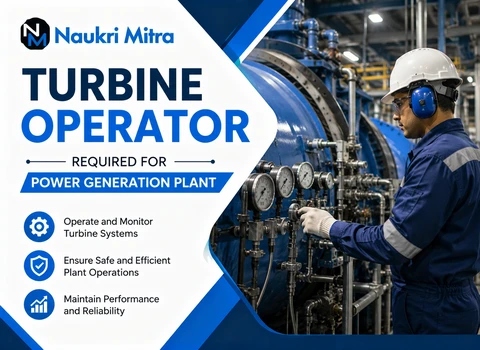
What Does a Turbine Operator Actually Do?
Every time a light switches on somewhere in Madhya Pradesh, there's a good chance a turbine somewhere is spinning to make that possible. The person who watches over that turbine, adjusts it, and catches problems before they turn into breakdowns is the Turbine Operator. This Full-time role, based in Singrauli, Madhya Pradesh, India, sits at the center of a power generation plant's daily operations. Steam or mechanical energy enters; the turbine converts it, and the operator ensures the conversion happens safely and without interruption.
It's not glamorous work in the traditional sense. But ask anyone who's worked a control room for a few years, and they'll tell you it's one of the more dependable career paths in India's industrial sector.
Why This Role Exists in the First Place
Turbines are sensitive machines. A pressure spike lasting even a few seconds too long can wear down bearings or trigger a safety shutdown. That's the whole reason plants keep trained operators on site rather than run things unattended. Someone needs to notice the small stuff — a gauge reading that's drifted, a sound that wasn't there yesterday — before it becomes expensive.
For freshers, this provides an entry point into the energy sector without requiring years of prior experience. For those who've already spent time around machinery, it's a chance to apply that background in a stable, long-term role.
Walking Through a Shift
Most shifts start the same way: a round of the turbine hall. Check the oil levels. Listen for anything unusual in the bearings. Look at the panel readings and compare them against what they should be. From there, the actual tasks vary depending on whether it's a routine day or something needs attention.
- Starting and stopping turbines according to set procedures
- Keeping an eye on pressure, temperature, and rotational speed
- Logging readings, either on paper or through a digital system
- Flagging anything abnormal — leaks, vibration, strange noise — to the supervisor
- Working alongside maintenance staff when servicing is scheduled
None of these tasks are complicated on their own. What makes the job demanding is doing them consistently, shift after shift, without letting attention slip.
Where This Kind of Work Happens
Singrauli has grown into one of the more recognized hubs for thermal power generation in this part of the country, so plants here are a common employer for this role. The same skill set also applies to captive power units operating alongside large factories and to cogeneration setups, where a facility generates its own electricity rather than relying entirely on the grid.
Equipment You'll Get Familiar With
Some of this is old-school and mechanical — pressure gauges, manual valves, basic hand tools for small adjustments. Increasingly, though, plants are shifting toward digital monitoring, with SCADA-based screens displaying live sensor data from across the turbine and generator. A good operator ends up comfortable with both — reading an analog gauge on the floor and interpreting a dashboard in the control room.
The Skills That Actually Matter Day to Day
Knowing how a turbine works helps, but it's not the whole picture. What separates someone who does well in this role from someone who struggles usually comes down to attention to detail and communication. Shift handovers, for instance, need to be precise — the incoming operator has to know exactly what happened in the last eight hours, not a rough summary.
Staying calm when an alarm goes off matters too. Panic doesn't fix a problem; a clear head reading the situation correctly does.
Getting Trained for the Role
Employers may prefer candidates with relevant machining or tool room training. Depending on the complexity of the work, an ITI in a machining-related trade, a Diploma in Mechanical or Tool and Die Engineering, or equivalent vocational training may be considered suitable. In practice, hands-on exposure counts for a lot here — familiarity with EDM machines, comfort reading engineering drawings, and experience using precision measuring instruments often carry as much weight as the certificate itself.
What the Job Asks of You Physically
There's a fair amount of standing and walking involved, plus climbing stairs or ladders to reach equipment mounted higher up. Turbine halls run warm and loud, so operators need decent stamina to get through a full shift without wearing down. Rotational shifts, including night duty, are common in this line of work since power generation doesn't stop when the sun goes down.
Staying Safe Around Machines That Don't Forgive Mistakes
Safety gear isn't optional here. Helmets, safety shoes, ear protection, and gloves are standard, and most plants enforce lockout-tagout procedures strictly before any maintenance begins. Steam lines and electrical panels don't give second chances, so the habit of double-checking before touching anything becomes second nature fairly quickly for anyone who stays in this field.
What Makes the Job Hard
Night shifts take a toll on sleep, and that's one of the more honest challenges people in this role will admit to. The constant background noise means ear protection stays on for most of the shift. And when an alarm sounds unexpectedly, there's no time to think it over slowly — a decision has to be made quickly, based on training and instinct built over time. Newer operators tend to find these pressures easier to manage once they've been through a few real incidents rather than just drills.
Where This Can Lead Over the Years
Operators who stick with it and build a solid track record often move up to senior operator positions or shift-in-charge roles, sometimes into specialized maintenance work within the same plant. What tends to get someone noticed for these positions isn't just time served — it's a consistent safety record and a reputation for handling problems without cutting corners.
Pay and What Else Might Come With It
This Full-time Turbine Operator position in Singrauli, Madhya Pradesh, India carries a monthly salary of ₹35,600. Beyond the base pay, some employers offer additional benefits such as overtime, Provident Fund (PF), ESI coverage, bonuses, uniforms, transport, or canteen access — though these depend entirely on the individual employer and shouldn't be assumed to be guaranteed.