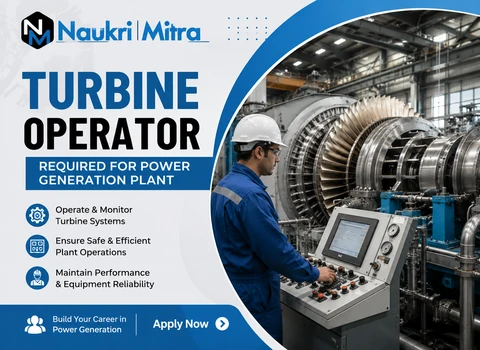
What It Actually Takes to Run a Turbine for a Living
Walk into any thermal power plant, and you'll find one machine that gets more attention than almost anything else on the floor: the turbine. It's loud, it's hot near the housing, and if it's not watched properly, things go wrong fast. That's the job of a Turbine Operator - staying close to that machine, reading its signals, and keeping it running the way it's supposed to.
This opening is for a Turbine Operator position in Korba, Chhattisgarh, India. It's a Full-time role paying ₹ 42,000 per month. Korba isn't a random location for this kind of work either - the district has a heavy concentration of power generation units and coal-linked industry, so operator jobs here aren't unusual, and the local workforce tends to already have some familiarity with plant environments.
Why This Job Exists in the First Place
Turbines don't run themselves, at least not safely. They spin at high speed under real pressure and heat, and the margin between "normal" and "problem" can be narrow. A plant can't afford to leave that unmonitored, which is exactly why operators are hired - someone has to be present, alert, and ready to act if a reading drifts outside its expected range.
What a Shift Actually Looks Like
Most shifts start with a handover from whoever was on before you. You'd hear about anything odd that happened - a pressure spike, a strange vibration, whatever. From there, the work is less about big dramatic moments and more about steady attention: checking gauges, logging numbers, adjusting valves when something needs correcting, and staying in touch with the boiler and control room teams, especially during startup or shutdown when things move quickly.
It's not physically exhausting work in the way lifting or digging is. But it does demand focus for hours at a stretch, because a turbine problem rarely announces itself loudly before it becomes serious.
The Equipment You'll Be Handling
Operators work directly with steam or gas turbines, governor systems, lubrication units, and condensers. For monitoring, expect to use pressure gauges, thermocouples, vibration sensors, and flow meters regularly. Basic tools come into play too - spanners, torque wrenches, and simple electrical testers - mostly for small adjustments or checks made during routine rounds rather than heavy repair work.
Qualifications Employers Tend to Look For
An ITI in Electrical or Mechanical trades is the usual entry point, and a Diploma in Mechanical or Electrical Engineering is also respected. But paper qualifications only go so far. What actually matters on the floor is whether someone can read an engineering drawing, make sense of control panel data quickly, and grasp basic thermodynamics well enough to understand why a reading matters, not just what it says. Being able to hand over a shift clearly to the next operator counts for more than people expect - plants run continuously, and a poor handover can cause confusion hours later.
Where People in This Role End Up Working
Thermal power stations are the most common setting, but captive power plants attached to larger industrial units and cogeneration facilities also hire for this kind of work. Given Korba's industrial base, opportunities here tend to remain closely tied to the region's coal and power generation activities.
Physical Side of the Job
Expect to be on your feet a fair amount - walking machine halls, climbing platforms to reach elevated equipment, moving between stations. Areas near the turbine housing run warm, and noise levels can be high, so reasonable fitness and tolerance for that kind of environment matter more than raw strength. Since this is continuous, round-the-clock work, shift rotation - including night duty - comes with the territory for this Full-time position.
Safety Isn't Optional Here
Power plants take safety seriously, and for good reason. You'll typically wear a safety helmet, ear protection, safety shoes, and gloves while on the floor. Lockout-tagout procedures before any maintenance work aren't just paperwork - they're what keeps someone from getting hurt near a machine that's supposed to be off but isn't fully isolated yet. Reporting anything unusual immediately, rather than waiting to see if it resolves on its own, is a habit worth building early.
What Trips Up New Operators
Reading several gauges at once while staying mentally sharp during a 2 AM shift isn't as easy as it sounds on paper. Sudden load changes, unexpected trips, or seasonal effects on cooling systems can all throw off someone who's still getting used to the plant's specific quirks. Most of this eases within the first few months, once the machine's normal behavior becomes familiar rather than something you're constantly second-guessing.
Where This Can Lead
Operators who perform consistently often move toward senior operator roles or shift-in-charge positions over time. Some branch into turbine control systems specifically, while others pick up boiler operations or general plant maintenance knowledge along the way - both routes tend to strengthen an operator's standing within the same power generation field rather than pulling them away from it.
Pay and What Else Might Come With It
The salary for this position is ₹42000 per month, for Full-time work based in Korba, Chhattisgarh, India. Depending on the employer, additional benefits sometimes include overtime pay, PF, ESI coverage, bonuses, uniforms, or transport and canteen facilities - these vary by company and shouldn't be assumed as guaranteed.
For someone building a technical career in India's power sector, this is a solid entry point. It rewards attentiveness and steady discipline more than flashy skill, and that combination tends to serve people well over a long stretch in this line of work.