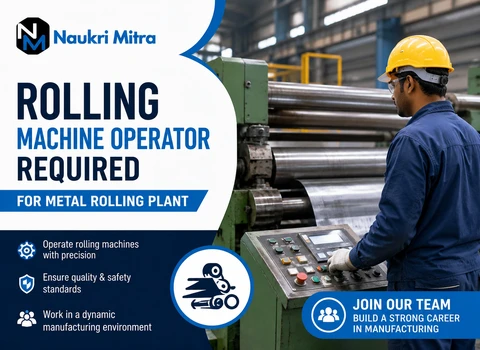
What It Actually Means to Work as a Rolling Machine Operator
Walk into any metal rolling plant in Gujarat, and you'll usually spot the operator before anyone else on the floor points them out — standing close to the mill, eyes on the gauge, hand near the control panel. That's the core of this job. A Rolling Machine Operator is required for a Metal Rolling Plant position based in Rajkot, where the role involves turning raw metal stock into flat sheets, rods, or sections that other industries can use. It's a Full-time role that suits people who like machines, don't mind heat and noise, and want work that produces something you can hold in your hand by the end of the shift.
Why This Position Keeps Opening Up in Rolling Plants
Rolling isn't forgiving. Get the roll gap wrong, run the speed too high, or miss a temperature reading, and an entire batch can come out warped or under-thickness. That's expensive. So plants keep hiring operators who understand not just how to run the mill, but why each setting matters. In and around Rajkot, Gujarat, where metal processing units are fairly common, this steady demand translates into regular openings for both fresh candidates and people with a few years of shop-floor experience.
How a Shift Usually Plays Out
Most days start with a walk-around — checking the mill, confirming there's enough raw material stacked and ready, and glancing at whatever's on the production board for that shift. Once the line starts moving, the job becomes a mix of feeding stock in, watching thickness readings, and making small adjustments as the metal passes through. Some shifts are routine. Others involve constant tweaking because the incoming material isn't perfectly uniform, which happens more often than people expect.
What Actually Falls Under This Job
- Running the rolling mill and the feeding setup that supplies it
- Adjusting roll gap and rolling speed for each specification
- Watching temperature closely when the process involves hot rolling
- Pulling samples and checking thickness with hand instruments
- Flagging anything that sounds or feels off to maintenance before it becomes a bigger fault
- Keeping a basic log of output, rejections, and downtime
Where This Kind of Work Happens
Steel re-rolling mills are the most obvious setting, but plenty of metal fabrication units and general industrial workshops run similar equipment. Larger setups have continuous rolling lines that barely stop; smaller workshops tend to work in batches, switching product specs a few times a day. Either way, expect heat if hot rolling is involved, a fair amount of noise, and machinery that never really stands still around you.
Tools You'll Have Your Hands On
Beyond the rolling mill itself — with its roll stands, shears, and coiler — the instruments matter just as much. Micrometers, vernier calipers, and thickness gauges are what tell you whether a batch is within tolerance or needs to be pulled aside. Operators who get comfortable with these tools early tend to waste far less material than those who rely purely on eyeballing the output.
Skills That Actually Matter Here
Knowing how a rolling sequence works, how to read a simple drawing or spec sheet, and how to make a roll adjustment without guessing — that's the technical backbone of the job. On the qualification side, employers often look for an ITI in a machining-related trade, or a Diploma in Mechanical or Tool and Die Engineering, though equivalent vocational training is usually considered too. In practice, having actually handled precision measuring instruments and read engineering drawings before tends to count for as much as the certificate itself.
The Less Technical Side of the Job
Standing for long stretches, staying alert even during a slow patch of the shift, and coordinating with a helper or supervisor without things getting mixed up — none of that shows up on a certificate, but it's what keeps a shift running smoothly. Patience matters more here than people assume, especially when a batch keeps drifting slightly out of spec and needs repeated small corrections.
The Physical Side of Working Near a Rolling Mill
Shift work is common, and that can include night or rotational shifts depending on how the plant is scheduled. Working close to hot metal and moving rolls for hours at a stretch isn't for everyone — it takes decent physical fitness, steady eyesight for reading gauges, and a tolerance for warm, noisy surroundings that don't really let up during a shift.
Staying Safe on the Floor
Safety gear here isn't optional. Safety shoes, gloves, a helmet, and eye protection are standard, and for good reason — rolling mills don't pause for a moment of carelessness. Following lockout steps before any maintenance work, keeping loose clothing away from moving rolls, and making sure walkways near the mill stay clear are habits that experienced operators pick up quickly, usually because someone warned them or because they saw a near miss firsthand.
Where New Operators Tend to Struggle
Judging the right roll pressure takes time — it's not something you get right on day one. Thickness can drift slightly over a long run, and catching that early rather than after twenty meters of output is a skill that comes with practice. Machine breakdowns and feeding hiccups also eat into targets more often than fresh candidates expect, and that's usually when patience gets tested the most.
Building a Longer Career in This Trade
Operators who become comfortable reading gauge charts, understand basic maintenance beyond their own machine, and become familiar with different metal grades tend to move ahead faster. Over a few years, it's common to see experienced operators step into shift-in-charge or machine-setter roles, staying within the same rolling and metal processing line of work rather than switching fields entirely.
Pay and What Else Might Come With It
This particular role, located in Rajkot, Gujarat, India, offers ₹29,000 per month on a Full-time basis. Depending on the company, operators may also see additional benefits layered on top — such as overtime pay, PF, ESI, bonus payouts, uniforms, transport support, or canteen facilities — though these vary by employer and shouldn't be assumed to be guaranteed.