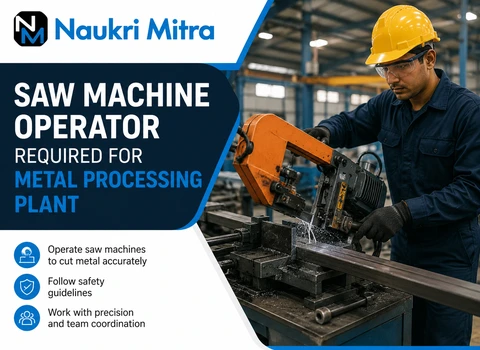
What It Takes to Cut Metal for a Living
Before a metal rod, pipe, or billet becomes part of a finished product, someone has to cut it to size first. That someone is a Saw Machine Operator. A metal processing plant in Rajkot, Gujarat, India is currently hiring for this position on a Full-time basis, with a monthly salary of ₹25000. If you're weighing this as a career option — whether you're fresh out of ITI or already have a few years on the shop floor — here's a realistic picture of what the job actually involves.
Why Plants Need a Dedicated Cutting Team
Raw metal doesn't arrive in usable pieces. Sheets, rods, pipes and billets come in standard lengths, and almost none of them match what a production order actually needs. Someone has to bring them down to size, accurately, before welding, machining, or fabrication can even begin. Get the cut wrong, and everything downstream slows down or gets scrapped. That's the entire reason this role exists on a production floor.
How the Shift Usually Plays Out
Most operators start by checking the machine — blade condition, coolant level, whether the guard is sitting right. Then the job cards or drawings come in, specifying lengths and quantities. Material gets clamped, measurements are set, and the cutting begins. It's not a one-and-done process either; pieces get pulled and checked against tolerance throughout the run, not just at the end. A batch that looks fine on paper can still go wrong if nobody's checking as it happens.
What the Job Actually Involves
- Setting up and running band saws, circular saws or power hacksaw machines
- Reading job cards and engineering drawings to get cutting specs right
- Picking the right blade and speed depending on the metal being cut
- Checking finished pieces with vernier calipers, micrometers or steel rules
- Handling routine upkeep — blade changes, lubrication, basic troubleshooting
- Logging output and flagging machine issues before they become bigger problems
Where This Work Happens
Metal processing plants are the obvious setting, but the same skills apply in steel fabrication units, tool rooms and general engineering workshops. Rajkot's industrial base leans heavily on metal and engineering manufacturing, so demand for cutting operators tends to stay fairly consistent in and around Gujarat's manufacturing belt.
The Machines and Tools You'll Actually Touch
Horizontal and vertical band saws are the most common. Some plants run circular cold saws or older power hacksaw units instead. Measuring is done with vernier calipers, micrometers, and steel tapes — nothing exotic, but accuracy matters every single time. In tool room settings, operators are sometimes exposed to EDM (Electrical Discharge Machining) as well, particularly when tolerances are tighter than standard cutting work requires.
Qualifications That Actually Help
An ITI certificate in a machining trade opens the door for most entry-level positions. A Diploma in Mechanical or Tool and Die Engineering helps for roles involving tighter precision work. But paper qualifications only go so far — plants notice fast whether someone can actually read a drawing correctly or use a micrometer without guessing. Hands-on familiarity with EDM machines and precision instruments often counts for more than the certificate itself.
The Physical Side Nobody Mentions in Job Ads
You're on your feet for most of the shift. Lifting metal stock, standing near a running machine, dealing with repetitive cutting cycles — it adds up by the end of the day. There's noise, there's metal dust, and occasionally coolant splashes on you. Shift work may apply depending on the plant's production schedule. This isn't desk work, and anyone considering it should know that going in.
Staying in One Piece: Safety on the Floor
Safety goggles, gloves, safety shoes, and ear protection where noise levels are high — these aren't optional extras. Most accidents around cutting machines happen because someone skipped a pre-shift check, wore loose clothing near a blade, or bypassed a guard to save two minutes. None of that time saved is worth an injury. Following the standard procedure every single time, not just when a supervisor is watching, is what actually keeps operators safe in the long term.
Problems You'll Run Into (and How Operators Deal With Them)
Blades sometimes wear out faster than expected. Material batches aren't always as consistent as they should be. Deadlines pile up. Operators who last in this field develop the habit of checking blade condition before it becomes a visible problem, double-checking the first few cuts of any new batch rather than assuming the setup is correct, and reporting odd machine noises immediately rather than waiting for a full breakdown.
Moving Up From Here
Operators who stick with it and build a track record often move into senior operator roles, shift-in-charge positions, or setup specialist roles — handling more complex jobs and training new staff. Getting comfortable across multiple machine types and precision instruments, rather than just one saw, is usually what pushes someone toward these next steps.
Pay and What Might Come With It
This position, based in Rajkot, Gujarat, India, is Full-time and pays ₹25000 per month. Some employers add extras like overtime pay, PF, ESI, bonuses, uniforms, transport, or canteen access on top of that — though these vary by company and shouldn't be assumed to be guaranteed.