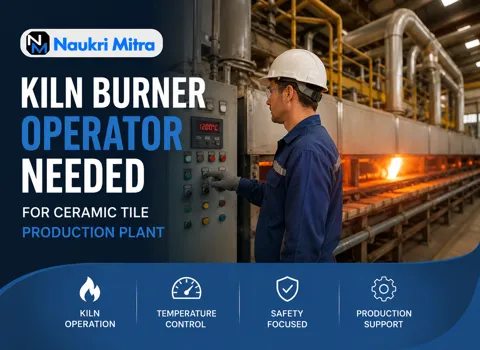
What Happens Inside the Kiln Section of a Tile Plant
Walk into any ceramic tile unit, and you'll notice the kiln section long before you reach it — the heat gives it away. This is where a Kiln Burner Operator works, and it's a role that sits right at the heart of tile making. Pressed tiles go in soft and untested; they come out hard, glazed, and ready for sorting. A Full-time opening for this position is currently open at a tile production plant in Morbi, Gujarat, one of India's biggest centers for ceramic manufacturing. If you're reading about this job for the first time, think of it less as "operating a machine" and more as managing a slow, continuous chemical transformation that has to stay within a narrow temperature window for hours at a stretch.
Why This Job Exists in the First Place
Tile plants can't afford guesswork at the firing stage. Fire a batch too cold, and the tiles stay porous, chip easily, or fail quality checks. Push the heat too high, and you get warping, color changes, or cracked stock — all of which means wasted raw material and lost production time. That's the entire reason this role exists: someone has to sit with the firing curve, watch it, and correct it before small drifts turn into rejected batches. Companies aren't just filling a headcount here; they're protecting output quality, and that's why even freshers taking up this job are given real responsibility fairly early.
A Rough Sketch of the Daily Routine
No two shifts are identical, but there's a general rhythm to it. Operators start by checking the handover notes and burner readings left by the previous shift — what temperature each zone was holding, whether anything needed adjustment, any flags raised. Then it's a matter of walking the length of the kiln, checking flame behavior, watching the panel, and making small corrections to gas flow or air pressure as tiles move through the different heating zones.
Some of the recurring tasks through the day include:
- Starting up and shutting down burners according to the production plan
- Holding each zone of the kiln at its correct temperature
- Logging readings and flagging anything unusual to the shift supervisor
- Timing the kiln speed with loading and unloading teams so nothing backs up
- Doing small maintenance jobs on burner nozzles and connected lines
Where People in This Trade Actually Work
This isn't office work, obviously. The job is based inside ceramic tile factories — and in a place like Morbi, there's no shortage of them. Sanitaryware units sometimes need similar skills too, since the firing principle is much the same. What all these workplaces have in common is a tunnel kiln or roller kiln running near-continuously, and an operator stationed close enough to react fast if something looks off.
The Equipment You'll Be Handling
A working knowledge of burner assemblies is non-negotiable, as is knowledge of thermocouples and pyrometers for temperature sensing. Most modern plants have shifted to PLC-controlled panels, so being comfortable reading a digital display — not just analog dials — has become part of the job now. Pressure gauges and gas flow meters come up daily, and a handheld temperature gun is often used for spot-checking a zone that seems inconsistent. Understanding how tiles pass through preheating, then firing, then cooling explains a lot about why timing matters as much as raw temperature here.
What Employers Look For on the Education Side
An ITI in mechanical, electrical, or instrumentation trades is a common entry point for freshers. Diploma holders in mechanical or ceramic technology tend to have an easier time being considered too. That said, plants in Morbi are known to train sincere workers on the floor itself — so a certificate helps, but it isn't the only door in.
Skills That Actually Separate a Good Operator from an Average One
- Being able to read a temperature graph and know instantly if something's drifting
- Staying calm and reacting fast when heat spikes or drops suddenly
- Basic troubleshooting on burner nozzles and gas lines without waiting for someone else
- Sticking to standard procedures even when the shift is quiet, and nothing seems wrong
- Talking clearly with the loading and quality teams so handoffs don't go wrong
The Physical Side of the Job
Expect to be on your feet for most of the shift, walking back and forth along the kiln, often in a warm, fairly loud environment. Night shifts come with the territory — kilns run around the clock in most plants because stopping and restarting a firing cycle wastes both time and fuel. If standing for long stretches near heat sources sounds manageable to you, the physical demands of this job won't come as a surprise.
Staying Safe Around Gas and High Heat
Safety here isn't optional or occasional — it's built into every shift. Before ignition, operators check for gas leaks. Direct contact with hot surfaces is avoided through training and habit, not just rules on a poster. Lockout procedures are followed whenever maintenance work is happening nearby. On the PPE side, expect heat-resistant gloves, safety goggles, and proper closed footwear as standard. Anything that smells off or looks like abnormal smoke gets reported immediately — that instinct usually takes a few months to build, but it becomes second nature.
What Trips Up New Operators
Reading flame color and panel data together, and actually trusting your read on it, takes time. Most newcomers struggle here at first and lean on senior technicians for a while before they become confident. Fuel pressure changes, power fluctuations, even seasonal humidity can throw off firing consistency in ways that aren't always obvious at first. The operators who do well tend to stay observant even during uneventful shifts, rather than paying attention only when something's clearly wrong.
Where This Role Can Lead
Most people don't start out running the burners solo — they begin as helpers, watching and assisting until they're trusted with full responsibility. From there, the natural progression is toward senior kiln operator roles, shift-in-charge positions, or eventually firing supervisor. Operators who develop a real feel for the firing curve over the years often end up training newer staff and handling the trickier firing schedules for different tile sizes and glaze types.
Pay and What Else Might Come With It
The role pays ₹35,800 a month, on a Full-time basis, at the tile production plant in Morbi, Gujarat. Beyond the fixed salary, some employers in this sector also offer overtime pay, PF, ESI coverage, uniforms, or canteen access — though these vary by company and aren't guaranteed across the board. It's worth confirming exactly what's included during the hiring conversation itself.