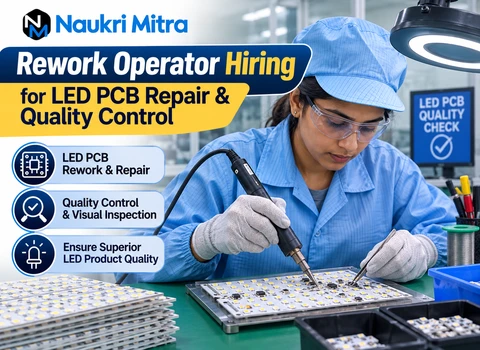
What Does a Rework Operator Actually Do?
Picture a PCB assembly line churning out LED boards all day. Not every board comes out right. Some have a solder joint that didn't form properly, a component sitting slightly off its pad, or an LED that failed the light test. Someone has to catch these boards and fix them before they get thrown away or shipped as defective. That's the job. This is a full-time Rework Operator position for LED PCB Repair & Quality Control, based in Mysuru, Karnataka, India, and it sits right at the point where a factory decides whether a board is worth saving.
Why This Role Exists on a Production Line
Scrapping a defective board costs money — the components, the labor, the material all go to waste. A skilled rework technician can often bring that same board back to spec in a few minutes. Multiply that across hundreds of boards a shift and the savings add up fast. That's really the whole reason this role exists: it's cheaper to repair than to discard, and LED manufacturing, in particular, can't afford a high rejection rate.
How a Shift Usually Plays Out
Boards arrive from the testing station tagged as faulty. The operator picks one up, looks at it under a magnifier or microscope, and figures out what went wrong. Sometimes it's obvious — a cold solder joint, a bent lead. Other times it takes a bit of digging with a multimeter to trace where the fault actually is. Once identified, the fix gets made, the board goes back for retesting, and the cycle repeats. Between repairs, there's usually some paperwork or digital logging involved, noting what kind of defect showed up, because that data feeds back to the main assembly team so they can fix the root cause.
What the Job Involves Day to Day
- Inspecting boards under magnification for soldering and placement defects
- Reworking components with a soldering iron or hot air rework station
- Swapping out damaged LEDs, resistors, capacitors, or connectors
- Retesting repaired boards with a multimeter or continuity tester
- Logging defect types for the quality team
- Handling boards with proper ESD precautions
Where You'd Be Working
These roles are found inside electronics assembly units, LED manufacturing plants, and PCB workshops. The floor is usually indoors, clean, and set up with individual workstations along a line. Most facilities use ESD-safe flooring and mats, because a single static discharge can silently kill a sensitive component without anyone noticing until the board fails testing.
The Tools You'll Get to Know
A soldering iron and desoldering pump handle most manual work. For surface-mount components, though, a hot-air rework station does the job better — it blows heated air directly onto the component until the solder softens, without disturbing the joints around it. That's why it's the go-to tool for tight, delicate LED boards where a regular iron could damage neighboring parts. A digital multimeter checks voltage, resistance, and continuity after every repair. Magnifying lamps or stereo microscopes are standard, too, since many of these defects are simply too small to catch with the naked eye.
Skills That Actually Matter Here
You don't need to be an electronics engineer, but you do need a working grasp of basic circuit theory and enough familiarity with SMD and through-hole components to know how each behaves under heat. Reading a simple circuit layout helps too. Beyond that, it comes down to hands — steady hands, good eyesight (or corrected vision), and the patience to do the same careful inspection fifty times in a row without cutting corners on the fiftieth.
Training and Educational Background
Employers may prefer candidates with relevant machining or tool room training. Depending on how technical the work gets, an ITI in an electronics or machining-related trade, a Diploma in Electronics or Mechanical Engineering, or equivalent vocational training can be suitable. In practice, hands-on experience with soldering equipment, reading engineering drawings, and using precision measuring instruments often counts for just as much as a certificate.
Physical Side of the Job
Expect to be on your feet or seated at a bench for long stretches, working with your hands close to the component under a light or lens. This is a full-time role and may involve shift work, depending on the production schedule. Eye fatigue is real in this line of work, so most operators learn to take short breaks to rest their eyes rather than push through.
Staying Safe on the Floor
Soldering produces fumes, so workstations typically have fume extractors right next to them. Safety glasses are standard, along with ESD wrist straps and heat-resistant gloves where required. Keeping a workstation uncluttered and following lockout steps around powered equipment may sound basic, but it's often where accidents are prevented before they happen.
What Makes the Job Hard — and How People Manage It
The repetitive strain of close, detailed work over a full shift catches up with people. Quality can slip in the last hour if concentration fades. Operators who last in this line tend to build small habits — double-checking a repair before sending the board off, keeping their tools calibrated, and staying current on newer LED component types as they show up on the line. None of it is complicated, but doing it consistently is what separates a reliable operator from one who just gets by.
Where the Role Can Lead
Put in a few years of consistent, accurate work, and there's usually a path forward — senior technician roles, quality inspection, line supervision, or specialized rework on more advanced electronics. It's rarely a fast track, but reliability on the bench is what employers notice first when they're looking to promote from within.
Pay and What Else Might Come With It
This position, based in Mysuru, Karnataka, India, pays ₹31,800 a month for full-time work. Some employers add extras on top — overtime, PF, ESI, bonuses, uniforms, transport, or canteen access — but these depend entirely on the company and shouldn't be assumed as guaranteed.