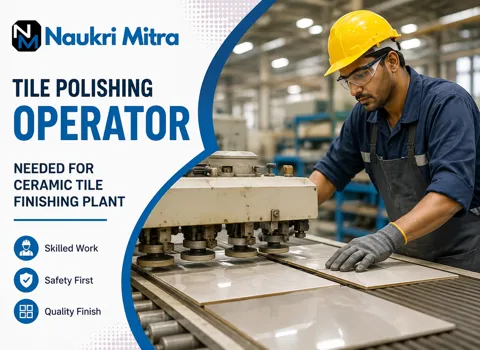
Understanding the Role of a Tile Polishing Operator in Ceramic Manufacturing
Ceramic tiles go through several stages before they reach a showroom floor, and one of the most important stages is polishing. A Tile Polishing Operator works at this finishing stage, using specialized machines to give tiles their smooth, glossy, or matte surface finish. This is a full-time position based in Virudhachalam, Tamil Nadu, India, and it plays a direct role in the final quality that customers see and feel when they buy tiles.
Ceramic tile finishing plants recruit operators for this role because polishing cannot be done casually. It requires attention to surface consistency, machine handling, and quality control. A single batch of poorly polished tiles can lead to rejections, so plants rely on trained operators who understand both the machine and the material.
What Happens on the Production Floor
A typical day for a machine operator in this line begins with checking the polishing line before production starts. This includes inspecting abrasive belts or polishing heads, checking water flow used for cooling and dust control, and confirming that tiles are loading correctly onto the conveyor.
Once production begins, the operator monitors:
- Tile feeding speed and alignment on the conveyor
- Polishing head pressure and abrasive wear
- Surface finish quality through visual and touch inspection
- Water and slurry management to prevent surface damage
Any inconsistency in gloss level, scratches, or uneven edges must be caught early, since these issues are far harder to correct later in packing.
Machines and Tools Commonly Used
Tile polishing lines usually include automatic or semi-automatic polishing machines with rotating abrasive heads of different grit levels. Along with the main machine, a technician regularly works with:
- Diamond or silicon carbide abrasive segments
- Surface gloss meters for quality checking
- Calipers or thickness gauges for dimension checks
- Basic hand tools for machine adjustment
Understanding how abrasive grit progression works, from coarse to fine, helps the operator control the final shine level of each tile batch.
Skills That Matter on the Shop Floor
Technical understanding matters, but practical shop-floor skill matters just as much. Employers usually look for operators who can read basic machine indicators, adjust settings without supervision after training, and identify defects quickly.
Employers may prefer candidates with relevant machining or tool room training. Depending on the complexity of the work, an ITI in a machining-related trade, a Diploma in Mechanical or Tool and Die Engineering, or equivalent vocational training may be considered suitable. Practical experience with EDM machines, engineering drawings, and precision measuring instruments is often valued as much as formal education, since it builds a strong foundation for handling precision finishing equipment.
Physical Demands and Working Conditions
This is standing, physically active work. Operators spend most of their shift near the polishing line, handling tiles, checking output, and making quick adjustments. The environment can involve dust, water spray, and machine noise, so staying alert to surroundings is part of the job. Shift work is common in ceramic tile plants, since production lines often run in rotations to meet output targets.
Safety Practices and Protective Equipment
Safety is taken seriously in tile finishing units due to moving machinery, water usage, and abrasive dust. Operators are generally expected to wear safety shoes, gloves, ear protection, and dust masks. Machines must never be adjusted while running, and loose clothing near rotating parts is strictly avoided.
Common Challenges Faced
New operators often find it difficult to judge finish quality quickly at first. Machine downtime due to abrasive wear, managing consistent water flow, and handling brittle tile edges are common day-to-day challenges that improve with experience.
Building a Long-Term Career
With experience, operators can move toward senior operator roles, shift-in-charge positions, or quality inspection responsibilities within the same plant. Learning multiple stages of tile finishing increases value as a skilled production worker over time.
Salary and Possible Benefits
This full-time position in Virudhachalam, Tamil Nadu, India offers a monthly salary of ₹31,400. Depending on the employer, additional benefits such as overtime pay, PF, ESI, bonus, uniforms, transport, or canteen facilities may also be available.