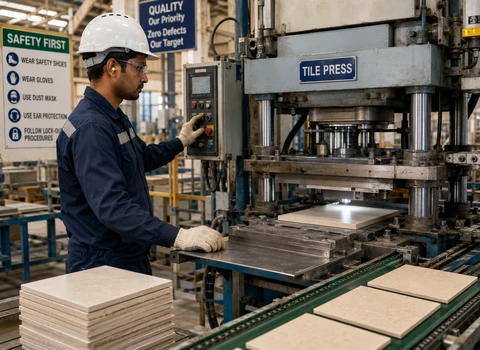
The Job Behind the Tile: What a Press Operator Does All Day
Every ceramic tile starts as loose powder. Somebody has to compress that powder into a solid, evenly shaped blank before it ever sees a kiln, and that somebody is the Tile Press Operator. It's a full-time factory position, and honestly it works for a wide range of people. Freshers pick it up. So do ITI graduates, diploma holders, and workers who've spent years around production lines already.
This particular opening sits at a ceramic tile plant in Sikandrabad, Uttar Pradesh, paying ₹33,700 a month. Units in that belt hire for this role often enough that it's become a fairly well-known entry point into tile manufacturing.
Why Plants Bother Hiring Someone Specifically for This
You'd think pressing tiles is straightforward. Powder in, tile out. But the margin for error is thin. Push the pressure too hard or too soft and thickness starts drifting across the batch. A mould that's even slightly off alignment chips the edges. Too much moisture in the mix, and the tile can crack before it's dry. None of this is dramatic on its own, but multiply it across a full shift, and you've got a pile of rejects and an unhappy plant manager. That's the reason this job isn't handed to whoever's free.
A Shift, More or Less
Nobody's day looks exactly the same, but there's a shape to it. Material gets loaded into the hopper. Pressure and cycle time are set for the tile size running that day. Before the first batch goes through, the mould and die get checked for alignment. Once tiles start coming out, they get pulled and checked, sometimes just a glance, sometimes with a caliper in hand. Output and rejects get logged. And if something sounds wrong- a knock, a pressure drop, anything- that gets reported before it becomes a bigger problem.
Getting to Know the Machine
The press itself, hydraulic or mechanical depending on the plant, is obviously central. Around it sit mould and die sets swapped out for different tile sizes, pressure gauges, a control panel, and measuring tools like vernier calipers for spot-checking dimensions. Conveyors usually carry finished tiles off toward drying or firing. It's not enough to just push buttons here. Operators who actually understand how these pieces work together are the ones who catch problems early, rather than waiting for someone else to notice.
What Gets a Candidate Noticed
An ITI qualification in a machining trade helps. So does a Diploma in Mechanical or Tool and Die Engineering. Freshers with decent technical sense still get considered for entry-level slots, though they'll usually need more training on the floor before they're fully independent. What tends to matter in practice is being able to read an engineering drawing without too much trouble, having some grasp of how hydraulics behave, and being comfortable with precision instruments. Spotting a deviation from spec quickly, rather than after the fact, is a real skill and plants notice it.
Physically, What This Involves
Standing for long stretches. Lifting molds. Working near machinery that runs under serious pressure. This isn't a role for someone hoping for something light. Shifts rotate at most plants, including night duty, so being flexible about timing matters just as much as the technical side.
Inside the Plant
Expect dust; ceramic powder has a way of settling on everything. Expect noise from the press cycles. And expect heat, especially near the drying or kiln areas. That combination means staying alert through a shift isn't optional, especially given the pressure these machines operate under.
Keeping Safe on the Line
Safety shoes, gloves, a dust mask, ear protection- these are standard on most press floors. Lock-out procedures during maintenance aren't a suggestion. Neither is keeping hands away from moving components. Operators who've been around a while treat these as habit rather than rules someone's watching them follow.
Where Things Get Hard, and What Helps
Repetition catches many newcomers off guard. Staying sharp two hours before shift end is genuinely tough. Mould changeovers, if rushed, eat into productive time and cause avoidable errors. What seems to actually help people: learning the changeover sequence properly rather than shortcutting it early on, keeping logs honest even when a rough estimate would be easier, and staying on good terms with maintenance so fixes happen quickly rather than after a long wait.
Moving Up From Here
Operators who stay consistent and build up technical judgment can move into senior operator roles, shift-in-charge positions, or quality-control work, usually within the same plant. The path here isn't about switching fields. It's about depth; the longer someone's reliable at this, the more responsibility tends to follow.
The Pay, and What Might Come With It
The role pays ₹33,700 monthly, full-time, based in Sikandrabad, Uttar Pradesh. Some plants add overtime pay, PF, ESI, a bonus around festivals, uniforms, transport, or canteen access on top of that. None of it is guaranteed, and it varies enough between employers that it's better treated as a possibility than a promise.