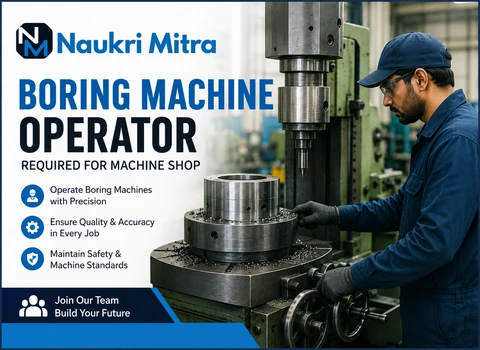
Understanding the Role of a Boring Machine Operator in a Machine Shop
A Boring Machine Operator is a skilled worker who runs boring machines to enlarge, smoothen, or finish holes in metal parts with high precision. This work is common in machine shops that produce components for automobiles, pumps, valves, agricultural equipment, and general engineering products. In Rajkot, Gujarat, a well-known hub for engineering and casting industries, machine shops regularly hire operators for this exact purpose, offering full-time positions with steady daily work.
Why Machine Shops Need This Skill
Boring is a precision process. When a casting or forged part comes with a rough hole, it needs to be enlarged to an exact diameter with a smooth internal finish. Regular drilling cannot achieve this level of accuracy. That is why machine shops depend on trained operators who understand tolerances, machine settings, and measurement. Without this skill, parts would not fit correctly during assembly, leading to rejections and delays.
What Happens on a Typical Working Day
A day usually starts with checking the machine, reviewing the job card or engineering drawing, and setting up the workpiece on the machine bed. The operator then selects the correct boring bar, sets spindle speed and feed rate, and begins the cutting process step by step. Throughout the shift, the operator keeps checking dimensions, adjusts the tool position as needed, and ensures the surface finish meets the drawing requirements.
Core Responsibilities on the Shop Floor
- Reading and interpreting engineering drawings correctly
- Setting up jigs, fixtures, and workpieces securely
- Operating conventional or CNC boring machines
- Checking bore diameter using bore gauges, micrometers, and dial indicators
- Identifying tool wear and changing inserts or boring bars when required
- Maintaining daily production and rejection records
Machines, Tools, and Instruments Used Regularly
Operators typically work with horizontal or vertical boring machines and, in some shops, with CNC boring or machining centers. Supporting tools include boring bars, single-point cutting tools, carbide inserts, and coolant systems. For quality checking, bore gauges, telescopic gauges, vernier calipers, micrometers, and dial bore indicators are used regularly. Familiarity with EDM machines and precision measuring instruments is often considered an added advantage, since some components may require electrical discharge machining before or after boring.
Skills That Employers Look For
Technical understanding of machining processes, cutting speeds, and feed rates is important. Equally important is the practical ability to read a drawing quickly and set up a job without wasting time. Attention to detail matters greatly in this profession, since even a small error in diameter can render a part unusable. Basic problem-solving skills also help, especially when a tool starts vibrating or a surface finish is not coming out right.
Educational Background That Helps
Employers may prefer candidates with relevant machining or tool room training. Depending on the complexity of the work, an ITI in a machining-related trade, a Diploma in Mechanical or Tool and Die Engineering, or equivalent vocational training may be considered suitable. In many cases, practical experience with EDM machines, engineering drawings, and precision measuring instruments is valued as much as formal education, especially for candidates who have already worked on the shop floor.
Working Environment and Physical Demands
This is a full-time, hands-on job that requires standing for long periods and handling heavy metal components. The workplace is generally a machine shop environment with continuous machine noise, cutting oil, and metal chips around the work area. Operators need reasonable physical stamina, good eyesight for reading small measurements, and steady hands for precise adjustments. Depending on production demand, shift work may be required in some machine shops.
Safety Practices and PPE
Safety is a daily priority in machining work. Common PPE includes safety shoes, safety goggles, gloves suited for machine handling, and sometimes ear protection due to machine noise. Operators are usually trained to keep hands away from moving spindles, avoid loose clothing near rotating parts, and follow lockout procedures during maintenance. Keeping the work area free of oil spills and metal chips also reduces the chance of slips and cuts.
Common Challenges on the Job
New operators often find it challenging to judge the right cutting speed for different metals or to detect tool wear before it affects the finish. Repetitive precision work can also be mentally tiring, since constant measurement checking is required. Experienced operators usually develop a practical sense for machine sound and vibration, which helps them catch problems early.
Building a Long-Term Career in This Field
Many operators start on manual or semi-automatic boring machines and gradually move to CNC boring or machining centers as they gain experience. With time, skilled operators can take up roles such as senior machine operator, machine setter, or quality checker within the same production line. Continuous learning about new machines and measurement methods helps operators remain valuable in growing engineering industries such as those in Rajkot.
Salary and Benefits Overview
For this Full-time position based in Rajkot, Gujarat, India, the monthly salary is ₹27,500. Along with the fixed salary, machine shops may offer benefits such as overtime pay, PF, ESI, a yearly bonus, uniforms, and, in some cases, transport or canteen facilities. These benefits are not guaranteed and may vary depending on the employer and shop policies.
Who Can Consider This Career
This role suits freshers with ITI training in machining trades, diploma holders in mechanical engineering, and experienced technicians looking for stable full-time work. It is also a good fit for anyone interested in precision manufacturing who enjoys practical, hands-on work rather than a desk job. For those willing to learn machine handling and measurement skills, a Boring Machine Operator role can be a solid entry point into India's growing machine shop and engineering sector.