What It Actually Means to Calibrate Industrial Instruments
Ask anyone who has worked in a process plant, and they'll tell you the same thing: a gauge that's off by even half a percent can cause real trouble down the line. A pressure reading that drifts, a thermocouple that stops tracking true temperature, a flow meter quietly losing accuracy over months of use - these small errors add up to bad batches, wasted material, or worse. Someone has to catch this before it becomes a problem. That job belongs to the Instrument Calibration Technician.
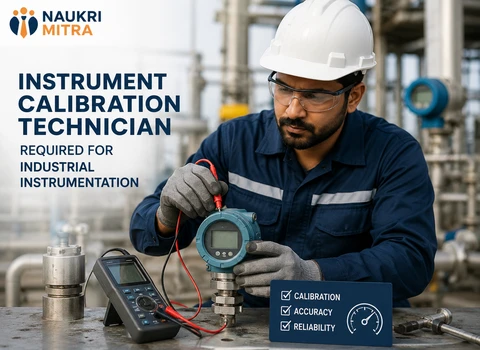
The opening here is for an Instrument Calibration Technician (Industrial Instrumentation), a Full-time role based in Vadodara, Gujarat, India. It's the kind of job that suits a fresh ITI pass-out just as well as someone who's spent years around plant maintenance. If you're trying to figure out what this career actually involves before applying anywhere, here's a realistic picture.
Why This Work Never Really Runs Out
Instruments don't stay accurate on their own. Vibration wears them down. Heat cycles push sensors out of range. Even normal daily use slowly shifts a reading away from the true value, and most operators won't notice until something goes wrong on the production line. Quality audits and internal checks both demand proof that every instrument was tested and corrected on schedule - not just once, but repeatedly. That's really the reason this role keeps getting hired for, batch after batch, plant after plant.
A Day on the Job Rarely Stays in One Place
Most days start with a maintenance schedule listing which instruments are due. From there it's a mix of workshop bench work and walking the plant floor. A technician might spend the first hour pulling a pressure gauge off a boiler line, checking it against a known reference standard, adjusting it, and logging exactly how far it had drifted before the fix. By afternoon, it could be a temperature transmitter on a reactor or a flow meter that operations flagged as inconsistent.
Some of the recurring tasks include:
- Pulling gauges, thermocouples, RTDs, transmitters and flow meters for checking
- Comparing each instrument's output against a certified reference
- Making small adjustments until the reading falls within tolerance
- Logging every reading, deviation and correction, either on paper or in calibration software
- Tagging equipment with its next due date so nothing gets missed
- Flagging instruments that can't be corrected so they get replaced instead
Because instruments are scattered across so many different sections of a plant, no two days end up looking quite the same.
Where This Kind of Work Shows Up
Wherever process control matters, calibration work follows. Chemical and petrochemical units, pharmaceutical plants, power stations, food processing lines, oil and gas installations, general engineering factories - all of them run on instruments that need periodic checking. Gujarat in particular has a heavy concentration of chemical and process industries, so demand for people who can do this work doesn't really dry up. On any given day the work location could be a control room, an instrumentation workshop bench, an outdoor area near storage tanks and pipelines, or occasionally a confined or elevated spot where an instrument happens to be mounted.
The Equipment That Fills the Toolbox
You can't calibrate anything without a trusted reference. So a technician's kit usually has one device to test and another, already known to be accurate, to compare against. That typically means pressure calibrators and dead weight testers, temperature baths or dry block calibrators along with reference thermometers, multimeters and process calibrators for electrical signals, and HART communicators when dealing with smart transmitters. Basic hand tools come into play for opening panels and fittings, and paperwork - certificates, tags, logbooks or calibration software - is always part of the job too.
Knowing how to operate a calibrator only gets you halfway. A technician also has to understand how the instrument itself behaves. Take a thermocouple - it puts out a tiny voltage that changes with temperature, and unless you know how to read that signal correctly, you won't catch when something's wrong.
What Employers Actually Check For
Formal training helps, but it isn't the whole story. Employers may prefer candidates with relevant machining or tool room training. Depending on the demands of the work, an ITI in a machining-related trade, a Diploma in Mechanical or Tool and Die Engineering, or similar vocational training is usually considered suitable. That said, hands-on experience with EDM machines, engineering drawings, and precision measuring instruments often counts for just as much as the certificate itself.
Past the paper qualifications, a few practical habits tend to separate a good technician from an average one - reading engineering drawings and datasheets without hesitation, a working grasp of electrical signals and loop testing, the patience to sit and record small variations without cutting corners, a steady hand around delicate equipment, and documentation that holds up when an auditor comes asking questions.
On Your Feet More Than You'd Expect
There's a fair amount of standing and walking between equipment locations, plus the occasional climb to reach an instrument mounted in an awkward spot. Plant areas can get warm or noisy depending on what's running nearby. Since many process industries run continuously, shift work is common - a technician might rotate through morning, evening, or night shifts depending on what the plant needs that week. One day you're in a quiet, air-conditioned calibration lab; the next you're on a production floor with machinery running a few feet away.
Nothing About This Is Optional: Safety
Calibration work regularly puts technicians near live equipment, pressurized lines, and electrical panels, so safety isn't treated as an afterthought. Safety shoes, helmets, gloves, and safety glasses are the usual PPE. Lockout-tagout procedures get followed before touching anything live, permit-to-work systems apply for confined spaces, and pressurized calibration equipment gets handled carefully every single time - not just when someone's watching. It protects the technician and everyone else on that plant floor, too.
Where Newcomers Tend to Struggle
Reading small deviations correctly takes practice, and it's usually the first thing new technicians find harder than expected. Unfamiliar instrument brands and models add another layer - what works on one manufacturer's gauge doesn't always apply to another's. Add in the reality of coordinating calibration around production schedules, arranging shutdowns without disrupting output, and keeping paperwork accurate under time pressure, and it becomes clear why experience matters so much in this line of work. Most of this smooths out with a year or two of steady exposure.
Growing Within Instrumentation Over Time
Experience opens doors here, but slowly. A technician who's put in the years can move toward handling more complex instruments, owning an entire calibration schedule, or supervising a small team. Getting exposure to plant-wide instrumentation systems and process control loops usually eventually pushes someone toward a senior technician or instrumentation in-charge position. It's not a fast climb, but it is a fairly steady one for people who keep their work accurate and their records clean.
What the Pay Looks Like
This particular opening pays ₹34,500 a month and is a Full-time position based in Vadodara, Gujarat, India. Pay in this line of work tends to vary based on how much experience someone has, how complex the instruments they handle are, and which industry sector they work in.
Other Things That Might Come With the Job
Depending on the employer, there could be overtime pay for extra hours, PF and ESI contributions, an annual bonus, uniforms, or transport and canteen facilities. None of these are guaranteed - they vary by company - so it's worth asking about them directly during the hiring process rather than assuming.
For someone coming from an ITI or diploma background and looking for steady, skill-based technical work, instrument calibration is a reasonably solid entry point, with real room to grow into senior instrumentation roles down the line.