
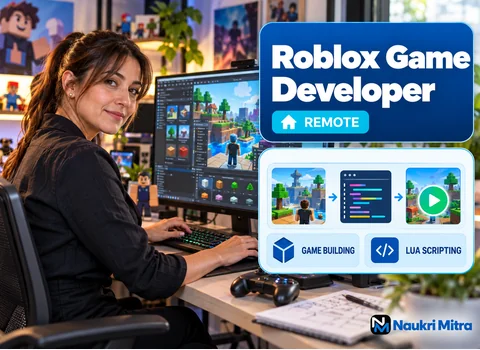
Monday morning, the bug channel has three new reports and they all say roughly the same thing: "my coins disappeared after the server restarted." One player attached a screenshot of an empty wallet. If that kind of message makes you curious instead of nervous, this listing is for you. Of the remote roblox game developer jobs hiring now, this Naukri Mitra listing is a full-time role paying USD 80,000 per year, and applicants can live in any country.
Before anyone panics about exploiters, the first guess is a dull one and often right: the coins were never saved. Many "vanished currency" reports on Roblox trace back to DataStores, the service that keeps player data between sessions. A server shuts down for an update, the save call either never fires or fails quietly, and the player's last half hour of progress goes with it.
Here is how a developer would typically start, and it gives a fair preview of the job. Open the place in Roblox Studio and read the save path from top to bottom. Is there a game:BindToClose handler, and does it actually wait for every player's save to finish before the server dies? Is the save inside a pcall, and if it fails, does anything log it or try again? Is the data only written when the player leaves, so a crash or restart skips it entirely?
Next, reproduce it. Start a local test server with two players, earn coins, shut the server down from the command bar, rejoin. If the coins are gone, you have a repro and the fix is close. If they survive, look at timing: maybe the live servers hit request limits when forty players leave at once, and some saves get dropped. Write up what you found in plain words; the designer will read it too.
Most weeks are spent building things. Here is the life of one feature: a crafting bench where players combine materials into gear.
It starts as a sketch in a shared doc: what goes in, what comes out, how long it takes, whether premium players get a speed boost. Your job is to ask the awkward questions early. What if the inventory is full? What if they log off mid-craft? Settling these on a short call is much cheaper than rewriting the system later.
Next you decide what lives where. The client shows the bench UI, plays the hammer animation and the sparks. The server owns the inventory, the recipe table and the timer. The two talk through RemoteEvents and RemoteFunctions, and you keep that surface small: one remote for "request craft", one for "craft finished".
Anything the client sends is a suggestion. If the request says "craft recipe 7", the server checks that recipe 7 exists, that the player is standing near a bench, that they really own the materials, and that they are not firing the remote twenty times a second. Exploiters will try all of these.
All of this is scripted in Luau inside Roblox Studio, ideally in ModuleScripts with type annotations so the next person can follow it. Combat, inventory, progression and monetization features all follow this pattern of server-owned state and a thin client.
Crafted items have to survive restarts, which leads back to the coin bug. A sound approach wraps every DataStore call in retries with a short backoff, saves on a regular interval as well as on leave, and uses some form of session locking so that two servers never write the same player's data at once.
Plenty of players are on low-end phones and older tablets. Before a feature ships, you check it in the MicroProfiler and the Developer Console, watch memory as players open the bench repeatedly, and cut anything wasteful, like textures far larger than the screen will show or loops that run every frame when once a second would do.
The bench mesh, the hammer and the gear pieces often come out of Blender. You should be comfortable cleaning up a model, checking scale and pivot, keeping polygon counts sensible, and importing it so it behaves in Studio.
Small teams often use Team Create inside Studio. Larger ones keep scripts in Git and use a sync tool that mirrors files between a code editor and Studio, so changes go through branches and reviews. Either setup is acceptable, as long as you are comfortable in it.
Then the feature goes to a playtest server, gets broken by testers in ways nobody predicted, gets fixed, and ships in a live update. After release you watch the error logs and the bug channel for a few days.
Put simply, a Roblox developer turns game ideas into working systems on the platform. In this role that means scripting gameplay in Luau, handling server-client communication and DataStores, importing Blender assets, fixing bugs and patching exploits, and making sure the game runs well for mobile players.
Two to three years of Roblox development is the stated bar, proven through shipped games or strong portfolio projects. A degree is optional. The core roblox game developer skills are expert Luau scripting in Roblox Studio, a firm grasp of client-server architecture, DataStores, performance tuning, and Blender for assets, plus comfort with Git or Team Create.
You need a capable PC of your own. Nothing exotic: a modern multi-core processor, 16 GB of RAM or more so Studio, Blender, a browser and a code editor can run together, a dedicated graphics card for Blender work and heavier places, and an SSD so large places open quickly. A stable broadband connection matters because Team Create and live testing both depend on it. Treat these as suggestions, not formal requirements.
For collaboration you'll use Team Create or Git with a sync tool, plus whatever chat and task board the team has picked.
For this full-time remote job, the roblox game developer salary per year is listed as USD 80,000. That is the figure in this listing; treat it as the stated annual pay rather than a promise about bonuses or extras. Elsewhere, pay varies a lot between studios, commissions and revenue-share deals.
People who type "how to become roblox game developer" into a search bar usually get pointed at videos. A better start is the official Roblox Creator Hub documentation and its tutorials, followed by small, finished projects. A roblox game developer course on a learning site or YouTube can help with structure, but no specific roblox game developer certification is required here. A live game with a working save system is stronger evidence than a certificate.
Roblox game developer interview questions often look like these: how would you stop a player from spoofing a purchase remote, what happens to data if two servers load the same profile, and how would you find what is making a place lag on mobile. Practice explaining your answers out loud, briefly.
Keep your roblox game developer resume to a page. List the games you worked on, your role on each, and one concrete result, such as "rewrote the save system and data-loss reports stopped". Link playable games and a short video of systems you built. Naukri Mitra charges nothing for applications.
Real employers don't ask applicants to pay anything, and they don't need your Roblox password. If a client wants you to log into their account, ask for Team Create access to the place instead. For freelance commissions, agree on scope in writing and use milestones so you are never far ahead of what you have been paid.