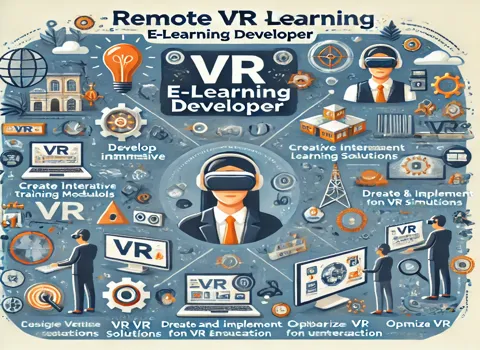
A headset can do something a slide deck never will: put someone inside the thing they're supposed to learn. That's the bet our company has been making since we started as a handful of people tinkering with early VR headsets and instructional design manuals, and it's paid off. We now build immersive training and education software used by learners who'd otherwise be stuck watching a video and hoping it sticks.
The short version
We need a
Remote Virtual Reality E-learning Developer who can take a training objective and turn it into an environment people actually want to spend time in. You'll spend most of your days in Unity or Unreal, working alongside instructional designers and artists to ship modules that hold up under real classroom or corporate use — not just look good in a five-minute demo. The position is fully remote, and we're set up for async collaboration across time zones, so where you're based matters less than how you work.
Day to day, this is what you're doing
Most weeks involve building and iterating on VR scenes: setting up environments, wiring interactions, scripting the logic that makes a scenario respond to what a learner actually does. You'll take raw curriculum from instructional designers and figure out how to make it spatial and interactive, rather than a lecture with a VR skin slapped on top. Some of the specific work:
- Building and refining learning modules in Unity or Unreal Engine, start to finish
- Scripting interactions, triggers, and gameplay logic in C# (or the equivalent for your engine)
- Turning course content into branching scenarios, quizzes, and other interactive checkpoints
- Testing on real hardware — Quest, Vive, whatever the client's using — and chasing down frame drops, clipping, and other bugs before learners hit them
- Sitting in on reviews with artists and designers so a module stays visually and pedagogically coherent
- Folding pilot feedback back into the build instead of treating v1 as final
- Writing down what you did and why, so someone else (possibly future you) can pick up the project without archaeology
It's not glamorous every day. Plenty of hours go into optimization work nobody will ever notice unless you skip it — the kind of thing where success looks like nothing going wrong, which is a strange thing to feel proud of until you get used to it. You'll also spend a fair amount of time in Slack threads and quick calls with instructional designers, hashing out how a training objective that reads fine on paper actually translates once someone's standing inside it.
What we need you to already have
We're not looking to train someone into VR development from scratch. You should be able to say yes to most of this:
- Experience: 2+ years building VR or real-time 3D applications professionally — training or e-learning experience is a strong plus, but general VR/AR product work counts too
- Education: Bachelor's degree, or a portfolio strong enough that the degree question becomes moot
- Engine skills: Real, shipped work in Unity or Unreal — not just tutorials followed to completion
- Programming: C# for Unity folks, C++/Blueprints for Unreal folks; Python is useful for tooling but not mandatory
- Instructional awareness: Enough grasp of how people actually learn that you don't build something visually impressive but pedagogically empty
- Debugging instinct: You can track down a weird performance issue or interaction bug without someone walking you through it step by step
Bonus points, not requirements
None of these are dealbreakers, but they'll get our attention:
- Hand-tracking, haptics, or spatial audio work
- A demo reel or shipped title in the training/education space specifically
- SCORM or xAPI experience for LMS integration
- Background in medical, aviation, or industrial training content — these clients tend to have unusually strict accuracy requirements
- Basic 3D modeling ability, even if it's not your main skill
Compensation and the practical stuff
The role pays $172,465 annually, and location doesn't change that number. Beyond salary, a few things worth knowing: we cover VR hardware and software licenses so you're not buying your own dev kit, hours are flexible enough to protect focus time rather than fill a calendar, and there's real room to grow — into a lead role, a mentoring track, or a specialization like performance optimization if that's where your interest goes. We'll also fund courses or conferences that keep your skills current, within reason.
One more thing worth saying plainly: postings for roles like this tend to show up on
Naukri Mitra because the platform attracts people who actually work in niche technical fields, rather than generalists clicking through anything remotely related. If that's how you found this, you're in the right place.
How the team actually works
Small pod, not a big department: a few developers, a couple of artists, instructional designers who know their subject matter cold. Nobody sits on a finished module for a month before anyone else sees it — you'll be sharing rough builds early and often, and getting blunt feedback in return. Decisions tend to go to whoever's closest to the problem rather than whoever has the fanciest title, which means junior devs get listened to here more than at most places.
Meetings are kept short on purpose. If something can be resolved async, it usually is. That said, this isn't a lone-wolf setup — you'll be pinged for opinions on things outside your immediate task more often than you might expect, because a lot of what makes these modules work comes down to small judgment calls that are easier to make as a group.
Applying
Send a resume plus something we can actually look at — a portfolio, a demo, a link to a VR build you've worked on. Skip the generic cover letter and instead tell us, in a couple of sentences, what you'd change about your best project if you had another month with it. That tells us more about how you think than a list of software you've used ever could.
We're open to applicants from the US, Canada, the UK, the EU, Australia, India, and many other places, as long as you can work independently and overlap reasonably with the team's core hours.