
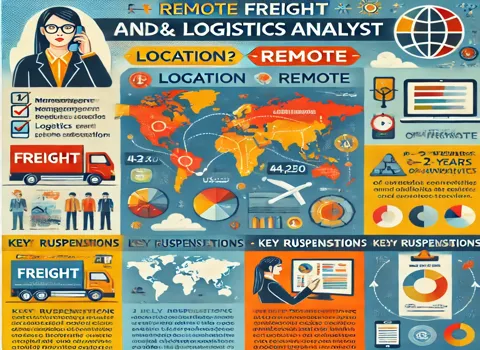
A container sitting at the wrong port for three extra days doesn't just cost money. It throws off a warehouse schedule two weeks out, delays a retailer's shelf restock, and eventually shows up as a late delivery on someone's doorstep. Catching that kind of problem early, or untangling it once it's already happened, is the job. We're hiring a Remote Freight and Logistics Analyst to sit at that intersection of data and real-world shipping.
The Role, Honestly
This isn't a job where you'll get bored watching numbers scroll by. You're tracking freight movement, checking whether carriers are actually holding up their end of the agreement, and turning shipment data into decisions someone can act on that same day. It's remote work, but it doesn't feel remote in the isolated sense — you're on calls with coordinators, trading messages with carriers, and syncing with clients who are often in a completely different time zone than you. Some days are quiet. You'll pull up a dashboard, notice a route trending slower than usual, and flag it before it becomes a problem. Other days aren't quiet at all — a port shuts down without warning, and suddenly you're rerouting three shipments before lunch. Both kinds of days matter.Day-to-Day Responsibilities
- Dig into freight data looking for patterns that predict delays or cost spikes
- Check carrier performance against what was promised in the service agreement
- Weigh different routes and shipping modes against each other — cost versus speed versus reliability
- Keep clients and internal teams updated on shipment status, especially when something's off schedule
- Handle the paperwork side of customs and cross-border compliance
- Put together reports that turn messy logistics data into something a non-analyst can actually read
- Jump in on scheduling conflicts with carriers or warehouses when a reroute is needed fast
What You'll Need
Education-wise, we're looking for a Bachelor's degree, though equivalent hands-on experience in a related field will also be considered. On the experience side, we want at least 1 year in logistics, freight coordination, supply chain analysis, or transportation data. If you're strong analytically but newer to the freight side specifically, that's often workable too — say so in your application. Beyond that, you'll want to be comfortable with Excel or Google Sheets (formulas, not just data entry), able to read a freight-tracking dashboard without hand-holding, and clear enough in writing that a carrier three time zones away understands your message the first time. A stable internet connection isn't optional here — it's part of the job.Nice to Have
- Background in freight forwarding, customs brokerage, or international shipping rules
- Hands-on time with a transportation management system or warehouse software
- Some comfort building dashboards, not just reading them
- Coursework or certification in supply chain management
- Prior work with global carriers or cross-border compliance specifically
Where a Role Like This Leads
Plenty of people use a role like this as a stepping stone rather than a destination — moving later into logistics performance tracking, supply chain optimization, or advisory work on distribution strategy. On platforms like Naukri Mitra, this kind of analyst position tends to show up as a common entry route into senior operations careers, mostly because the analytical muscle you build here transfers well beyond freight specifically.Compensation and What Comes With It
The role pays $55,250 annually. Alongside that:- Work from anywhere, as long as your internet holds up
- Paid time off — actually take it, not just accrue it
- Training support when you want to build a new skill or close a gap
- Flexible hours, judged on output rather than a fixed clock
- A team that checks in regularly rather than disappearing between deadlines