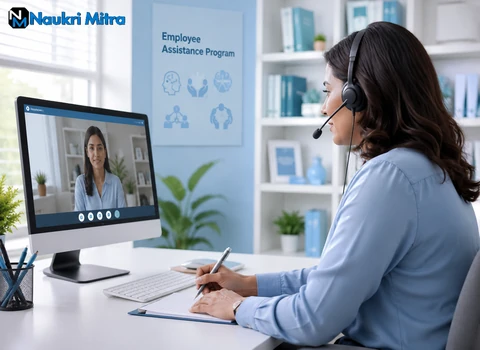
Nobody walks into their manager's office and announces they're falling apart. It shows up sideways instead — a missed deadline, a short temper, someone who's just quietly stopped being themselves at work. A
Remote EAP Counselor is often the first person to hear the real version of what's going on, and what happens in that conversation can be the difference between someone burning out completely and finding their footing again.
What this job actually is
You'd provide short-term, confidential counseling to employees across a range of industries, entirely through secure telehealth. It's full-time, fully remote, with a flexible Monday-to-Friday schedule, and pays $111,500 a year. What walks in the door varies wildly — anxiety, grief, relationship strain, substance use, a work-life balance that's quietly wrecking someone. This isn't long-term therapy. The job is to stabilize someone quickly and point them toward the right next step, whether that's a few more sessions with you or a referral to someone better equipped for their situation.
The setting is its own thing, different from private practice in ways that matter. Clients often show up with almost no context — a manager mentioned EAP once, or this is genuinely the first time they've spoken to any kind of therapist. Part of the actual skill here is making that first call feel safe fast, because you might not get a second one.
Where your time goes
- Deliver short-term, solution-focused counseling by secure telehealth for issues spanning anxiety, depression, grief, and relationship conflict
- Handle acute crises with real-time de-escalation and risk assessment, keeping client safety the first priority every single time
- Talk through workplace stressors and interpersonal conflict with HR and management, helping build a culture where people can actually say something's wrong
- Refer clients into longer-term care, recovery programs, or financial and legal support when needed, then follow up to confirm the handoff actually worked
- Help shape wellness workshops, webinars, and internal campaigns around employee mental health
- Keep documentation accurate and current in a secure EHR system, fully compliant with HIPAA and standard ethical guidelines
What you need to bring
- Education: Master's degree in counseling, psychology, social work, marriage and family therapy, or a closely related behavioral science field
- Licensure: Active, unrestricted clinical license — LPC, LCSW, LMFT, LPCC, or equivalent, in your state of residence
- Experience: At least 3 years of clinical counseling work, ideally in EAP, corporate wellness, or outpatient mental health settings
- Telehealth background: Real experience delivering care through HIPAA-compliant technology, not just theoretical familiarity
- Clinical presence: The ability to sit with someone mid-crisis without rushing them toward a resolution before they're actually ready for one
- Discretion: Handling sensitive information with the seriousness it deserves, every single time, no exceptions
What makes an application stand out
- Crisis intervention certification such as ASIST or Psychological First Aid
- Experience working with frontline workers or other high-stress occupational groups
- Familiarity with DEI practices as they apply to clinical mental health work
- Multilingual fluency that lets you reach a wider range of employees in their own language
None of these are hard requirements on their own. They matter more for organizations with a genuinely diverse or high-stress workforce, which describes most of ours.
The tools you'd actually use
Sessions run on HIPAA-compliant platforms like Zoom for Healthcare or Doxy.me. Documentation lives in a secure EHR built for case management, and day-to-day coordination happens via Microsoft Teams and Slack, alongside appointment and follow-up scheduling software. None of this involves much of a learning curve if you've done telehealth work before — and either way, onboarding walks you through our specific setup.
Why this work matters more than it usually gets credit for
The impact here is quiet. You're not just treating someone's individual distress in a given session — you're part of why absenteeism drops, why turnover slows down, why a workplace starts to feel like somewhere people can actually admit they're struggling instead of pretending everything's fine right up until it isn't. Roles like this often surface through channels such as
Naukri Mitra, since licensed clinicians with genuine EAP or telehealth experience aren't an easy pool to reach through a typical job board.
Most of the time, you won't find out how a case actually turns out. That's just how short-term, referral-based work goes. Clinicians who stick with this field long-term tend to make peace with that early, and find something satisfying in the handoff itself rather than needing to see the whole story play out.
Pay, growth, and support
- $111,500 annual salary, with eligibility for performance-based bonuses in future review cycles
- Continuing education support, including CEU credits and licensure renewal assistance
- Peer consultation groups and clinical supervision, so you're never working entirely on your own
- Real pathways toward supervisory roles or specialization in areas like trauma work, couples counseling, or workplace stress
There's also access to monthly webinars from outside clinical experts, plus an internal library of current tools and case studies, so staying sharp doesn't depend entirely on what you can dig up on your own time.
Who tends to do well here?
Clinicians who can hold a nonjudgmental space for people from wildly different backgrounds and problems, session after session, without it quietly wearing them down in ways that leak into the work. You'll need real comfort with digital platforms, genuine clinical instinct, and the flexibility to shift your whole approach depending on who's in front of you that day — a grieving new parent and a burned-out frontline worker need very different things from the same fifty minutes. Good boundaries matter more than most people expect when they come in; this kind of work can quietly erode someone who never learns to actually close a session and step away from it.
Apply
Send your resume along with your active license details and a short note on what draws you to EAP work specifically, rather than private practice or another clinical setting. We're looking for people who understand the particular rhythm of this job, not just anyone with a license and an open calendar. Talented professionals from the United States, Canada, the United Kingdom, EU countries, Australia, India, and many other regions are encouraged to apply.