
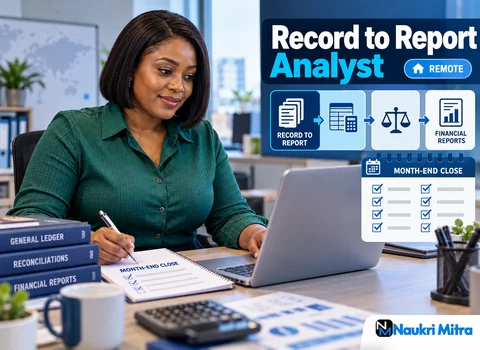
Day three of close, and a debit is sitting in the suspense account with nothing on it but a batch reference. Accounts payable says it is not theirs. Treasury says the same. The balance sheet cannot be signed off while it sits there, and somebody has to answer the question nobody wants to own: where did it come from? Opening that posting, following the document trail back to whoever keyed it, and getting it reclassed or reversed is the heart of this role. This seat is among the remote record to report analyst jobs that sit inside a global close team. Full-time and home-based, it pays $3,750 a month in USD, and anyone who can keep pace with that team may apply, whatever their country.
Close usually opens with entries. You prepare and post journal entries for the items the subledgers do not carry on their own: reclasses, corrections, allocations and month-end accruals for services received but not yet invoiced. Each entry needs support attached, a clear line description and the right cost centre, because an auditor or a reviewer will open it months later with no context.
Accruals reward a habit of asking early. If a vendor bill for facilities work is expected but has not arrived, you estimate it from the purchase order or last month's run rate, book it, and set it to reverse. Next month you check that the reversal and the real invoice met where they should.
Once entries are in, the reconciliation work starts. In BlackLine each balance sheet account has an owner, a preparer and a reviewer, and your job as preparer is to show that the general ledger balance agrees with something independent: a bank statement, a fixed asset register, a subledger report or an aging schedule. Where it does not agree, you list the reconciling items, explain each one and say when it will clear.
A line that has sat open for three months with the note "under investigation" will come back to you, so part of the work is chasing items to closure rather than just carrying them forward. That suspense balance from the opening ends up here too, with its trail written down.
Group companies charge each other for shared services, loans and recharged costs, and every receivable in one entity should match a payable in another. Intercompany reconciliation means pulling both sides, matching them by counterparty and currency, and raising the differences with the accountant who owns the other entity. Timing gaps, a charge booked in one month by the sender and the next by the receiver, are the usual culprit; foreign exchange differences come a close second. Mismatches left unresolved block consolidation, so these get attention early in the calendar.
Everything above runs against a close calendar: a task list where each item has an owner and a working day, written as WD-2, WD+1, WD+3 and so on around month end. Supporting month-end close tasks on schedule is a stated part of this role, and a missed WD+2 task holds up whoever comes after you.
For a remote analyst the calendar also sets the clock. If the entities you support sit in Europe or North America, your shift will usually overlap their working day, and the busiest days of close can run longer than the rest of the month. Ask during interviews which time zone the team follows, how many days the close takes and whether any WD falls on a weekend.
After the books are closed, the reporting team builds flux reports comparing this month with last month and with budget. When a line moves more than expected, they come to the R2R analyst for the reason. A useful answer is specific: travel expense rose because a quarterly conference invoice landed, or rent fell because last month carried a catch-up entry. "Higher activity" helps nobody. Getting to that answer means drilling from the account balance to the journal lines and source documents behind it.
Most of your time is spent inside an ERP. In SAP FICO that means transactions such as FB50 for postings, FBL3N for line items and the period-end tools for currency revaluation. In Oracle General Ledger it means journal batches, account inquiries and period status. Working knowledge of either, plus BlackLine, is what this role expects; nobody expects you to have configured the system.
Excel carries the rest. You will build reconciliations with lookups and pivot tables, compare two data dumps line by line and tie totals back to a trial balance. A reconciliation that does not foot is the first thing a reviewer spots.
The baseline is a B.Com or M.Com degree with 1 to 3 years in general ledger or month-end close work. Progress toward CA Inter, ACCA or CMA is welcome rather than required, and it shows a reviewer that your accounting standards knowledge goes past the degree syllabus. Beyond that, the role asks for working knowledge of SAP FICO, Oracle GL or BlackLine, strong Excel reconciliation skills and the discipline to meet close deadlines on shift. Those are the core record to report analyst skills, and the duties above are simply what a GL desk does every month.
Work like this mostly sits in global capability centres: finance hubs that multinationals run for their own group companies, often in India, Eastern Europe, the Philippines or Latin America. Large finance outsourcing providers run similar R2R towers for clients. In either setting the analyst seat looks much the same, with a process owner, a team lead, a set of entities and a monthly calendar.
Many record to report analyst work from home jobs come out of these centres. As for the record to report analyst salary on this role, it is $3,750 per month, quoted in USD, for full-time work. How that lands in your account after tax and currency conversion depends on your country and the payment arrangement, so check those details before you accept.
An honest word for freshers: this role asks for 1 to 3 years of GL or close experience, so a new graduate with no work history will find it a stretch. That does not close the door. Many R2R analysts started in accounts payable or accounts receivable, where they learned posting, vendor reconciliations and month-end cut-off before moving into general ledger. CA articleship counts too, especially if you worked on statutory audits and saw how reconciliations are tested from the other side.
If you are in one of those seats now, ask to own a small set of balance sheet reconciliations or to help with accruals during close. A year of that, described plainly on your CV with the systems you used, is a sound route into general ledger work.
People often ask which finance tower is better. Neither is. Order to cash covers billing, cash application, credit and collections; it is close to customers and rewards persistence and clear communication with outside parties. Record to report sits at the end of every other process and turns their output into a trial balance; it rewards patience with detail, a firm grasp of accounting entries and comfort with deadlines that do not move. Choose the one that matches how you like to work. Both teach you the ledger.
The R2R path has visible steps. Analysts who reconcile cleanly and explain variances well tend to become senior analysts, then team leads reviewing other people's work, then process leads owning an entity's close end to end. From there the work turns toward controllership: signing off balance sheets, managing audits and advising on accounting treatment. Financial controller is a realistic long-term aim, and finishing CA, ACCA or CMA usually matters most at that stage. Progress depends on your performance and the openings around you, so treat it as direction rather than a timetable.