
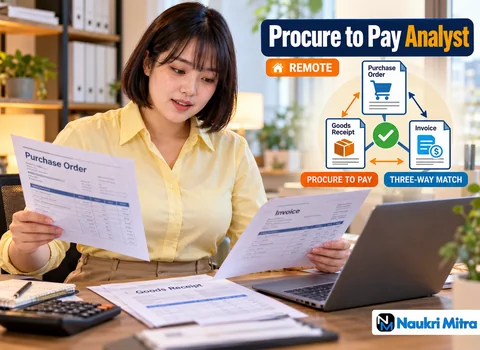
Take an illustrative case. The purchase order says 100 units. The goods receipt says 96. The invoice bills for 100, at the right unit price, with a polite note asking for payment within 30 days. No single document is wrong, yet together they say the company is about to pay for four boxes nobody signed for. Catching that, and knowing what to do next, is the core of remote procure to pay analyst jobs like this one. The answer, for the record, is not "pay it and hope". You put the invoice on a quantity hold, ask the warehouse whether a second delivery is pending, and email the vendor asking for a credit note or a revised invoice for 96. Then you note what you did, so the trail is clear for any later review.
This is a full-time, remote role open worldwide, on the buying and paying side of a finance shared services team. The short procure to pay analyst job description: make sure the company pays the right supplier the right amount, once, for things it ordered and received. The longer version follows one invoice.
It starts when someone inside the business raises a purchase requisition, say for replacement laptops or a month of cleaning services. Once approved, it becomes a purchase order in SAP Ariba, Coupa or SAP MM, depending on what the client runs. You'll read a lot of POs and learn to spot a line set up with the wrong unit of measure (boxes of 12 versus single items is a classic).
When goods arrive, someone books a goods receipt against the PO. The supplier's invoice lands in a shared mailbox or portal and gets captured, usually by OCR. You check that capture: an invoice number read as 1O452 instead of 10452 is a small typo with a large consequence.
A 2-way match compares the invoice to the PO: same vendor, same price, quantity not above what was ordered. It's common for services and low-value items. A 3-way match adds the goods receipt, so the system also checks that you're only paying for what arrived. Tolerance settings decide how fussy it is. A client might allow a price variance of 2% or a few dollars before the invoice blocks. Anything outside tolerance goes to you.
Price variances usually mean a stale PO or a vendor applying a new rate list early. Quantity variances mean a short shipment, a split delivery or a receipt nobody posted. You place the right hold, route it to the buyer, and chase until it's released. Sometimes the buyer agrees the new price and amends the PO; sometimes the vendor issues a credit. Either way the invoice doesn't move until someone with authority decides. Non-PO invoices follow an approval workflow, and you'll notice when one has sat in someone's queue for nine days.
Duplicate invoices come up again and again. They arrive by email and again by post, or resent with "INV-" added to the number. Systems flag exact matches; the clever ones slip through on a changed character. You'll check vendor, amount and date ranges, and develop a healthy suspicion of any supplier who sends the same bill "just in case".
Every payment depends on the vendor record: legal name, tax ID, payment terms and remittance details. You keep it clean and flag duplicate vendor entries. A change request that arrives by email with urgency and new account details deserves a call-back check before anything is changed.
Suppliers ask where their money is. You check status, explain holds plainly and give a realistic date. You prepare the proposal list for the payment run; releasing payments usually sits with another team. At month-end you help accrue goods received but not yet invoiced.
Put simply: perform three-way matches across purchase orders, goods receipts and invoices; resolve price and quantity mismatches by working with buyers and vendors; post approved invoices in SAP Ariba or Coupa; and keep vendor master data accurate. Vendor communication is almost entirely by email. A courteous reply stating the PO number, the variance and what you need closes a query faster than three vague ones. Shift hours depend on the regions you support. A team covering European or US suppliers may ask for some overlap with their business day, so confirm the expected hours before you accept an offer.
The titles overlap. In general, an accounts payable specialist focuses on processing and paying invoices. A procure to pay analyst looks at the whole chain, including whether the PO was set up properly, why receipts are missing and which vendors keep generating exceptions. If one supplier triggers price holds every month, you tell the buyer the contract rate in the system is out of date.
The listing asks for a commerce or finance graduate with one to three years in accounts payable or procurement support. Well-trained freshers may be considered, so this opening can sit among entry level remote procure to pay analyst jobs, but "well-trained" matters. Show you understand match logic, have practised in an ERP or sandbox, and can explain a variance. You'll also need familiarity with SAP Ariba, Coupa or SAP MM and good written English.
Among procure to pay analyst skills, confident Excel is a stated requirement. That means VLOOKUP or XLOOKUP to compare an open-invoice extract against a vendor statement, pivot tables to summarise holds by reason and age, conditional formatting to surface duplicate invoice numbers, and text functions to clean messy supplier references. The most useful spreadsheet task in this field is reconciling a vendor statement line by line: which invoices the supplier thinks are open, which ones you've paid, and which ones only one side has ever seen.
For procure to pay analyst work from home jobs, the first requirement is a dependable internet connection. A second monitor helps (comparing a PDF with an ERP screen on one display gets old fast), and vendor bank details shouldn't sit open on a shared family computer.
On procure to pay analyst salary per month, the figure given is USD 3,750 per month, and the job is full-time. That is not a market range; procure to pay analyst salary elsewhere varies by employer and region. Ask about pay dates and employment type at interview.
Procure to pay analyst jobs remote worldwide come from global capability centres, outsourcing providers for finance and accounting, shared services hubs of multinational groups, and consulting firms that run P2P for clients. Shift patterns at these employers often follow the client's time zone, so a team serving US suppliers may start later in the day. A common career path runs from analyst to senior analyst or team lead, then into process excellence, P2P controller work or procurement operations. Automation tends to shift the work: auto-matching can clear clean invoices, which leaves more of the exceptions and disputes for people.
Breaking into P2P does not take one paid procure to pay analyst course; start with the learning material SAP and Coupa make available, and practise the match in a spreadsheet: build a small PO, receipt and invoice table and write the formula that flags a variance. On procure to pay analyst certification, CPSM is a broader supply management credential and SAP offers Ariba-related certifications; neither is required here. For procure to pay analyst interview questions, expect to be asked to walk through a failed 3-way match, explain how you'd spot a duplicate, and describe how you'd handle a vendor bank detail change request. On your procure to pay analyst resume, list the ERP you've used and any ageing reports you owned.
Use the apply option on this page and attach a resume that shows AP, procurement or ERP exposure clearly near the top. A short note on one invoice problem you solved says more than adjectives. Mention your time zone so overlap can be judged. A so-called employer asking you for money is a scam signal, so ignore any fee request.