
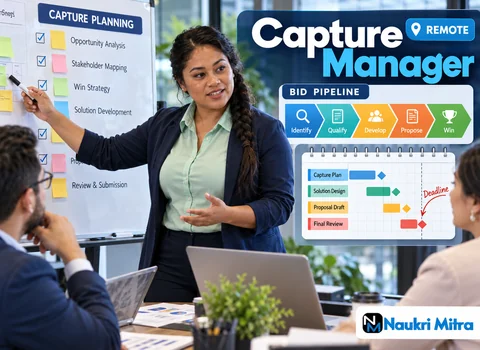
An agency forecast entry goes live eighteen months before anyone writes a solicitation. It is three lines long: a program name, a rough dollar band, a target quarter. Most firms scroll past it. The person who flags it and quietly starts asking questions is the one this listing wants. Among remote capture manager jobs, this one is full-time, paid USD 75,000 per year and sits squarely in the long game on federal bids, ending where the proposal writing begins. It also counts among capture manager jobs remote worldwide, with no country restriction in the listing, though a clearance requirement, if it applies, could narrow that.
Read this capture manager job description as a sequence of moves. The timeline is illustrative; real schedules slip, compress and sometimes vanish.
You have a forecast line and little else. You find out whether the requirement is real, who holds the current contract, when it expires and whether the customer is unhappy. You open a Salesforce opportunity, give it a low probability and write down the questions you cannot yet answer.
The board fills up. You meet the program office where the agency allows it, read past solicitations from the same office, map likely competitors and decide which partners you need. At each gate, leadership either keeps funding the pursuit or pulls it.
You are not writing volumes. You hand a finished capture plan to the proposal manager, walk them through the customer's hot buttons, confirm teaming agreements are signed and stay close for questions. By that stage, much of the strategy is already set.
Opportunity identification starts in two places. GovWin IQ is the market research side: you use it to follow agency plans, see who holds a contract now and when it ends, and spot a pursuit taking shape before any notice is posted. SAM.gov is the official government site where notices appear, such as sources sought, requests for information, presolicitation notices and, later, the solicitation itself. You check both on a routine, filter by the NAICS codes and agencies the company targets, and push anything promising into Salesforce with a note on why it fits.
Every pursuit costs money, and a full proposal can tie up a team for weeks. So the bid/no-bid decision is your most important move, and you make it more than once. Early gates ask simple things. Does the company have relevant past performance? Does anyone know the customer? Is there a set-aside the company qualifies for? Later gates ask whether the pricing works and whether a partner gap can close in time. You bring leadership an honest recommendation, including the uncomfortable no-bid.
Good capture is mostly research. On the customer side you want the mission, the budget pressure, who evaluates proposals and what went wrong on the last contract. Some of that comes from GovWin IQ and public documents; some from industry days and permitted conversations.
For competitors you build profiles: the incumbent, who has bid this office before, likely teams and weak spots. A working note might read: "Incumbent has had turnover on the help desk task; customer mentioned response times twice at industry day." That detail becomes a discriminator later.
Few firms cover every requirement alone. You identify gaps, find partners who fill them, agree who does what and get teaming agreements and NDAs moving with contracts staff. Sometimes the smart move is joining another prime's team as a sub.
With the team set, you shape the approach, staffing model and transition plan with technical leads. From that come win themes: short statements tying a customer need to a feature of your offer and a proof point. They become the spine the proposal team writes against.
Price-to-win, put simply, is an estimate of the price range likely to beat rivals while still meeting the customer's needs and keeping the company healthy. You need not be a pricing analyst, but you should be able to brief the assumptions and challenge them. A black hat review has colleagues play your competitors, predicting each rival's strategy and price posture, then attacking your plan from those angles. You carry the resulting fixes forward.
When the final RFP posts, the proposal manager takes over schedule, compliance and writing. Your handoff package covers the capture plan, customer profile, competitor assessments, win themes, teaming status and the price-to-win summary. Throughout the pursuit, every gate decision, contact and probability change lives in Salesforce, so leadership can read the pipeline without chasing you.
You need at least five years in government contracting business development or proposal management, plus a history of winning federal bids and working knowledge of GovWin IQ, SAM.gov and Salesforce. Of all the capture manager skills, judgment about when to walk away and patience with research matter most. No single capture manager course or capture manager certification is mandatory; Shipley capture training or APMP certification is preferred.
On how to become a capture manager, there is no single route, though many people arrive from proposals. If you have run proposals, you know compliance matrices, color team reviews and how themes fail on the page. Moving across usually means volunteering for early work: sitting in on gate reviews, building a competitor profile, drafting a capture plan for a smaller pursuit.
Capture also differs from general business development. A BD manager works relationships across many prospects, while a capture manager owns one pursuit from qualification to handoff; small firms often combine the two. Over time, capture leads move into director of capture roles, then vice president of growth, setting pursuit strategy for the whole company.
Unlike some capture manager work from home jobs, this seat comes with two possible conditions. The listing says a security clearance may be needed, which can depend on the agencies being pursued, and that occasional travel may be needed, for an industry day, customer meeting or in-person review. Neither is certain. Ask the hiring team early, especially if you hold no clearance today.
On capture manager salary per year, the post offers USD 75,000, full-time, with no restriction on where candidates live. No bonus, commission or benefits details are published, so ask rather than assume. Pay elsewhere varies with clearance level, company size and win history; use the listed figure as the reference for this job.
Build your capture manager resume around pursuits, not duties. "Led capture on a civilian agency IT services recompete; recommended teaming with a small business for set-aside eligibility; won" says more than "responsible for business development."
Expect capture manager interview questions like these: describe a pursuit you recommended dropping; how do you profile a competitor without inside information; what goes in your handoff package. Have real stories ready.
Lists of remote capture manager jobs hiring now also appear on boards such as ClearanceJobs, where federal IT integrators, defense services firms, small set-aside businesses and consultancies post cleared roles. This listing takes no payment from applicants, and neither does any serious contractor.
Capture roles for people with no experience are rare, and anyone hoping for entry level remote capture manager jobs should know this is not one. Proposal coordinator, then proposal manager or BD analyst, is the sensible route. When your experience fits, send your CV with a note naming one pursuit you won and one no-bid you stand by.