
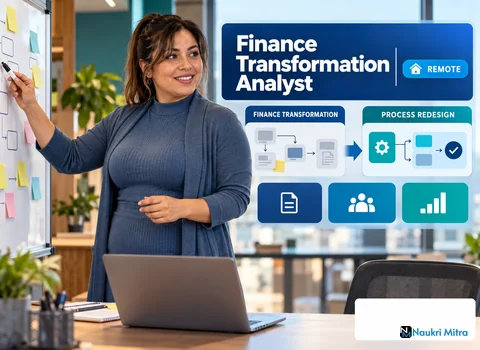
The cutover below is a composite example rather than a real project. Friday, 9 p.m.: the legacy ERP goes read-only and nobody can post another journal in it. By 2 a.m. the opening balances have gone into the new ledger. At 7 a.m. on Saturday someone runs the first trial balance in the new system and it is out by 1,184.37. The go/no-go call is at noon. The analyst on that call pulls the legacy closing trial balance and the load file side by side, sorts both by account, and checks first for the boring causes: a rounding rule on foreign currency balances, a cost centre that was retired in the mapping table but still had a balance, an intercompany account that loaded to the wrong company code. That Saturday morning shows remote finance transformation analyst jobs at their sharpest, and this listing is for that kind of person: full-time, fully remote, open worldwide, paying USD 75,000 per year.
The rest of the year is calmer. Read this as a finance transformation analyst job description arranged like a project office's ERP rollout plan: the work is set out phase by phase, followed by background, hours, pay and how to put an application together.
Every rollout starts with current-state mapping, and it is less glamorous than it sounds. You sit on calls with accounts payable clerks, the fixed asset accountant and the person who does bank reconciliations, and you ask them to share their screen and walk you through last month. You draw what happens, not what the policy says. The useful findings are usually small: a spreadsheet that re-keys vendor invoices because the old system cannot split freight, or an approval that sits in someone's inbox for four days every month end.
Your output here is a set of process maps (swimlanes work fine), a list of pain points with an owner against each, and a requirements log that later becomes the test script backbone.
Depending on the programme, the target platform will be SAP S/4HANA or Oracle Cloud ERP. You are not the solution architect, but you are in the design workshops, translating "we need to see accruals by project" into a requirement the configuration team can act on. You also push back politely when a request would mean customising something the standard product already handles.
An accounting background helps most here. Migration runs happen several times before go-live (mock loads), and after each one you reconcile: record counts, control totals by company code, open items in payables and receivables, fixed asset cost and accumulated depreciation. You keep a reconciliation workbook with a sign-off column, because at cutover someone will ask who approved the vendor master and you will want the answer in one click.
The Saturday-morning variance in the opening example is exactly what mock loads are meant to flush out early. When a difference survives into cutover, the workbook from the mocks is what lets you find it in an hour instead of a day.
UAT is run with the people who will live in the new system. You prepare test scripts from the requirements log, book sessions across regions, and sit with testers while they post an invoice, run a payment proposal or close a period. Defects go into a tracker with steps to reproduce and a screenshot. Part of the job is telling a genuine defect apart from "this works, it is just different from what I'm used to," and handling the second kind with patience and a short how-to note rather than a ticket.
The cutover plan is a long checklist with times, owners and dependencies: freeze legacy postings, extract final balances, load, reconcile, sign off, open the new period. Your piece is usually the finance reconciliation steps and the go/no-go evidence pack.
Hypercare is the support period right after go-live; its length is set by each project. Users raise issues, and you triage them: training gap, data problem or real configuration bug. You run the first month end in the new system alongside the accounting team and note every step that took longer than it should have.
Programmes get funded on promised benefits, such as fewer days to close, fewer manual journals or faster invoice approval. You build the Power BI reports that track those numbers from baseline to post-go-live, so the steering group sees evidence instead of opinions. A page showing manual journals per month before and after go-live gives them something concrete to discuss.
Lean Six Sigma thinking runs underneath all of this. When you map a process, you are looking for waiting, rework and handoffs that add nothing. A three-way match that fails because purchase orders are raised after the invoice arrives is waste, and the fix lies in when purchase orders get raised.
Expect to need a finance, accounting or business degree and between two and four years in accounting, FP&A or ERP project work. You need practical exposure to SAP S/4HANA or Oracle Cloud and to Power BI. A Lean Six Sigma belt, a CPA or a CMA is a plus, not a requirement, so no single finance transformation analyst certification will make or break an application.
How does this differ from an FP&A analyst? FP&A people forecast and explain the numbers. A transformation analyst changes how the numbers get produced. On finance transformation analyst skills, reconciliation accuracy and clear documentation matter as much as system knowledge. Many people make the move from accounting by volunteering for their company's next system upgrade, owning the reconciliation for one module, then building from there. Truly entry level remote finance transformation analyst jobs are uncommon, and this one wants two to four years, so if you have no experience yet, plan on some close or reporting work first.
Finance teams on these programmes are often spread over several countries, which is why the role is open worldwide. No fixed hours appear in the listing, but design workshops and UAT sessions usually need overlap with users in other regions, so a few early starts or late finishes come with the job. Cutover weekends are fixed by the project plan. A quiet room, a dependable connection and a second monitor for the reconciliation workbook make finance transformation analyst work from home jobs much easier to do well.
This listing pays USD 75,000 per year, and the post is full-time. That is the finance transformation analyst salary per year stated here; anything else, such as how it is paid out or reviewed, would be confirmed with the employer during hiring. The role is remote and is listed among finance transformation analyst jobs remote worldwide, with no relocation involved.
A move into this field starts with your finance transformation analyst resume, which should read like a project log. For each role, name the system, the phase you worked in and one measurable result, for example "reconciled 14 company codes across three mock loads." A specific line like that tells a reader more than a list of duties.
You pay nothing to apply on Naukri Mitra. Any request for a fee before an offer, whether it is called training or processing, is a reason to stop replying.