
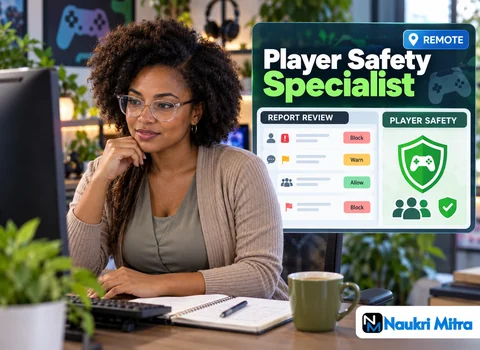
Three reports land in the queue within a minute of each other. The first says a teammate called the reporter "absolute garbage at this game, uninstall." The second flags a voice clip where one player aims a slur at another over their background. The third is a text message, sent after a lost match, that names the other player's city and says they will "find out what happens next." This listing covers one of the remote player safety specialist jobs that exist to sort those three correctly, every shift, on a full-time basis paid at USD 3,500 per month, open to applicants anywhere in the world.
The first one is rude, and it stays up. Most guidelines allow trash talk aimed at play, and punishing it teaches players that reporting is a weapon. You close it as no violation and leave a one-line note saying why.
The second breaks the rules. A slur targeting someone's identity is a clear hate speech violation under almost any game's policy, so you check the player's history, apply the action the enforcement ladder calls for (perhaps a voice mute and a formal warning for a first offence, a suspension for a repeat), and record the clip reference.
The third is the one you slow down for. A location next to a vague threat could be bluster, but you do not decide that alone. You escalate per policy to the specialist team, attach what you saw, and leave the investigating to them.
If you want the plain player safety specialist job description, it is this: you review flagged voice and chat reports, apply the community guidelines, issue warnings, mutes or bans, escalate threats and child safety cases, and record the trends you notice so the policy people can improve the rules.
Internally, community guidelines work like a rulebook with definitions and edge cases. Good specialists know the difference between "harassment" and "targeted harassment" in their game's policy, and they look it up when unsure instead of going on gut feeling.
Many studios run automated detection. The listing names ToxMod, used on voice chat, and Community Sift, used on text chat and usernames; both sort incoming content and attach a rough priority. Neither gives you a verdict. A flag tells you where to look, and you still listen to the full clip or read the surrounding lines. Tools can misread sarcasm between friends or a player quoting what was said to them.
Who said it, to whom, in what match, and after what? Two people in the same party exchanging insults is different from a stranger following someone across three lobbies. Checking prior reports and chat logs before acting is routine.
Players compare bans publicly. Using the enforcement matrix the same way every time protects players and your colleagues.
Some of your decisions will be appealed, and some of those will be reviewed by someone else. Write case notes so a stranger can understand your call in fifteen seconds: what was reported, what you found, which rule, which action. When the same grey-area case keeps coming up, say a new slang term or a meme that is being used to dodge filters, log it and flag it to the policy team.
The two overlap, and some employers use the titles interchangeably. A general content moderator often reviews posts, images or listings across many kinds of platforms against a fixed checklist. A player safety specialist works inside a game's community, deals heavily with live voice and chat, needs to understand how players actually talk in that genre, and usually feeds back into game-specific policy. Gaming knowledge matters here in a way it may not for general moderation.
Most of the queue is ordinary rudeness. Some of it is not. Over a month you will likely see hateful language, self-harm statements, threats and, occasionally, material that suggests a child may be at risk. You do not handle the deep investigation of those last cases; you escalate per policy to the specialist team. You still have to see enough to recognise them.
That builds up. People in this work describe trouble switching off after a shift or the content resurfacing at odd moments. Those reactions are common, and the work has to be managed rather than just endured.
Before you accept any offer, ask the employer directly what wellbeing support they provide. Useful questions: Is there access to counselling, and is it confidential? Are there scheduled breaks away from the queue? Can I rotate off severe content queues? Is there a limit on how long one person spends on the worst categories? This listing does not state any particular support, so treat the answers you get in interviews as part of deciding whether the role is right for you.
A graduate in any field qualifies, as does equivalent experience. About a year in content moderation, customer support or community management is preferred, not required, so newer applicants with the right temperament have a realistic chance. You also need solid written English, real familiarity with online games and their culture, familiarity with ToxMod or Community Sift, and the resilience to review disturbing content without it taking over your week.
The player safety specialist skills that matter most in practice: careful reading, calm judgement, consistency, clear note writing, and knowing when a case is above your pay grade. Volunteer community moderation or game support tickets often build exactly this.
For this listing, the player safety specialist salary is set at USD 3,500 per month, full-time. The page does not turn that into an annual number, and no bonuses or extra perks appear. Pay in this field varies by employer, region and shift pattern, so compare offers on the monthly figure and the support that comes with it.
Player safety specialist jobs remote worldwide are usually offered by game studios and publishers running their own safety teams, by business process outsourcing (BPO) firms that staff moderation for several games, and by trust and safety service vendors. Some are hired in-house; many are hired through an outsourcing partner.
Growth in gaming trust and safety tends to go in a few directions. Strong specialists move into senior reviewer or quality analyst roles, team lead positions, policy writing, or specialist queues that handle the escalated categories after additional training. Others move toward community management or safety tooling.
Anyone wondering how to become player safety specialist with no background should start by reading. Pick two or three big games and study their published community guidelines and enforcement pages closely. Then read through the public documentation for ToxMod and Community Sift so you understand what the tools flag and how severity levels work.
As for training, no single player safety specialist course or player safety specialist certification is universally required by employers. Free trust and safety introductions help, but practical moderation history usually counts for more than a certificate.
Expect player safety specialist interview questions built around scenarios. You may be shown chat logs and asked what action you would take and why, how you would handle a player arguing their ban, or what you would do with a case that worries you but does not clearly break a rule. Rehearse explaining your reasoning aloud.
Your player safety specialist resume should be specific. Instead of "moderated a community," give a concrete example such as "moderated a 12,000-member game community, handled around 40 reports a week, wrote its mute and ban guidelines." List the tools you know, the games you know well, and any experience with escalation or ticket queues.
You pay nothing to apply here. Interviews, training and equipment should never come with a bill, so walk away from anyone who asks for money. If entry level remote player safety specialist jobs hiring now are your search, note that this one accepts people from every country.