
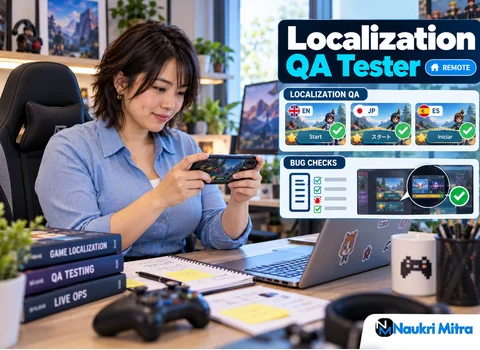
Picture the options screen in German: the save button reads "Einstellungen speich..." because the word ran out of room halfway through. Two menus later, a grizzled mercenary in the Hindi build addresses a street kid with the respectful "aap", as if the boy were his grandfather. Nobody on the dev team noticed, because nobody there reads German or Hindi. Catching that sort of thing is the whole point of remote localization qa tester jobs, and this listing wants a full-time tester who can do it from home for USD 3,500 per month.
Anyone, anywhere, can apply, and all of it happens online. You play pre-release builds in your native language, compare what appears on screen with the source text and glossary, and file bugs that a developer in another time zone can fix without asking you a single follow-up question.
The cleanest way to explain the work is to walk through a single test pass. Say build 0.9.412 lands on a Tuesday morning with a note that the Spanish, Japanese and Hindi strings have been updated.
Before launching anything, you read the test plan. It tells you which areas are in scope (maybe the crafting menu, the first three story chapters and the store page) and which are frozen. Then you open the glossary. If the glossary says the in-game currency is "Shards" in English and keeps that word untranslated, a line that suddenly calls it "Cristales" is a bug, even if "Cristales" sounds nicer. Testers who skip the glossary end up reporting style preferences instead of real defects.
Now you play. Translators often work from spreadsheets with no screenshots, so they cannot see that a string sits on a tiny tooltip or gets spoken by a ten-year-old. You can. You read every dialogue box, item description, tutorial pop-up and error message in the actual game, at the actual resolution, and ask whether it fits, sounds right and means what the English means.
Each bug goes into Jira. A good ticket has a short title ("[HI] Shop tooltip: 'Kharido' truncated at 1920x1080"), the build number, platform, exact repro steps, what you expected, what you saw, the string ID if the tool shows it, and a screenshot with the problem circled. Suggest a fix when you can, such as a shorter word that fits.
When build 0.9.418 arrives, you go back through the tickets marked fixed and confirm them. Sometimes the fix works. Sometimes the shorter German word now fits but the French one broke. You close what is solved, reopen what isn't, and note anything new.
People mix these up. A functional tester hunts crashes, collision holes, broken quests and progression blockers, and can work in English only. A localization tester cares about language: whether the words are correct, complete, readable and suited to the scene. You will still report a crash if you trip over one, but your main value is that you read the game the way a player in your market will.
This is one of those localization qa tester jobs remote worldwide where the language matters more than paperwork. The listing asks for:
No degree is required. Prior LQA or game testing experience helps but will not block you, which makes this a realistic pick among entry level remote localization qa tester jobs for a fluent, observant gamer. If you have been scrolling through localization qa tester jobs no experience posts with little luck, this one is worth a look.
The localization qa tester skills that matter most are close reading, consistency checking against a glossary, and clear written English. Behind those sit a few practical ones: taking clean screenshots, describing repro steps in order, knowing your language's typography rules (spacing before French punctuation, for instance), and understanding how placeholders like %s or {player_name} behave. Patience counts too.
You need a capable PC and a reliable connection, since builds can be large and you may stream or download them often. A decent monitor helps, because truncation at one resolution can disappear at another. Console experience is useful for spotting platform-specific text such as button prompts, though the listing only names PC or console gaming knowledge, not your own dev kit.
This position is full-time and pays USD 3,500 per month. The listing gives it as a monthly rate, so read it that way. If you are searching for localization qa tester salary per month, treat this number as what this role offers, not as a market average. Pay elsewhere depends on language pair, studio and region, and no single figure applies everywhere.
It can be. Many people start in LQA and move into lead tester roles, localization project coordination, translation, or wider QA. The skills carry over well: you learn how games are built and shipped, how teams handle text, and how to communicate defects clearly across languages.
Wondering how to become localization qa tester without formal training? Start small. Pick a game you know that offers your language, switch it on, and keep a notebook of every awkward line, cut-off label or mistranslation you find. Write each one up as if it were a ticket. That gives you real samples to talk about.
On a localization qa tester course or a localization qa tester certification: none is required here. Free material on QA basics, writing bug reports and Jira's own documentation will get you most of the way. A small portfolio of sample tickets usually impresses hiring leads more than a certificate does.
For your localization qa tester resume, list your native language and English level at the top, the platforms and genres you play, any translation or testing work, and attention-to-detail examples.
Expect localization qa tester interview questions that test you live: a screenshot with three hidden errors, a source line and a weak translation to critique, or a request to write a bug report on the spot. Practice reading a screen slowly and describing what is wrong in plain words.
Apply through the listing with a short note naming your native language, your English level, the games and platforms you know best, and any testing background. Attach one or two sample bug write-ups if you have them. Real employers never charge you for a test, a headset or training. If anyone asks for money in exchange for one of these localization qa tester work from home jobs, walk away. This listing is open now, and applying costs nothing.