
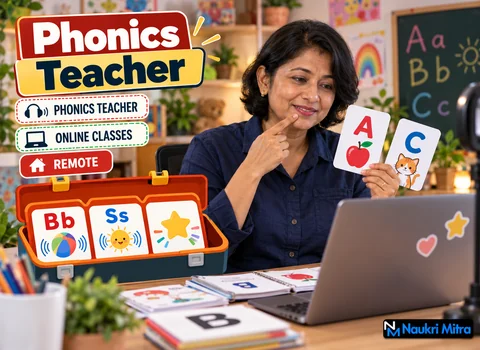
Picture a five-year-old whose whole face fills the screen. He holds the card so close to the webcam that the letters blur into a red smudge, and he says it anyway: "c... a... t." After a pause comes a louder "Cat!" He is right, and he knows it. If that small moment makes you smile, online phonics teacher jobs may suit you. The post is part-time and home-based, applicants can live in any country, and it pays eight US dollars an hour for teaching young children to hear English sounds and blend them into words in short live classes.
An online phonics teacher helps young children connect letters to the sounds they make, then stitch those sounds into words. On paper, the phonics teacher job description is short: teach letter sounds, blending, segmenting and CVC words, keep children engaged with flashcards, songs and games, set light reading practice, and send parents progress notes.
Young children concentrate for only a few minutes at a stretch, so each class is built in small pieces. The sections below follow one class from start to finish.
Class opens with a wave and a name. You check that the child can hear you, that the parent has the microphone on, and that the screen is not pointed at the ceiling. A short hello song with actions comes next, followed by a quick review of a few cards from last week. If they forget, say it with them and move on. The warm-up should make them feel clever, not tested.
Each class introduces one new letter sound. In the Jolly Phonics approach, every sound comes with a short story and a hand action. For /s/, you might weave your hand like a snake and hiss. For /a/, you might wiggle your fingers up your arm as if ants were crawling there.
You show the letter shape, say the pure sound ("sss", not "suh"), and ask the child to copy both the sound and the action. A quick hunt follows: which picture starts with /s/, the sun, the sock or the cat?
Blending sits at the centre of the lesson. It means saying sounds one after another and pushing them together into a word. CVC words (consonant, vowel, consonant, such as cat, sit, map and hop) are where most children start.
Try "sound buttons": tap under each letter as you say it, then sweep your finger along the word and say it whole. Go slowly at first. Some children blend straight away; others say "c-a-t" correctly many times before the word suddenly appears. Segmenting is the reverse. You say "pin" and the child splits it into /p/ /i/ /n/, holding up a finger for each sound.
Pay attention to your own voice. An extra "uh" on each consonant ("cuh-a-tuh") makes blending nearly impossible.
By now the child is ready to play, and so are you. Good phonics teaching tools are often very plain:
Each game is really more blending practice in disguise. A child who will not read a list of five words will happily read the same five to "feed" a hungry monster puppet.
End on a high. Praise one specific thing ("You blended 'map' all by yourself!"), sing a goodbye song and wave. Then, after the call, set a short practice task: a few CVC words to read with a parent, or a page of sound pictures to colour.
The parent note comes last. Mention the sound taught and what went well, and suggest one thing to practise at home.
A Jolly Phonics certificate, or a similar phonics teacher course, is preferred for this role. Training of this kind usually covers the full set of letter sounds, the order they are taught in, the stories and actions, tricky words, and how to teach blending and segmenting. Length and format vary by provider.
Plenty of people type "how to become phonics teacher" into a search bar with little background. A recognised phonics teacher certification helps, and these steps get you started:
Phonics teacher jobs for freshers do exist, and people searching for phonics teacher jobs no experience should know a demo class often counts for more than years on a CV. On your phonics teacher resume, list any training, time spent with young children (nursery, Sunday school, tutoring, babysitting), and your setup. Typical phonics teacher interview questions ask you to say a set of sounds aloud, explain how you would teach blending, and show how you would handle a shy or restless child. A short sample lesson is the best way to answer that last part.
Each hour of live phonics teaching earns $8 USD. Across the wider market, phonics teacher salary figures vary a great deal by platform, training and student time zone, so treat any number you see elsewhere as a rough guide rather than a promise.
Like most part time phonics teacher jobs, classes are short and slot around study, family or another job. Hours depend on student bookings and can change week to week.
A studio is not needed, though a tidy, well-lit corner helps a lot on Zoom or any video tool:
Do a test call first, and hold cards at arm's length, not right up to the lens.
Platforms hiring online phonics teachers for kids include children's English academies that run live classes, general tutoring marketplaces where teachers list their own profile, and small schools that offer extra reading support online. Some arrangements are freelance, where you are paid per class, while others are ongoing part-time roles like this one.
Much of the demand comes from parents who want early reading support at home, including many families outside English-speaking countries whose children get little one-to-one practice at school.
People often lump these roles together, but they teach different things. A phonics teacher works on the code of reading: which letters make which sounds, and how sounds blend into written words. Lessons follow a set sequence, and progress shows up as a child reading new words off a card.
A spoken English teacher for kids works on talking and listening: vocabulary, sentence patterns, conversation and confidence. There may be no reading at all in a lesson. The phonics teacher skills that matter most are precise sound pronunciation and patience with repetition, along with a sense of when a child is close to blending. A spoken English class leans more on conversation and role-play. Many teachers do both, but if you love that "Cat!" moment, phonics is the closer fit.