
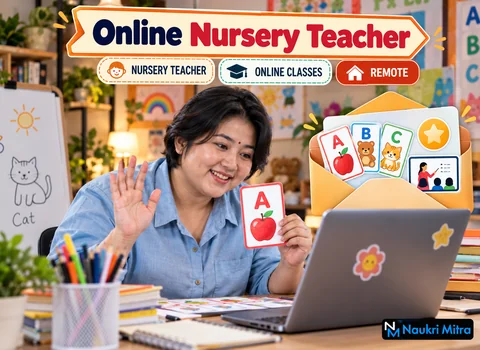
The hello song starts and eight small faces fill the screen. One child is upside down on a sofa, one is holding a toy giraffe to the camera, and a mum leans in to find the mute button for her son, who has decided to sing louder than everyone else. That is circle time in remote nursery teacher jobs, and this full-time post asks you to lead it every morning. You teach from home, wherever in the world home happens to be, and the monthly salary is $400 in USD. You will run live classes with rhymes, phonics, stories and play for toddlers, track early milestones and keep parents in the loop.
Put simply, you teach the same things a good nursery room teaches, only through a webcam. Each day you run live group classes for very young children, usually aged around two to five, using songs, picture stories, sound games and movement. You also watch for early learning signs, such as a child answering in a full sentence for the first time.
The written nursery teacher job description for this post covers four areas: live teaching, activity planning, milestone tracking and parent updates.
Timetables vary by batch and by the time zones of the families you teach, so treat this as an example rather than a fixed schedule.
Laptop charged, ring light on, puppet ready, flashcards stacked in order. You test your audio and keep water close, because singing is thirsty work.
Children trickle in and you greet each one by name, which matters more to a three-year-old than any lesson plan. The hello song runs twice so late arrivals can join in.
Today's sound is "b". A ball bounces on screen, a big red "b" card comes up, and children copy the sound with their mouths wide. Then a hunt: "Find something that starts with b!" Bananas, books and one baby brother appear.
A short picture story, then everyone stands for an action rhyme, stretching tall like trees.
A calm goodbye song, then quick notes on each child before the next group logs in.
Toddlers learn by doing, so passive watching is the enemy. Good online nursery class activities give children something to say, touch or move every few minutes. A typical mix includes:
You will also prepare simple weekly activity plans so parents know what is coming and can keep a crayon or a spoon ready.
The basics are a laptop whose camera works and broadband that will not freeze halfway through a rhyme. Classes usually run on a video platform such as Zoom or Google Meet, or on the school's own classroom software. You should be comfortable sharing your screen and muting a noisy line kindly.
The fun part is the physical kit. Large, bold flashcards read well on a small phone screen. Hand puppets give shy children someone to talk to. A soft ball, a scarf and a small whiteboard cover a lot of ground. Keep your background plain so the props stand out.
Very young children cannot sit for long. Sessions for this age group are usually short, often somewhere between 20 and 45 minutes depending on age and the school's plan, with a change of activity every few minutes. Sit at eye level with the camera, frame yourself from the waist up so hand actions show, and face a window or light rather than sitting with it behind you. Speak a little slower than normal.
In a physical nursery, parents wave at the door and leave. Online, a parent or carer is often right beside the child, holding the tablet, helping with the mute button, sometimes answering for them.
Keep every update on the school's official channels. That protects you, the family and the child.
Teaching minors on camera carries real responsibility. You will be expected to follow the school's child safeguarding policy and a clear code of conduct, which normally includes:
Some schools ask for a background check or a signed conduct agreement before your first class.
An NTT (Nursery Teacher Training), ECCE (Early Childhood Care and Education) or equivalent early childhood qualification is required. Two to three years of nursery or preschool teaching experience is preferred, though not mandatory. Beyond paperwork, the nursery teacher skills that matter most here are cheerful, clear English, real comfort on camera, patience with very short attention spans and confident use of props and flashcards.
The usual first step is a recognised nursery teacher course, and many of these end with a nursery teacher certification. Then build practice by volunteering at a playgroup or recording demo lessons. Entry level remote nursery teacher jobs do exist for people with little classroom time, but even those usually expect the qualification plus a confident demo class.
This is a full-time position paying $400 per month in USD, worked entirely from home and open worldwide. Confirm class timings and payment method in writing before you start. Elsewhere, a nursery teacher salary may be quoted monthly or as a nursery teacher salary per year, and the figure moves a great deal between countries and schools, so judge any offer by its written terms.
A nursery teacher works with the youngest learners, focusing on speech, social habits, sounds and early motor skills through play. Kindergarten teaching, usually for slightly older children, adds more structured reading, writing and number work and longer sessions.
Growth in early childhood online teaching can follow several paths: lead teacher for a group of batches, curriculum writer for activity plans, teacher trainer who reviews demo classes, or parent-engagement coordinator.
Online preschools, early-learning platforms and tutoring services hire for nursery teacher work from home jobs, and many advertise nursery teacher jobs remote worldwide. To stand out, keep your nursery teacher resume to one or two pages. List your qualification, age groups taught and platforms you know; a short demo video helps.
Nursery teacher interview questions often ask you to soothe a crying child over video, or to tell a parent kindly that progress is slow. Expect a live demo class too.
When you see remote nursery teacher jobs hiring now, check carefully. A real preschool never charges an application fee or sells you its starter kit. Fuzzy duties, interviews conducted purely by text, a demand that you decide by tonight, or a request for bank papers and identity proof ahead of any written offer are all reasons to slow down. Ask for a contract that states pay, hours and notice terms, and look for the organisation's real address and reviews from other teachers.