
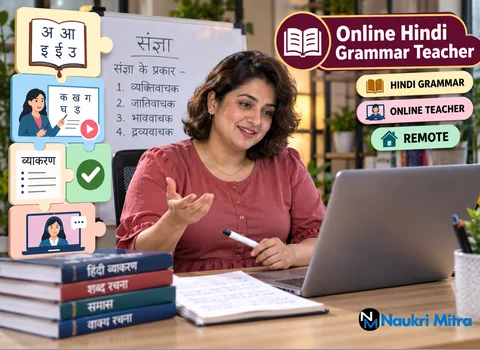
A Class 8 student writes विद्यालय = विद्या + लय and looks pleased. The teacher puts a small circle around the split and asks one question: where did the long आ of आलय go? The word is विद्या + आलय. When आ meets आ, the two join into a single long आ, and that is दीर्घ संधि. The student rewrites it, says the rule aloud once, and next time catches it alone. That kind of patient correction is what these online Hindi grammar teacher jobs are about. You can apply from any country; the role is Part-time, taught online from home, and pays $8 per hour (USD). You teach Hindi vyakaran in live video classes, prepare worksheets and online quizzes, correct written exercises, and help students write letters, essays and comprehension answers for their school exams.
Most of the hours go into live classes. A lesson usually opens with a short warm-up from the last topic, moves to one new rule with two or three examples, and ends with practice the student does while you watch. Outside class you prepare the next worksheet, set a quick quiz, and mark the exercises that came in.
The topics are the usual school grammar areas: sandhi, samas, karak, ras and alankar, with letter writing, essays and unseen passages alongside. A good Hindi grammar teacher job description is this list plus one expectation: that you explain each rule so clearly that a child can repeat it back in their own words.
Many students find sandhi hard, often because they try to memorise splits instead of seeing the sound change. It helps to teach it in three families: स्वर संधि (vowel meets vowel), व्यंजन संधि (a consonant is involved) and विसर्ग संधि (the visarga changes). Inside स्वर संधि, start with the easy ones. दीर्घ संधि joins similar vowels into a long one, as in विद्यालय. गुण संधि turns अ + इ into ए, so देव + इन्द्र becomes देवेन्द्र.
One rule is worth being strict about: every split must give two real words. If the student writes a piece that is not a word, the split is wrong, full stop.
Samas joins words into one compound, and the student must be able to open it back up with a vigraha. राजपुत्र opens as राजा का पुत्र, so it is तत्पुरुष. Now give them दशानन. Most will write दस आनन and stop. Ask whom the word refers to. दस हैं आनन जिसके, that is, रावण, and because the compound points to someone outside the two words, it is बहुव्रीहि.
Students also mix up sandhi and samas. A short way to put it: sandhi is about sounds joining, samas is about words and meaning joining. A child who can say that sentence usually stops confusing the two.
Karak is where non-native learners and school children meet the same wall. The markers are small, but each carries a role. ने marks the doer in many past-tense sentences, को often marks the object or receiver, से can mean "with" (करण) or "from" in the sense of separation (अपादान), के लिए shows purpose, का, के, की show relation, and में and पर show place. A sentence such as राम ने चाकू से फल काटा lets you point to three karak in one line (कर्ता, करण and कर्म, even though फल carries no marker).
Ask students to build one sentence for each marker and read it aloud.
Higher classes bring poetry, and with it ras and alankar. For alankar, start with sound and comparison. अनुप्रास repeats a sound, as in चारु चंद्र की चंचल किरणें. उपमा compares openly with words such as सा, सम or समान: मुख चन्द्रमा के समान सुन्दर है.
For ras, connect each one to a feeling the student already knows: वीर for courage, करुण for grief, हास्य for laughter, शान्त for calm. Then read a short passage together and have them name the ras with a reason.
Grammar has to show up in writing. You will guide students through formal and informal letters (the format, the opening line, the closing), short essays with a clear introduction and conclusion, and unseen passages where they must answer in their own words. When marking, correct the spelling, the matra and the karak first, then the structure. Return the work with two or three specific notes rather than a page of red ink.
Online classes need simple tools that work every time. Most teachers use a video call app with screen sharing, a shared document or whiteboard for live writing, and a form or quiz tool for short tests. A worksheet can be a one-page document with ten sandhi splits and five samas vigraha. A quiz can be eight quick questions the student answers before the next lesson.
Clean Devanagari typing saves a lot of time. A few setup tips:
The listing asks for an MA in Hindi, ideally with a B.Ed. Some school or tutoring experience is preferred. You need thorough knowledge of vyakaran (sandhi, samas, karak and alankar), fluent Devanagari typing, clear explanations, and a laptop with a webcam and stable internet.
Teaching experience is preferred rather than listed as required, which leaves the door open to an MA Hindi graduate searching for Hindi grammar teacher jobs for freshers. The subject training still has to be there. If you want to become a Hindi grammar teacher without years in a classroom, a B.Ed or a short Hindi grammar teacher course on teaching methods helps. Any Hindi grammar teacher certification you hold is worth listing. On your Hindi grammar teacher resume, put your degree first, then any teaching or tutoring, then two or three topics you teach especially well.
The Hindi grammar teacher skills that matter most are accuracy, patience and the habit of giving a small example before a long rule. In a demo or interview, expect to explain a sandhi split, correct a sample paragraph, or show how you would start a lesson for a beginner.
A school student in India or abroad usually already speaks some Hindi. Their need is exam grammar: named rules, standard examples, the textbook's terms, and written answers in the expected format.
A non-native adult learner is different. They may not read Devanagari yet, and the word "karak" means nothing to them at first. Start with the script, then sentence patterns, and explain the case markers through English comparisons before naming them. Sandhi and alankar come much later, if at all.
Classes bring in $8 per hour (USD). The job is Part-time, so it can sit alongside a school post, study or other tutoring. Hindi grammar teacher salary arrangements in the wider market vary: some places pay per class, some per student, some per month. Only the hourly USD figure applies to this post. When you compare Hindi grammar teacher salary per hour figures from other offers, look at each one separately.
The work also suits anyone looking for Hindi grammar teacher work from home, since every class runs online from your own desk.
To begin, prepare a short demo lesson on one topic, a sample worksheet, and a clean profile that lists your degree and the classes you can teach. Test your camera, microphone and screen sharing before the first session. Marketplace platforms such as Preply and italki are examples of where language tutors list themselves, and many teachers also find part time Hindi grammar teacher jobs through schools or private referrals. Freelance Hindi grammar teacher jobs work in a similar way: you choose your topics, keep good records and build a reputation through students' progress.
Interest can come from several directions: families abroad who want children to keep up their Hindi, students in India who want extra help before school exams, and adult learners who study Hindi for work, travel, films or family.