
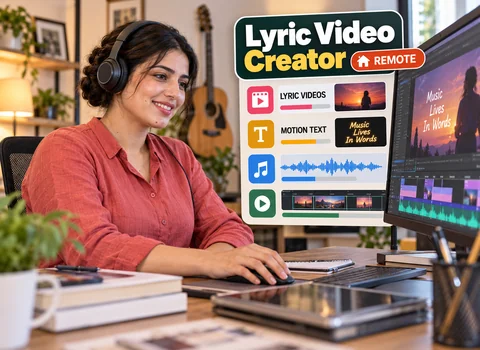
00:12.40 "low tide" lands on the snare. 00:13.85 "on Ward Road" slides in from the left on the hi-hat run. 00:16.90 the chorus word "stay" holds for three beats, then shatters on the crash. That is the top of a cue sheet for "Salt on the Window", a song invented for this listing. These online lyric video creator jobs pay $18 per hour (USD), with part-time hours done entirely from home and open to editors in any country. You map the beats of a licensed song, set its words in motion and deliver files for YouTube and Reels.
In short, the role makes words behave like an instrument. Each line arrives with the singer and moves to suit the track. A slow piano ballad wants soft fades and wide letter spacing. A drill track wants hard cuts and type that hits on the kick. The lyric video creator job description here covers four things: syncing lyrics line by line to the audio, animating kinetic typography and backgrounds in After Effects, Premiere Pro or CapCut, matching the mood of each song, and exporting for YouTube and Reels.
Freelancers often quote per video, but this listing pays by the hour. Searches for lyric video creator salary per hour show a wide spread; here the rate is $18. Release-day bonuses are the employer's call, not part of this offer. Hours vary by project.
Before a letter moves, you build a map. Play the song and tap a marker on every downbeat. Then mark where each line starts and ends, plus moments that deserve an accent: a snare fill, a drop, a breath before the chorus. In After Effects you can press the asterisk key on the numeric keypad during preview to lay markers in time. In Premiere Pro, the M key does the same on the timeline.
Of all lyric video creator skills, timing is the one clients notice first. Words two frames late feel wrong even to viewers who could not say why, so many creators let a word appear a frame early. Check it on headphones.
Kinetic typography is the craft of making letters carry rhythm and feeling. The usual controls are position, scale, rotation, opacity, tracking and blur, timed with easing curves so movement settles instead of stopping dead. Give your typefaces rules: verses in a quiet weight, the hook in a heavy one.
Backgrounds, such as a looping texture or a gradient that shifts colour at the key change, must stay calm enough for words to read on a phone. A kinetic typography course on any learning platform, or tutorials on text animators and expressions, will teach the mechanics. No lyric video creator course or certification is required for this role; your reel matters far more than a certificate.
After Effects is where the detailed work lives. Text layers with animators let you reveal a line by character or by word, and the range selector can be keyed to your beat markers. Many creators use one layer per line, trimmed to the markers. Premiere Pro handles lighter jobs, such as simple fades over a client's footage, with heavier animation brought in from After Effects through Dynamic Link.
Say a client sends "Salt on the Window": a three-minute indie track at 92 BPM, a WAV master, the lyric sheet. You build the beat map in the first hour. Verses get a soft serif that types on word by word. In the chorus, "stay" scales up on the downbeat, holds for three beats, then breaks apart on the crash cymbal using a hand-built particle layer. The background is a slow push over a rainy window texture the client licensed. You send a low-resolution draft with a burned-in timecode, so notes can read "01:42.10, line comes in late". One revision round fixes two timing slips and a typo in the bridge, and you export the finals.
Artists often want a 15 to 30 second cut of the hook for Reels, Shorts or TikTok. CapCut is quick for this: a vertical canvas, auto-captions and a beat feature that drops markers for you. Treat its auto-captions as a rough start, never a finished sync, because sung lyrics trip up speech recognition. Check every word against the lyric sheet.
The main video is usually 1920 by 1080 or 3840 by 2160 at the frame rate the client sets, H.264 in an MP4 wrapper, with AAC audio at 48 kHz. The short cut is 1080 by 1920 in 9:16. Keep words inside the safe area, since Reels and Shorts cover the lower and right edges with buttons and captions. Name exports clearly, for example salt-window_yt_16x9_v3.mp4.
A song carries two copyrights: one in the sound recording and one in the composition, which includes the lyrics. The client must hold, or have written permission for, both before a lyric video goes public. A fan wanting a video for someone else's hit is not covered; decline that job. YouTube Content ID scans uploads and can claim a video that uses music without a licence. The rights holder may then take its ad revenue, track it or block it in some or all countries, and a formal copyright takedown can remove it. Use only fonts and textures licensed for commercial video.
Can you earn from lyric videos on YouTube yourself? Only with songs you hold the rights to, and only once your channel meets the YouTube Partner Program requirements. On this listing you are paid for the work, not from views.
Part time lyric video creator jobs follow release calendars. A typical week might hold one full video and a couple of short cuts. A brief and audio arrive. You send a style frame and a chorus test, then the full draft, then one or two revision rounds against a fixed premiere date.
A good lyric video creator work from home setup starts with a computer that can edit and render video, ideally with 16 GB of RAM or more and SSD storage. A calibrated screen keeps gradient backgrounds predictable. Stable broadband matters because WAV masters and 4K renders are large. Store each project in the cloud under names like v03_final_mix, and treat unreleased songs as private.
Your reel is the application. Keep it under two minutes, open with your best sync moment, show one slow track, one fast one and a vertical short, and use only licensed or approved music.
On a lyric video creator resume, list your software, the styles you handle and links to finished pieces. Expect a short sync test, perhaps 30 seconds of audio and lyrics to animate. A fair test is short; a full video requested "as a test" is unpaid work. Interview questions are practical, such as what you do when the lyric sheet does not match the recording.
Lyric video creator jobs for freshers are realistic here, because no degree or prior experience is required, only a reel. To land a first client, many beginners make two or three videos for independent artists who agree in writing. Musicians also hire on marketplaces such as Fiverr and SoundBetter, examples of a market with its own fees and terms.
A music video editor cuts filmed footage: performance takes, story scenes, colour and pacing. A lyric video is mostly typography and graphics built from the audio and lyric sheet, with footage as an optional layer. From here many creators move into motion design for album campaigns and animated cover art. Freelance lyric video creator jobs reward people who never miss a release date.
Applying is free. Send your reel link, your editing tools, favourite lyric styles and time zone.