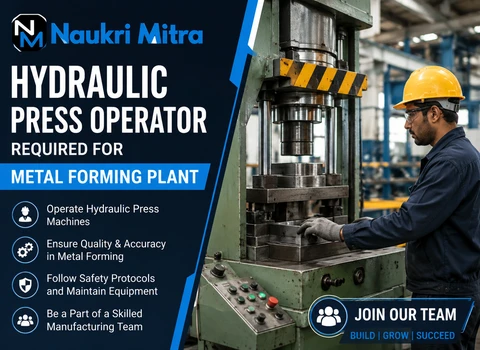
The Thud You Hear Before You See the Machine
Step onto the floor of a metal forming unit and one sound stands out — a steady, mechanical thud, sheet after sheet, shaped in seconds. That's the hydraulic press at work. A Hydraulic Press Operator Is Required for a metal forming plant; they handle this machine directly, feeding in raw metal and pulling out formed parts used later in vehicles, appliances, and industrial machinery. It's a full-time job based in Faridabad, Haryana, India — and honestly, it's not a role for someone who wants a quiet desk job.
Machines Don't Run Themselves
A hydraulic press bends, punches, or shapes metal using controlled fluid pressure. Simple in concept. Not so simple in practice — get the pressure or alignment wrong, and you either damage the die or end up with a stack of rejected parts. Plants hire for this role because that margin for error is small, and someone has to own it.
What Actually Happens on Shift
Mornings usually start with a walk-around: oil levels, pressure readings, die alignment. Nothing runs until that's cleared. Then it's loading sheets, setting stroke length, running a couple of test pieces, and only then starting full production. From there, it's repetition — but the kind that demands attention, because one distracted moment can throw off an entire batch.
- Positioning and feeding metal blanks into the press
- Watching pressure gauges and hydraulic fluid levels
- Swapping or adjusting dies and punches between jobs
- Checking finished parts against dimension specs
- Logging output and flagging anything that looks off
Faridabad's Industrial Backbone
This kind of work is common in metal forming units, auto component factories, and sheet metal fabrication shops. Faridabad has been part of Haryana's manufacturing landscape for decades, and plants here regularly need hands-on operators who know their way around a press floor.
The Tools of the Trade
It's not just the press. Operators handle dies, punches, vernier calipers, micrometers, and dial gauges throughout the shift to check whether parts meet spec. Some setups also run on hydraulic power packs with pressure control valves — worth knowing, even at a basic level.
What Gets Someone Hired
Knowing the machine helps, but judgment matters more. Employers may prefer candidates with relevant machining or tool room training. Depending on the complexity of the work, an ITI in a machining-related trade, a Diploma in Mechanical or Tool and Die Engineering, or equivalent vocational training may be considered suitable. Practical experience with EDM machines, engineering drawings, and precision measuring instruments is often valued as much as formal education.
Freshers straight out of ITI and experienced hands moving between plants both land these roles regularly — most plants train operators on their specific press model anyway.
On Your Feet, Most of the Day
Expect long hours of standing, some lifting, and constant awareness of nearby moving parts. Rotational shifts are common because production rarely stops at the end of the day.
Around Heavy Machinery, Shortcuts Aren't Worth It
A hydraulic press applies serious mechanical force. Safety shoes, gloves, and eye protection are standard, and lockout steps during maintenance aren't optional extras — they're the difference between routine work and a serious accident. Guards and safety switches stay in place, always, no matter how much of a hurry the shift is in.
The Less Glamorous Parts of the Job
Noise. Repetition. The occasional jammed sheet or misfed blank. None of it is dramatic, but it adds up over a shift. Operators who last in this trade tend to check the dies before every batch starts and speak up the moment something sounds wrong, rather than waiting to see if it fixes itself.
Where the Experience Can Take You
Time on the floor tends to open doors — senior operator, shift in-charge, die-setting specialist. Some operators end up training newer hires or moving toward quality inspection, still within the same plant, still in the same trade.
What It Pays, and What Else Might Come With It
The role pays ₹28,500 a month. Beyond that, some employers offer overtime, PF, ESI, bonus, uniforms, transport, or canteen access — not guaranteed everywhere, but common enough to ask about during hiring.
If working with machines and getting precision right sound like your kind of job, this full-time position in Faridabad is a solid way to enter India's manufacturing sector.