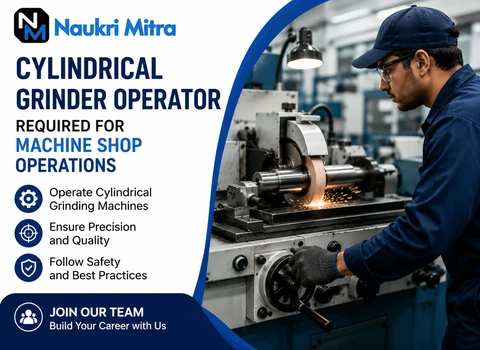
What Does a Cylindrical Grinder Operator Actually Do?
Ask anyone on a machine shop floor, and they'll tell you: grinding is where the real precision happens. A Cylindrical Grinder Operator runs the machines that bring shafts, pins, rollers, and bushings down to their final, exact size — often to within a few microns. This job is currently open in Pune, Maharashtra, for a full-time role paying ₹27,500 per month.
It's not a glamorous title, but it's one of those roles a factory genuinely can't run without.
Why This Job Exists in the First Place
A lathe can shape metal. A mill can cut it. But neither gets a shaft round enough or smooth enough for something like a bearing seat or a hydraulic piston. That last bit of finishing precision comes from grinding. Get it wrong — even by a hair — and the part is scrap. That's the whole reason this role exists: someone has to own that final, unforgiving step.
A Day on the Floor
No two days are identical, but there's a rhythm to it. Machines get checked first thing. The grinding wheel gets a once-over for wear. Then the drawing for the job comes out, and the real work starts:
- Loading the workpiece — between centers, or into a chuck
- Picking the right wheel for the material being ground
- Taking a trial pass, then measuring before committing
- Fine-tuning feed rate and speed until the finish is right
- Logging readings and flagging anything off-spec to the supervisor
Some shifts mean grinding one high-tolerance part for hours straight. Others are all changeovers — small batches, different setups, back-to-back.
More Than Just Running a Machine
The actual grinding is only part of it. An operator reads the drawing, calculates the tolerance, and ensures the piece is right before it's allowed to move forward. If the wheel starts wearing unevenly, that gets reported — not ignored. Keeping the machine clean and sticking to the production schedule matters just as much as the grinding itself.
Where People With This Skill End Up Working
Automotive component units hire for this. So do general engineering workshops, tool rooms, and factories making hydraulic or pneumatic parts. You won't find this work outdoors — it's floor work, inside a shop or a manufacturing unit. Pune has a fair number of engineering and auto-ancillary companies, which is part of why this kind of role often shows up here.
What's on the Workbench
The grinding machine gets all the attention, but half the job happens with instruments in hand. Micrometers and vernier calipers for checking size. Dial gauges and bore gauges for roundness. A surface plate to set a proper reference. A diamond dresser to keep the wheel true. And coolant running the whole time, because grinding generates real heat.
In tool rooms especially, knowing your way around an EDM machine and being able to read a technical drawing without help counts for a lot.
What Separates a Good Operator From an Average One
Technical skill gets you in the door. Patience keeps you there. The operators who last are the ones who catch a problem before it becomes ten bad parts — people who read drawings properly, know their tolerance limits cold, and don't need someone standing over their shoulder every time something looks slightly off. On the softer side: showing up on time, working well with the rest of the shift, and being upfront when something's gone wrong instead of quietly hoping no one notices.
What Kind of Training Helps
It varies with the complexity of the work. An ITI certificate in a machining trade is often enough for entry-level positions. For more demanding tool room work, employers sometimes look for a Diploma in Mechanical or Tool and Die Engineering, or similar vocational training. That said, plenty of shop floors care more about hands-on experience with measuring instruments and drawings than about the certificate itself — which is good news for freshers who've had solid practical training, and for experienced hands who've simply learned it on the job.
What the Body Deals With
You're on your feet most of the shift. There's metal handling involved, and you need to stay switched on around machinery that doesn't wait for a distracted moment. Shops can get loud, and grinding does throw off heat — decent ventilation and coolant systems handle most of that in properly run units. Shift work is fairly standard in manufacturing, so some flexibility around timing is usually part of the deal.
Staying Safe Around the Wheel
A rotating grinding wheel doesn't forgive carelessness. Safety glasses, gloves built for machine work, safety shoes, and ear protection in loud areas are the basics most shops expect. Lockout procedures during maintenance aren't optional, and machine guards exist for a reason — bypassing them is how people get hurt.
What Actually Trips People Up
Long production runs test your consistency, and wheel wear can quietly throw off measurements if nobody's checking. The operators who avoid trouble build measurement checks into their routine rather than treating them as an afterthought, and they take care of their tools instead of running them into the ground. There's also a skill in listening — a change in the machine's sound or vibration often tells you something's wrong before the measurement does.
Where This Can Lead
Do the job well for long enough, and the path forward usually opens up on its own. That might mean handling tougher, higher-precision jobs, stepping into a small supervisory role, or moving into quality inspection within the same setup. Operators who pick up multiple grinding techniques and become comfortable with a wider range of measuring instruments tend to be considered for senior technician roles down the line.
Pay and What Might Come With It
This full-time role, based in Pune, Maharashtra, pays ₹27,500 per month. Some employers add overtime pay, PF, ESI, an annual bonus, uniforms, or transport and canteen facilities on top of that — though this isn't the same everywhere, and it's worth confirming what's actually on offer rather than assuming.
If precision machining is a field you're considering, this is a reasonably solid place to start — and a trade where the skills you build only get more valuable the longer you're in it.