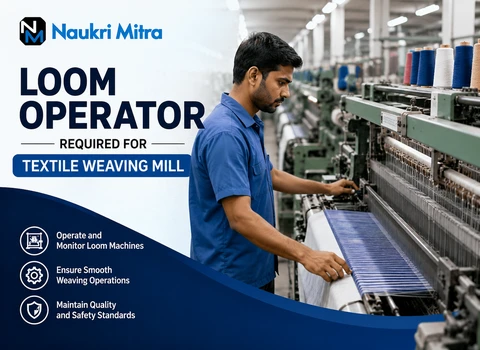
What Does a Loom Operator Actually Do?
Walk onto the floor of any weaving mill, and you'll hear it before you see it — the steady clatter of dozens of looms running at once. Somewhere in that noise is the Loom Operator, moving between machines, checking threads, catching problems before they turn into wasted fabric. A textile weaving mill in Bhiwandi, Maharashtra, India, is hiring for this position right now on a Full-time basis, paying ₹26,500 per month.
It's not a desk job, and it's not glamorous. But it's one of the backbone roles that keeps India's textile sector moving.
Why This Job Exists in the First Place
Looms don't run themselves. Even the automatic ones need someone watching for thread breaks, yarn shortages, and fabric defects. Leave a machine unsupervised for ten minutes, and you could end up with meters of ruined cloth — wasted yarn, wasted time, and a quality problem the mill has to answer for. That's the real reason mills keep hiring for this role. Production targets and fabric quality both depend on having someone reliable at the machine.
A Shift on the Weaving Floor
Most operators start their shift by checking the basics — yarn supply, tension settings, and whether the machine ran cleanly the previous shift. Then it's threading new bobbins, watching the fabric come off the loom inch by inch, and stepping in the second something looks off. A snapped thread here, a loose weave there. Somewhere in between, there's paperwork too — production counts, defect logs, handovers to the next shift.
What the Job Actually Involves
- Running power looms or shuttleless looms to hit daily output targets
- Spotting and fixing thread breaks and weaving faults as they happen
- Changing yarn beams and bobbins mid-production
- Basic cleaning and lubrication of loom parts
- Keeping production and quality records up to date
- Working with supervisors and quality checkers when fabric doesn't meet standard
Where You'd Actually Be Working
This kind of work happens in textile weaving mills and powerloom units — factory floors packed with rows of running machines. Bhiwandi has long been one of Maharashtra's biggest powerloom hubs, and mills there supply fabric to buyers across the country. It's loud, it's fast-paced, and there's rarely a quiet moment once the machines are up and running.
The Tools of the Trade
Power looms are the main equipment here, and increasingly, shuttleless or automatic looms in the more modern units. Around them, operators handle bobbin winders, warping machines, shuttle and pirn tools. Measuring fabric width or checking thread density comes down to simple tools — tape measures, thread counters — but knowing what the numbers mean matters more than the tools themselves. Tension too tight or too loose, yarn quality slipping, machine speed mismatched to the thread — all of it shows up in the finished cloth if you're not paying attention.
What Separates a Good Operator from an Average One
Sharp eyes matter more than people expect. A defect that's easy to miss at a glance can run for meters before someone catches it, and by then the damage is done. Add to that steady hands, patience for repetitive work stretched across a long shift, and a working sense of how the machine behaves when something's about to go wrong.
An ITI qualification in a textile or mechanical trade is often preferred, though many operators pick up the craft on the shop floor, learning from senior workers over months rather than in a classroom. Basic mechanical troubleshooting helps too — many small loom adjustments are handled by the operator directly, without waiting on the maintenance team every time.
The Physical Side of the Job
You're on your feet for most of the shift. There's bending to thread yarn, walking between machines, reaching to check tension or clear a jam. It adds up over a full day. Weaving mills typically run rotational shifts to keep production going around the clock, so day shifts, night shifts, and rotating schedules are all part of the deal depending on the mill.
Staying Safe Around the Machines
Moving parts, flying lint, constant noise — a weaving floor has its share of hazards, and safety habits aren't optional. Ear protection, safety shoes, and dust masks are standard PPE for this work. Loose clothing and untied hair near a running loom is asking for trouble. Faulty wiring or a mechanical fault that isn't reported quickly can worsen.
The Hard Parts Nobody Mentions Upfront
New operators usually struggle with two things first — the noise, and the speed needed to catch a defect before it spreads across several meters of fabric. Humid weather brings its own headache, with yarn breaking more often than usual. Power fluctuations cause downtime too, and there's not much an operator can do about that except stay ready to restart cleanly once power's back. Experienced hands handle all this by staying alert, keeping their tools organized, and not letting small issues go unresolved.
Where the Job Can Lead
Stick with it, and there's a real path forward. Operators who consistently perform well often move into senior operator roles, shift supervision, or quality checking within the same mill. The ones who really understand machine settings — not just running them, but tuning them — end up training newer workers or getting handed the more advanced automatic looms.
Pay and What Else Might Come With It
This Full-time role in Bhiwandi, Maharashtra, India pays ₹26,500 per month. Beyond the base salary, some mills offer overtime pay, PF and ESI coverage, festival bonuses, uniforms, or canteen and transport facilities — though this depends entirely on the individual employer and shouldn't be assumed as guaranteed.
If You're Thinking About This as a Career
Patience and attention to detail will take you further here than any certificate. If you can, visit a working mill before deciding — talk to operators already on the floor, see the pace for yourself. For freshers and ITI candidates especially, showing up willing to learn beats prior experience most of the time. Mills would rather train someone attentive than manage someone who already thinks they know it all.