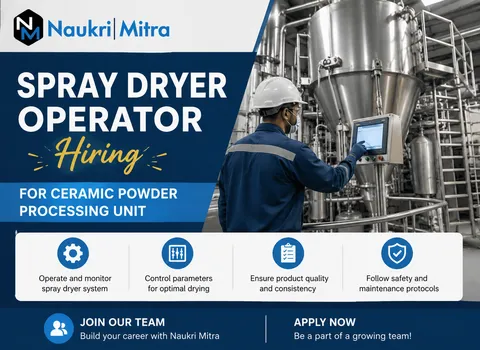
Before the Kiln, There's a Spray Dryer
Most people picture kilns and finished tiles when they think of ceramics. Almost nobody pictures the step before that — wet slurry turning into dry powder. That step is the whole job here. This opening, listed as Spray Dryer Operator Hiring for Ceramic Powder Processing Unit, is a full-time role in Himmatnagar, Gujarat. Nobody notices this machine when it works right. Everyone notices when it doesn't.
Slurry goes in wet. Hot air does the rest. What comes out has to be dry enough, fine enough, and consistent enough to press into shape later. Get the drying wrong and you don't find out until the tiles come out of the kiln cracked or uneven — by then it's too late to fix cheaply.
Why This Isn't a Machine You Leave Running Alone
Spray dryers don't run themselves, not really. Feed rate drifts. Air temperature shifts a few degrees and the powder texture changes with it. Even the weather outside — humidity, mostly — nudges things off course. A plant can't afford to find out three hours later that a whole tank of powder came out too moist. That's the entire reason someone sits at the panel watching numbers instead of trusting the machine to sort itself out.
A Shift, Roughly
Walk in, check the slurry tank, check that the hot air generator has actually reached temperature, glance at whatever the last shift left in the log. Then it's mostly watching — inlet temperature, outlet temperature, the sound the atomizer makes when something's slightly wrong with it. Every so often, pull a sample. Rub it between your fingers if you have to. Run it through a sieve. Adjust and repeat.
What Actually Fills the Hours
- Starting and stopping the dryer the right way, not the fast way
- Nudging slurry flow, burner heat, and air pressure as the batch demands
- Testing moisture and grain size on pulled samples
- Writing down readings, and flagging the ones that don't look right
- Cleaning nozzles and filters before they clog and slow everything down
Where This Job Physically Happens
Ceramic powder units, tile factories, sanitaryware plants — these are the places hiring for this kind of role. Picture a tall drying tower, slurry mixing tanks nearby, conveyors or pneumatic lines moving material between stages, all inside a large industrial shed. It's loud near the dryer. It's warm near the dryer. And however good the dust control is, some of it still gets into the air.
The Equipment You End Up Knowing by Feel
The dryer tower and its hot air generator are the obvious ones. Less obvious: slurry pumps, atomizer heads, pressure gauges, temperature gauges, moisture meters, sometimes a sieve analyzer sitting off to the side for particle-size checks. Bigger, newer plants run this off a PLC screen instead of dials you turn by hand. Either way, you learn to read the numbers fast.
What Gets Someone Hired
An ITI background in a relevant trade helps. So does a diploma in mechanical or ceramic engineering. But plenty of operators learned all this on the floor, not in a classroom. What actually matters is reading a gauge without hesitating, having some working sense of how heat transfer behaves, and not being careless around live electrical equipment. Logs need to be accurate too — sloppy record-keeping causes its own headaches later.
On Your Feet, Mostly
Standing for most of the shift. Climbing to platforms above the dryer when needed. Working close enough to the drying chamber to feel the heat off it. And because these units often run continuously, shifts rotate — this isn't a job with fixed nine-to-five hours.
Safety Isn't a Suggestion Here
Heat, moving parts, fine airborne powder — none of that mixes well with carelessness. Safety shoes, gloves, a dust mask, goggles: standard gear, not optional extras. Lockout steps before any maintenance, no shortcuts. Plants that actually enforce this see fewer accidents and less downtime, and it shows.
Where New Operators Trip Up
Catching temperature drift before it turns into a bad batch — that takes months to get a feel for, not days. Early on it's easy to react a step too slow. It gets better with time on the floor. Keeping the nozzles clean and the area free of settled dust also prevents a lot of problems that would otherwise eat into a shift.
Where This Can Lead
Stick with it and the usual path runs through senior operator first, then shift-in-charge, then maybe process supervisor — all still inside ceramic processing, since the knowledge built here doesn't transfer cleanly to unrelated industries.
The Number That Matters Most
₹33,200 a month is the pay for this role. Some employers add overtime, PF, ESI, bonuses, uniforms, or transport on top — none of that guaranteed, and it varies company to company.