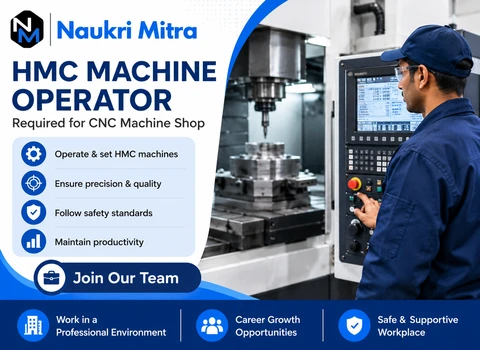
What Does an HMC Machine Operator Actually Do?
Walk into any CNC machine shop, and you'll notice the Horizontal Machining Center almost immediately — it's usually one of the bigger, busier machines on the floor. The HMC Machine Operator, who runs it, is responsible for turning raw or semi-finished metal blocks into precise components. This particular opening is a Full-time role based in Hosur, Tamil Nadu, and it pays ₹31,000 a month. Beyond the numbers, though, it's a job built around patience, precision, and a genuine interest in how machines cut metal to exact tolerances.
Why This Role Matters on the Production Floor
Horizontal Machining Centers aren't simple to run. They handle multi-sided cutting in a single setup, which saves time but also raises the stakes — get the fixture wrong or misread a drawing, and you could ruin an expensive workpiece in minutes. That's exactly why shops don't hand this machine to just anyone. They want someone who checks twice before hitting cycle start, someone who notices when a cutting sound changes pitch or when coolant flow drops. The quality of the final part depends almost entirely on the operator's attention that day.
A Shift, Start to Finish
Most days begin the same way: pick up the job card, pull out the drawing, and confirm what's expected before touching the machine. From there, the workpiece is clamped or fixtured, tooling is loaded, and the program either runs as-is or is tweaked slightly for offsets. Once the cycle starts, the real work is watching — listening for anything unusual, checking the first few parts against the drawing, and stepping in the moment something looks off.
What the Job Actually Involves
- Setting up jigs, fixtures, and workpieces before each run
- Running and adjusting CNC programs on the HMC
- Measuring finished components with precision instruments
- Handling tool changes and offset corrections mid-shift
- Logging output numbers and flagging rejections
- Basic upkeep and cleaning of the machine after use
The Kind of Places You'd Be Working
This kind of work happens in CNC machine shops and precision tool rooms — the sort that supply components to automotive and industrial engineering companies. Tamil Nadu has a strong base of such manufacturing units, and Hosur, in particular, has grown into a hub for precision component manufacturing over the years. Some shops run purely on job orders from bigger manufacturers; others build and machine their own product lines from start to finish.
Machines, Tools, and the Instruments You'll Reach For
The HMC itself is only part of the picture. You'll also be working with end mills, drills, and other cutting tools, plus measuring gear like vernier calipers, micrometers, and height gauges — sometimes a dial indicator too, depending on tolerance requirements. In many tool rooms, EDM (Electrical Discharge Machining) also comes into play, particularly for shapes and cavities that a cutting tool simply can't reach.
Skills That Actually Matter Here
Drawing reading tops the list — if you can't interpret a GD&T symbol or a tolerance callout correctly, everything downstream suffers. After that comes comfort with basic G-code and M-code logic, an intuitive sense of cutting speeds and feeds, and the ability to spot tool wear before it shows up as a rejected part. None of this replaces hands-on time at the machine; textbook knowledge only gets you halfway there.
Where the Training Usually Comes From
Depending on how complex the machining work gets, employers often look at candidates with an ITI in a machining trade, or a Diploma in Mechanical or Tool and Die Engineering. Equivalent vocational training counts too. What tends to matter just as much, though, is practical exposure — time spent around EDM machines, reading actual engineering drawings, and using precision instruments rather than just learning about them in a classroom.
What the Work Demands Physically
You're on your feet for most of the shift, lifting workpieces, handling tools, and staying alert near a running machine. It's not desk work, and it's not meant to be. Shops running this kind of production typically operate on shifts, so working early mornings or nights on rotation is the norm more often than not.
Safety Isn't Optional Here
Metal chips fly. Spindles spin fast. Coolant gets everywhere. Given all that, safety glasses, safety shoes, and proper gloves aren't suggestions — they're basic gear you'll wear every shift. Loose clothing near a rotating spindle is a genuinely bad idea, and clearing a jam or swapping a tool without following lockout steps is how accidents happen. Good operators build these habits early and never really let them go.
Where New Operators Tend to Struggle
Reading a dense drawing quickly, figuring out why a dimension keeps drifting off tolerance, dealing with a sudden tool breakage right before a deadline — these are the moments that separate a confident operator from a nervous one. There's no shortcut here except time and repetition. Slowing down to double-check a measurement, even under pressure, saves far more time than it costs.
Building a Career Beyond the First Few Years
Operators who stick with it and pay attention usually move on to handling trickier multi-axis setups, editing programs directly instead of just running them, or stepping into a shift-in-charge role. It's not a fast climb, but it's a steady one — reliability and precision tend to speak louder than anything on a resume in this line of work.
Pay and What Else Might Come With It
This position offers ₹31,000 per month for full-time work in Hosur, Tamil Nadu. On top of that, some employers offer extras like overtime pay, PF, ESI, bonuses, uniforms, transport, or canteen access — though this really depends on the specific company, so it's worth confirming directly with the employer before assuming anything is included.