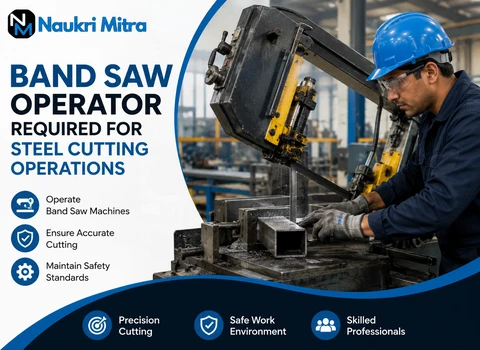
Cutting Steel for a Living: What This Job Really Involves
Walk into almost any steel workshop, and you'll hear it before you see it — the steady grind of a band saw working through a metal bar. That's the machine at the center of this job. It's a Full-time role based in Ludhiana, Punjab, India, paying ₹25,500 a month, and it sits at a stage of production that most finished steel products pass through at some point: getting cut down to size before anything else can happen to them.
Why This Position Exists at All
Raw steel doesn't arrive at a factory pre-cut. Bars, angles, pipes and flats come in standard lengths, and someone has to bring them down to whatever size a job requires — six inches, six feet, whatever the order calls for. Get it wrong, and you've wasted material that costs money and takes time to replace. That's really the whole reason a Band Saw Operator gets hired: precision on a repetitive task that a business can't afford to get wrong too often.
A Look at Ludhiana's Steel and Fabrication Scene
Ludhiana has never been short on metalworking activity. Among steel trading businesses, small fabrication units, and manufacturing setups scattered across Punjab, there's a fairly constant need for people who can cut stock accurately and meet production targets. Construction hardware, machine components, general engineering parts — a lot of it starts with someone standing at a saw.
How the Day Actually Unfolds
Most shifts start with a cutting list — basically a work order telling you what to cut and how many. From there it's fairly hands-on:
- Pulling the right raw material — MS bars, angles, pipes, flats, whatever's specified
- Marking cut lengths with a tape or scale
- Adjusting blade tension and cutting speed to suit the thickness on hand
- Feeding the piece through and watching the cut as it happens
- Cleaning up burrs once the piece is cut
- Logging what's been cut against the dispatch sheet
On a busy day this same sequence might repeat fifty or sixty times. It sounds simple written out like this, but doing it accurately, cut after cut, for eight or ten hours is where the actual skill shows up.
The Tools That Sit Alongside the Machine
The saw itself is only part of the picture. Operators lean on measuring tapes, try squares, and vernier calipers to keep every cut within tolerance. Some of the better-equipped units now use digital length stoppers, which let you set a length once and repeat it without remeasuring each piece — a small thing that saves a surprising amount of time on bulk orders.
What Employers Are Actually Looking For
An ITI certificate in a machining trade is usually the baseline employers look for, though a Diploma in Mechanical Engineering (or something similar) tends to open doors to more complex or precision-heavy cutting work. That said, paper qualifications only go so far. Someone who's spent time actually reading engineering drawings and handling measuring instruments on the shop floor often has an edge over a candidate with better certificates but less hands-on time.
Blade selection is another thing that separates an experienced hand from a beginner — different metals and thicknesses call for different blade types, and knowing this without being told is the kind of judgment that comes with time on the job.
What It Asks of You Physically
This isn't a desk job by any stretch. Expect to be on your feet most of the shift, lifting and positioning bars, staying alert around a moving blade. Shift work is fairly standard in cutting sections, especially where a factory is trying to keep multiple production lines fed without gaps.
The Environment You'll Be Working In
Steel cutting floors aren't quiet places. There's noise from the saw itself, metal dust in the air, sometimes sparks, and occasionally coolant fluid depending on the setup. A well-run workshop keeps ventilation and lighting in decent shape, but the environment is industrial through and through — this isn't something to go in expecting otherwise.
Safety Isn't Optional Around a Moving Blade
Given the machinery involved, safety habits matter more here than in many other roles. What you'd typically expect to use:
- Safety goggles, to keep metal chips out of your eyes
- Gloves for handling material — though these come off the moment the actual cutting starts
- Steel-toe shoes, in case something heavy shifts or falls
- Ear protection, particularly in sections where several saws run at once
Beyond the gear, the basic rule operators are trained on is simple: never force material through the blade, and keep hands well clear of the cutting line at all times.
What Tends to Go Wrong on the Job
The physical strain of handling steel all day adds up faster than people expect. Blades also wear down or lose tension over time, and if that goes unnoticed, cuts start drifting out of spec without anyone realizing it until a batch is already done. Operators who last in this line of work tend to be the ones who catch these signs early — a slightly rougher cut, a change in sound, a blade running hotter than usual.
Where Experience Can Take You
Stick with it long enough, and there's room to move — toward higher-precision cutting equipment, into a supervisory role over a small cutting section, or into quality checking within the same production line. None of this happens automatically; it tends to go to whoever's shown they can cut accurately and safely, shift after shift, without needing constant supervision.
Pay and What Might Come With It
The role pays ₹25,500 a month, Full-time, based in Ludhiana, Punjab, India. Beyond the base salary, some employers offer overtime pay, PF and ESI, festival bonuses, uniforms, and occasionally transport or canteen facilities — though none of this is guaranteed and it really depends on the specific workplace.
For someone looking to get into industrial work, or already in it and looking to specialize, this is a fairly grounded way in — practical, skill-based, and tied to a part of manufacturing that isn't going away anytime soon in a city like Ludhiana.