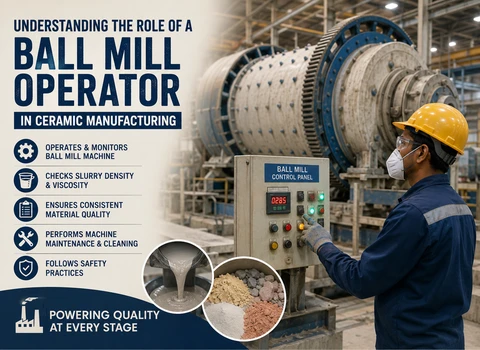
Understanding the Role of a Ball Mill Operator in Ceramic Manufacturing
A Ball Mill Operator is a skilled production worker who manages one of the most important stages of ceramic and tile making — grinding and mixing raw materials into a fine slurry. This role forms the backbone of any ceramic production line, since the quality of the final tile depends heavily on how well the raw materials are processed at this early stage. This opening covers the position of Ball Mill Operator at a ceramic & tiles manufacturing plant based in Thangadh, Gujarat, India, offered on a Full-time basis.
Why Ceramic Plants Depend on This Position
Ceramic and tile manufacturers cannot produce consistent, high-quality tiles without properly ground raw material. Clay, feldspar, quartz, and other minerals need to be broken down and blended into a smooth, uniform slurry before they can move to the shaping and firing stages. A skilled operator ensures this happens correctly, batch after batch, which is why plants actively recruit for this position rather than leaving it to untrained staff.
What a Typical Working Day Looks Like
The daily routine of a plant operator in this field centers on monitoring machinery and inspecting material quality. A regular shift usually includes:
- Loading raw materials such as clay, feldspar, and quartz into the ball mill in the correct proportions
- Starting, monitoring, and stopping the mill as per the batch cycle
- Checking slurry density and viscosity using measuring instruments
- Recording batch details, grinding time, and material consumption
- Cleaning and inspecting the mill drum, liners, and grinding media
- Reporting unusual sounds, vibrations, or slow rotation to the maintenance team
Core Responsibilities on the Production Floor
Beyond routine operation, the equipment operator is also responsible for maintaining consistency across batches. This includes adjusting water content, grinding duration, and material ratios based on the specific gravity readings taken during the process. Any deviation can affect the final tile's strength, texture, and finish, so attention to detail is essential.
Machines, Tools, and Instruments Used on the Job
A ball mill is a rotating cylindrical drum filled with grinding media such as alumina balls or pebbles. As the drum turns, the media crushes and grinds the raw material against water to form a fine, uniform slurry. Along with the mill itself, a technician regularly works with:
- Specific gravity cups and viscosity cups for slurry testing
- Weighing scales for measuring raw material batches
- Sieves for checking particle fineness
- Basic hand tools for maintenance and cleaning
- Control panels for starting, stopping, and timing the mill cycle
Skills That Make an Operator Successful
Technical understanding of grinding processes is important, but practical workplace skills matter just as much. A good machine operator needs patience, consistency, and the ability to notice small changes in material behavior. Basic knowledge of mechanical systems, an eye for detail, and the discipline to follow standard operating procedures all contribute to doing this job well.
Educational Background and Training Preferred
Employers in this industry often prefer candidates who have completed an ITI course in a mechanical or related trade, though freshers with a strong willingness to learn are also considered. Diploma holders in mechanical engineering may find it easier to understand the technical aspects of milling and material processing. Hands-on exposure to industrial machinery, even informally gained, is often valued as much as formal certificates.
Physical Demands and Working Conditions
This is a physically active role that involves standing for long periods, lifting bags of raw material, and working near moving machinery. The working environment can be dusty and noisy, which is typical of ceramic manufacturing units. Depending on production requirements, the plant may operate in shifts, and operators should be prepared for shift-based schedules common in this industry.
Safety Practices and Protective Equipment
Safety is a serious part of daily work in this profession. Operators are generally expected to use personal protective equipment such as dust masks, safety goggles, gloves, and safety shoes. Following lock-out procedures before maintenance, keeping walkways clear, and avoiding loose clothing near rotating machinery are basic but essential precautions.
Common Challenges Faced on the Job
New operators often find it challenging to judge the right consistency of slurry purely by observation, a skill that improves with experience. Dust exposure, machine noise, and the repetitive nature of batch cycles are other common challenges. Learning to identify early signs of liner wear or motor strain can prevent bigger breakdowns later.
Building a Long-Term Career in This Field
With experience, a production worker in this area can progress toward roles such as senior operator, shift in-charge, or grinding section supervisor. Gaining familiarity with different mill sizes, material types, and process parameters helps operators take on more responsibility over time within the ceramic manufacturing sector.
Salary and Benefits for This Position
This Full-time position in Thangadh, Gujarat, India offers a monthly salary of ₹34,600. Depending on the employer, additional benefits may include overtime pay, Provident Fund (PF), Employee State Insurance (ESI), bonuses, uniforms, transport facilities, or canteen access, though these vary by workplace and are not guaranteed.